
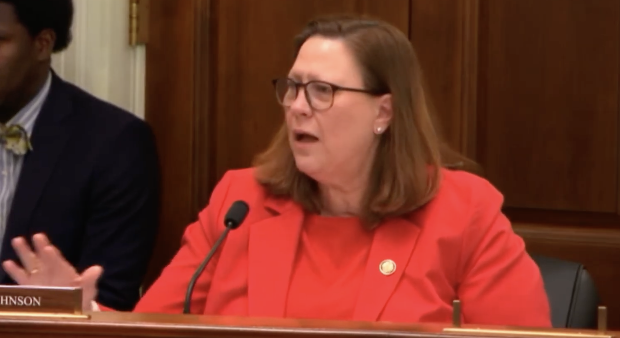
During a Committee on House Administration markup on January 14, 2026, Rep. Julie Johnson of Texas spoke forcefully about proposed legislation addressing stock trading by members of Congress. Her remarks focused on what she described as a major shortcoming in the Republican-backed bill under consideration: while it places new restrictions on trading, it does not fully prohibit members of Congress or their immediate family members from owning or trading individual stocks.
Johnson argued that partial limits fall short of restoring public trust in government. In her view, restrictions without a clear ban lack meaningful enforcement and leave room for continued conflicts of interest. She used a metaphor to describe the proposal as having “no porridge in the bowl,” meaning it does not offer a substantive solution to a problem voters increasingly care about. For Johnson, the issue is not fine-tuning rules but addressing the underlying concern that lawmakers may benefit financially from information or decisions tied to their official duties.
Throughout her comments, Johnson emphasized the importance of divestment from publicly traded stocks, rather than narrow limitations on transactions. She clarified that her focus was not on small businesses or local community institutions, which are not publicly traded, but on investments that could create real or perceived conflicts of interest. According to Johnson, eliminating those holdings is essential to improving confidence in Congress and in government institutions more broadly.
Johnson framed her position within a larger conversation about public trust. She said she regularly hears from constituents who feel disconnected from or distrustful of Congress, and she believes financial conflicts—real or perceived—play a significant role in that sentiment. Holding public office, she argued, requires accepting a higher ethical standard, including avoiding situations that could raise questions about personal gain.
One notable aspect of her remarks was her support for a separate proposal introduced by Rep. Chip Roy, a conservative Republican from Texas. Johnson highlighted this as an example of rare bipartisan alignment on the issue of congressional stock trading. While she acknowledged that she does not often find herself supporting Roy’s legislation, she said she agreed with his goal of addressing what she sees as widespread concerns about ethics and accountability in Congress.
Johnson also spoke personally about divestment, noting that she supports paying capital gains taxes on the sale of assets if that is what is required to meet ethical standards. For her, the financial cost is outweighed by the responsibility lawmakers have to demonstrate integrity and avoid even the appearance of impropriety.
She urged her colleagues on the committee to seriously consider amendments that would strengthen the bill, particularly those that would move closer to a full ban on stock trading by members of Congress and their dependents. Johnson said the committee had a rare opportunity to take meaningful action on an issue with strong public support, rather than passing a measure that appears responsive but changes little in practice.
In closing, Johnson framed the debate as a test of Congress’s willingness to hold itself accountable. She argued that voters expect more than symbolic reform and that decisive action on stock trading could be a tangible step toward rebuilding trust. Her remarks underscored an ongoing debate in Congress: whether incremental restrictions are sufficient, or whether only a complete ban can address ethical concerns surrounding lawmakers’ financial interests.
Source: Congresswoman Julie Johnson



