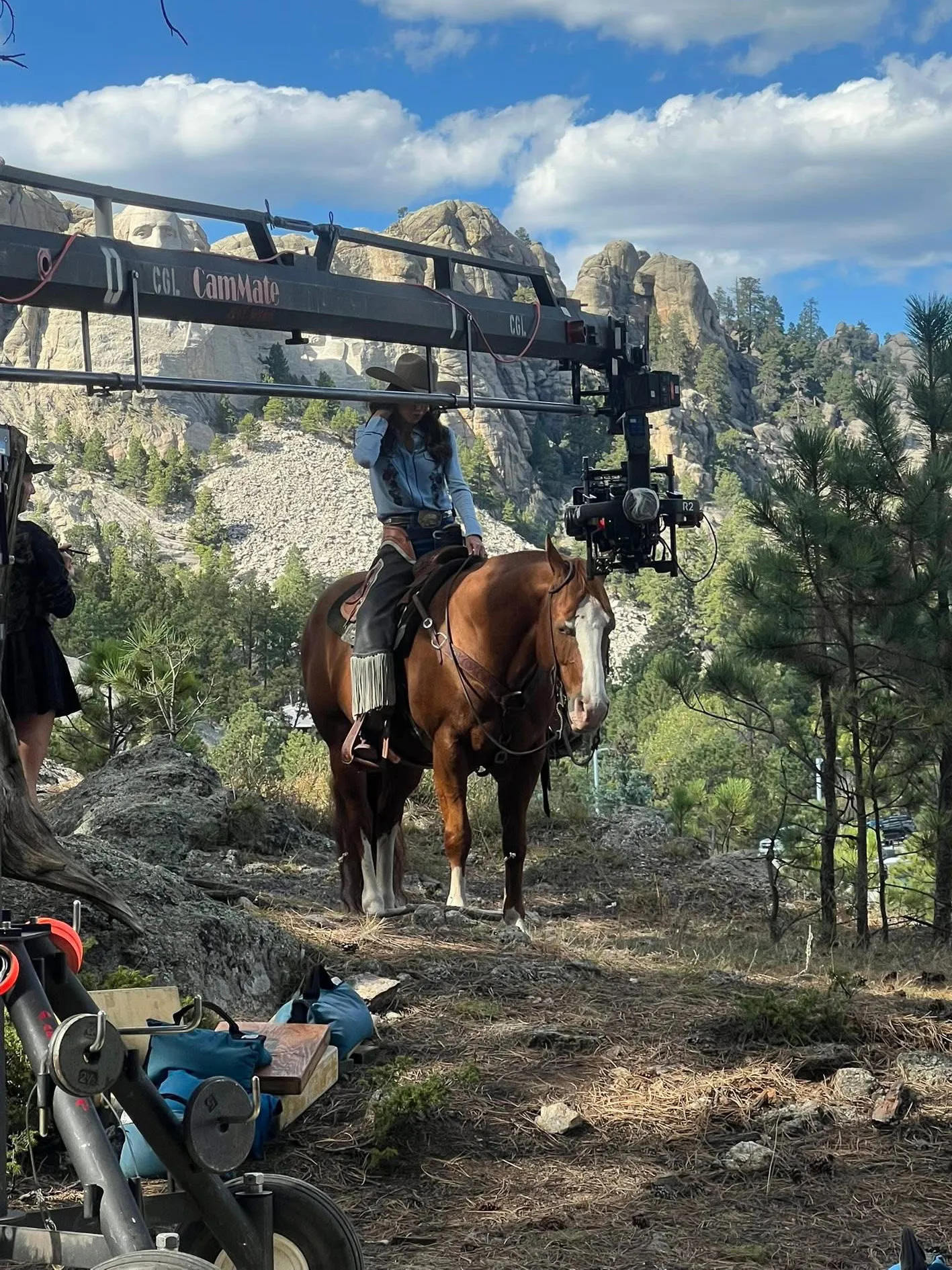
It was a carefully staged image: a cabinet secretary on horseback, framed by Mount Rushmore, delivering a warning to migrants in a voice meant to sound like authority itself. But behind the cinematic sweep of Kristi Noem’s immigration ad was something far less mythic — a paper trail of invoices, contracts, and mounting political fallout that would ultimately cost her the job.
Financial disclosures now reveal that taxpayers covered tens of thousands of dollars in production costs for the South Dakota shoot alone, including nearly $4,000 for hair and makeup and more than $40,000 in vendor expenses. Among them: a $20,000 payment tied to a barrel racer, which included the rental of the horse that carried Noem through the ad’s most striking visuals.
The spot was part of a much larger campaign — an aggressive, high-dollar messaging blitz from the Department of Homeland Security that ballooned to more than $200 million in total spending. At its center was a no-bid contract awarded to Safe America Media, a MAGA-aligned firm incorporated just one week before receiving $143 million from DHS.
That firm subcontracted production work to The Strategy Group Company, an Ohio-based outfit led by Ben Yoho — whose personal ties to Noem’s former spokesperson have only intensified scrutiny around the deal.
Invoices reviewed by lawmakers paint a picture of a production that spared little expense. The company reported roughly $100,000 in labor costs and a $60,000 signing bonus, which it described as “standard.” In total, it says it received just over $226,000 for work spanning multiple shoots and dozens of ads.
But for critics in Congress, the specifics only underscore a broader concern: how a government agency ended up funding what looks, in tone and scale, like a political campaign.
“This looks like waste, fraud, and abuse to me,” said Senator Peter Welch.
Senator Richard Blumenthal was more blunt: “This absurd waste… is completely unacceptable.”
The Strategy Group has pushed back, insisting it never contracted directly with DHS and that lawmakers are misrepresenting its role. Still, the structure of the deal — a newly formed firm, a massive no-bid contract, and politically connected players — has fueled bipartisan unease.
Even some Republicans have balked. During a tense Senate hearing, Senator John Kennedy openly questioned how such spending could have been approved at all.
“It troubles me,” he said. “A fifth to a quarter of a billion dollars in taxpayer money… I just can’t agree with it.”
Noem, for her part, defended the campaign as effective.
“They were effective,” she told lawmakers.
“In your name recognition,” Kennedy shot back.
That exchange would come to define the controversy: a campaign framed as national security messaging but widely perceived as self-promotion — expensive, polished, and politically charged.

The unraveling was swift. After her testimony, President Donald Trump publicly distanced himself from the ads, stating he had never approved the campaign. Days later, Noem’s departure was announced.
Now, the fallout is shifting from political to potentially legal. Several Democratic lawmakers have referred Noem to the Department of Justice, accusing her of misleading Congress in what they describe as a “brazen” attempt to avoid accountability.
Her successor, Senator Markwayne Mullin of Oklahoma, steps into a department already under pressure — not just from the controversy, but from broader questions about oversight, spending, and the blurred line between governance and spectacle.
In the end, the image that defined the campaign — Noem on horseback, issuing a warning — may linger. But so will the cost.
Not just in dollars, but in the growing sense that the machinery of government had been repurposed into something else entirely: a production, a performance, and, ultimately, a scandal.