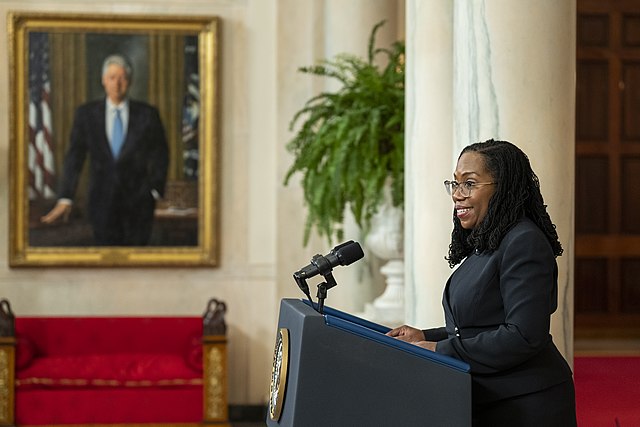
Justice Ketanji Brown Jackson issued a blistering dissent this week after the Supreme Court handed political candidates a powerful new tool to challenge election rules—warning that the majority had abandoned long-standing legal principles to favor politicians.
In a decision authored by Chief Justice John Roberts, the Court ruled that Rep. Mike Bost, an Illinois Republican, has standing to challenge state vote-counting rules simply because he is a candidate for office. The ruling makes it easier for candidates to sue states over how ballots are counted, even before an election takes place.

Under Illinois law, election officials count mail-in ballots that are postmarked or certified by Election Day and received up to two weeks later. Bost, who won reelection in 2024, argued that those rules violate federal law.
Roberts’ majority concluded that candidates have “a concrete and particularized interest” in how votes are counted in their elections, regardless of whether the rules actually harm their chances of winning or impose direct costs.
Justice Amy Coney Barrett, joined by Justice Elena Kagan, agreed with the outcome but sharply criticized the Court’s reasoning. Barrett argued that Bost had standing not because he was a candidate, but because he alleged a traditional “pocketbook injury”—namely, the added campaign costs of monitoring ballots for two extra weeks.
“I cannot join the Court’s creation of a bespoke standing rule for candidates,” Barrett wrote, warning that the majority’s approach was “unmoored from precedent.”
The conservative majority brushed aside that concern, arguing that requiring candidates to show a real risk of losing an election would force lawsuits to be filed at the last minute—or after elections had already concluded. The Court also mocked Barrett’s cost-based approach, noting it would lead to absurd results where a candidate who pays a poll watcher “a penny” would have standing, while one relying on volunteers would not.

Jackson, joined by Justice Sonia Sotomayor, seized on Barrett’s concurrence to argue that even a conservative justice recognized the danger of the Court’s move.
“As Justice Barrett explains, this harm-free Article III standing rule finds no support in our precedents,” Jackson wrote.
She accused the Court of abandoning judicial restraint and destabilizing both standing doctrine and the electoral system by carving out special rules for political candidates—rules that ordinary litigants do not enjoy.
“I am all for simplifying our standing law,” Jackson wrote. “But I am against doing so selectively.”
In her view, the Constitution requires plaintiffs to show a real and imminent injury, not a speculative grievance tied to political ambition. By lowering that bar for candidates, Jackson warned, the Court has invited a flood of pre-election lawsuits that could upend election administration nationwide.
“Bost has plainly failed to allege facts that support an inference of standing under our established precedents,” she concluded.