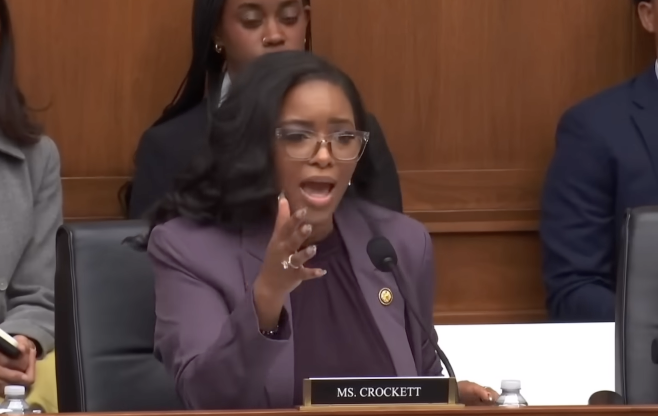
During a committee hearing focused on January 6, Congresswoman Jasmine Crockett used her background as a criminal defense attorney to walk witnesses through how the justice system handled the events of that day. Her remarks aimed to clarify facts that, in her view, are often overshadowed by speculation or misinformation.
Crockett began by addressing claims that federal law enforcement unfairly targeted ordinary Americans. She questioned witnesses about fears of FBI raids and noted the distinction between concern and reality, emphasizing that investigations and searches require legal authorization. She also pointed out that the FBI director overseeing January 6 investigations had been appointed during the Trump administration, underscoring that the agency’s leadership was not newly installed by political opponents.
Throughout the exchange, Crockett repeatedly returned to process. She explained how criminal cases typically unfold: investigations lead to search warrants, evidence is presented to grand juries, indictments are issued if standards are met, and defendants ultimately face trial or enter guilty pleas. Drawing from her own legal experience, she acknowledged that defense attorneys often challenge flaws in investigations, but stressed that identifying flaws does not automatically invalidate convictions.
Crockett asked witnesses to confirm that more than a thousand individuals were convicted for criminal conduct connected to January 6. Those convictions, she noted, resulted from jury verdicts, bench trials, or voluntary guilty pleas. She emphasized that plea agreements require defendants to formally admit guilt in court, reinforcing that these outcomes were not imposed unilaterally by prosecutors or political actors.
She also addressed recurring claims of political persecution. Crockett cited examples where high-profile figures were investigated but not ultimately prosecuted, arguing that failed or dismissed cases demonstrate limits on prosecutorial power rather than its abuse. From her perspective, repeated unsuccessful attempts to secure indictments show that legal standards, not politics alone, determine outcomes.
Another portion of her questioning focused on extremist affiliations. Crockett asked witnesses to confirm whether some individuals convicted for January 6-related offenses had documented ties to white supremacist or extremist groups, including neo-Nazi organizations and the Proud Boys. Witnesses acknowledged that in some cases, prosecutors introduced explicit evidence of such affiliations. Crockett also referenced widely recognized symbols and imagery that have been associated with extremist movements, underscoring that these connections were part of court records, not assumptions.
Throughout her remarks, Crockett expressed frustration with what she described as fear-driven narratives that portray convicted individuals as innocent victims of government overreach. She contrasted those narratives with the documented legal record: investigations reviewed by courts, evidence tested through adversarial proceedings, and verdicts delivered by judges and juries.
By the end of her time, Crockett framed her comments as a defense of institutional process rather than a political argument. She maintained that understanding how investigations, indictments, trials, and pleas actually function is essential to evaluating January 6 accountability. Her message centered on the idea that the justice system’s outcomes were produced through established legal mechanisms, and that public debate should be grounded in those documented facts.
Source: Congresswoman Jasmine Crockett