

The fight over President Donald Trump’s planned White House ballroom has erupted into a full-blown war — not just over architecture, but over ego, expertise, and who gets to define beauty in the nation’s most symbolic home.
At the center of the clash is Karoline Leavitt, who went on the offensive after a sharply critical feature from The New York Times questioned both the design and feasibility of the proposed $400 million structure.
Her response was blunt, dismissing the critics as “random people” who have never built anything — a swipe aimed at reporters Larry Buchanan and Emily Badger, while sidestepping the credentials of architect Junho Lee, who also contributed to the piece.
Leavitt framed the project as a long-overdue upgrade to the White House, arguing that Trump and his team of architects are delivering a “beautiful ballroom” without burdening taxpayers. The administration maintains the project will be fully funded through private donations, a claim that has done little to quiet skepticism.
Because the criticism isn’t just about cost.
It’s about scale — and what that scale does to one of the most recognizable buildings in the world.
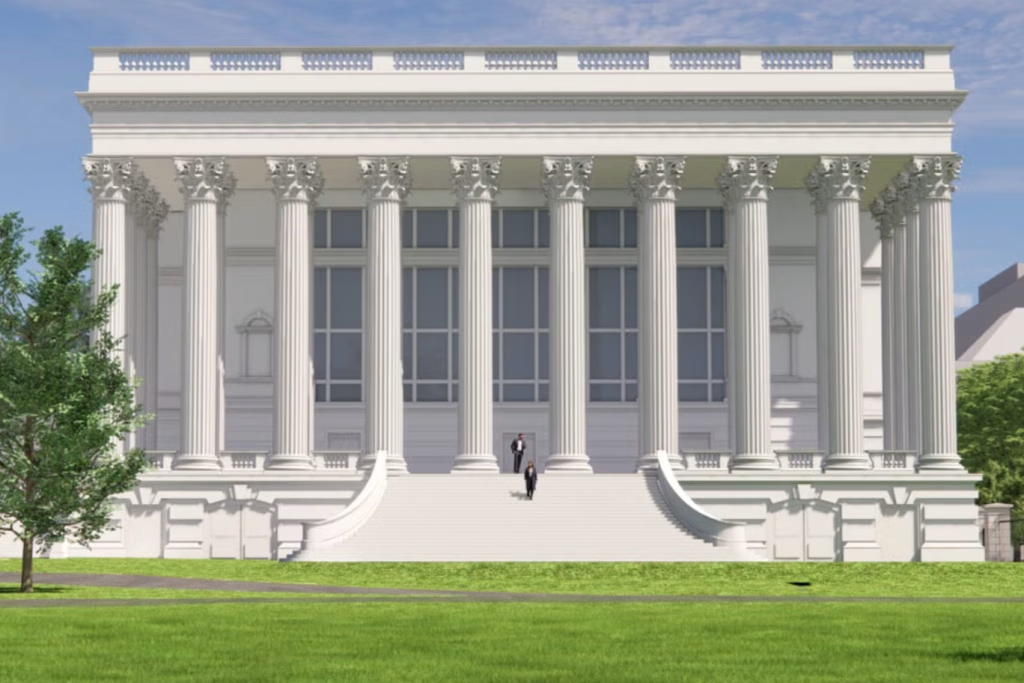
According to the report, the proposed ballroom would be roughly 60 percent larger than the Executive Residence itself. From the south side, critics argue, it wouldn’t complement the White House — it would dominate it, disrupting the carefully balanced symmetry that has defined the complex for generations.
Then there are the design choices.
A grand staircase that leads nowhere.
A south portico added not for function, but for appearance.
Columns so large they could block natural light and obscure views from inside the ballroom.
Even the windows, in some areas, aren’t windows at all — but masonry niches designed to look like them.
To critics, these details point to something deeper than questionable taste. They suggest a project driven by spectacle over substance — a building designed to impress at a glance, even if it falters under scrutiny.
The timeline has raised just as many eyebrows.
Construction is expected to begin as early as this spring, a pace that one architect, Thomas Gallas, said “never made any sense,” given the scale and complexity of the project. The implication is clear: the design may still be evolving even as plans move toward execution.
For supporters, though, the criticism misses the point entirely.
Trump’s brand has always leaned into grandeur, scale, and visual impact — and the ballroom is no exception. To them, the project is less about preserving tradition and more about redefining it.
That tension — between preservation and reinvention — now sits squarely before the National Capital Planning Commission, which is set to make a final decision on the proposal.
And when they vote, it won’t just determine whether a ballroom gets built.
It will decide what the White House is allowed to become.



