
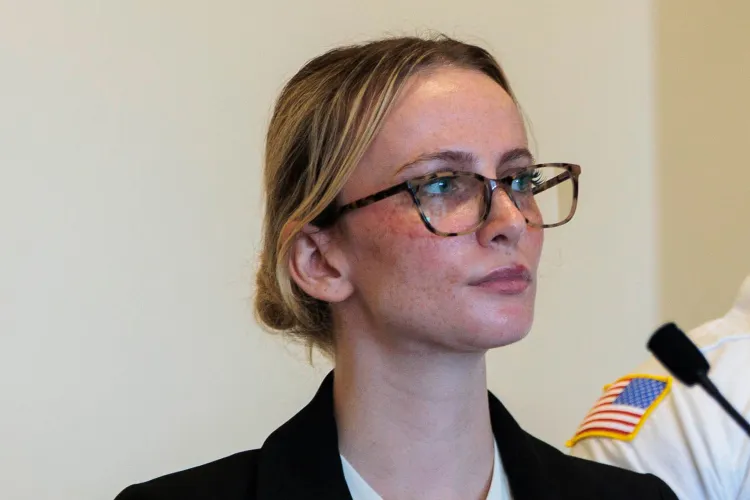
A Massachusetts courtroom became the final battleground for a case defined by chaos, contradiction, and a moment that spiraled into gunfire — leaving one officer wounded and another insisting it was never meant to happen that way.
Kelsey Fitzsimmons, a 29-year-old former officer with the North Andover Police Department, was found not guilty of assault by means of a dangerous weapon after a four-day bench trial in Essex County Superior Court. The ruling, handed down by Jeffrey Karp, hinged on one central issue: no one could definitively prove what happened in the seconds before the gun went off.
The case stems from a June 30, 2025 confrontation inside Fitzsimmons’ home, where she was on leave and caring for her four-month-old son. At the time, she had been diagnosed with postpartum depression — a factor that would later shape her defense — and was navigating a deteriorating relationship with her former fiancé, Justin Aylaian.
Unbeknownst to her, Aylaian had filed a restraining order days earlier, alleging violence and claiming she posed a danger to him and their child. When officers arrived to serve the order, the situation quickly escalated. The order granted temporary custody of the infant to Aylaian, who was called to the home to collect the child.
According to reports, Fitzsimmons began gathering supplies for her son — diapers, clothes, essentials — while officers Patrick Noonan and Timothy Houston escorted her through the house. But when she learned Aylaian had arrived, tensions spiked.
What happened next fractured into two irreconcilable accounts.
Noonan testified that Fitzsimmons pulled a firearm, attempted to shoot him, and then tried to load the weapon after it failed to fire — prompting him to shoot her in the chest. Houston, positioned downstairs, recalled hearing Noonan shout, “Kelsey don’t do it,” followed by gunfire.
Fitzsimmons told a different story entirely.
“I never pointed my firearm at the officer,” she said. “That officer was not just a colleague; he was my friend.” Instead, she claimed, she had drawn the weapon to take her own life — a moment of crisis, not an act of violence.

Judge Karp ultimately found that the prosecution could not eliminate reasonable doubt between those two narratives. In a case where seconds mattered and perspectives diverged, that uncertainty proved decisive.
Fitzsimmons survived the shooting but spent weeks hospitalized with a gunshot wound to the chest. She was later jailed for more than 100 days before being released on bail. In the aftermath, she lost her job and sold her home — her life unraveling long before the verdict arrived.
Now acquitted, she faces the long process of rebuilding.



