
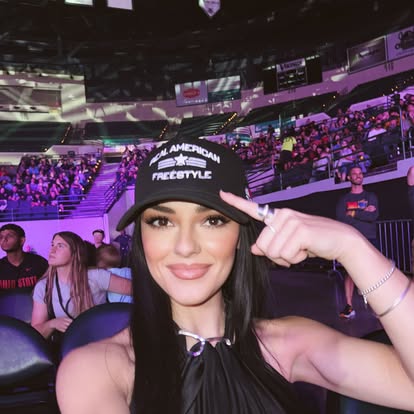
A late-night thread, a web of accusations, and a deepening fracture inside the political movement that once prided itself on unity.
Alexis Wilkins, a country singer and the girlfriend of FBI Director Kash Patel, is claiming that a network of far-right influencers is part of a “foreign-linked influence operation” designed to destabilize Donald Trump’s presidency from within.
In a sprawling 13-part thread posted to X, Wilkins said she has gathered evidence of what she described as coordinated online behavior — a campaign she believes is engineered to create chaos inside the Republican Party ahead of the 2026 midterm elections.
Her central claim: that the MAGA movement isn’t losing support — it’s being manipulated.
“It has an infiltration problem,” she wrote.
Wilkins pointed to what she called “abnormal” social media amplification of conspiracy theories about her, including claims that she is a “honeypot” agent tied to Israeli intelligence. She has previously taken legal action against right-wing influencers over those allegations.
In her thread, she named several prominent figures — including Candace Owens, Michael Flynn, and Joe Kent — suggesting their rhetoric and appearances were part of a broader pattern that fractures Trump’s base.
Wilkins alleged that moments of unity on the right are quickly disrupted by waves of conspiratorial messaging, often tinged with antisemitic themes. She specifically cited commentary around the killing of activist Charlie Kirk, arguing that it triggered a surge in accusations and narratives that deepened internal divisions.
She also connected the alleged effort to broader geopolitical tensions, claiming the campaign seeks to erode support for the Trump administration’s war posture with Iran by targeting morale and amplifying anti-interventionist sentiment.
But those accused have forcefully rejected her claims.
Owens dismissed the thread as “completely and utterly false,” mocking Wilkins publicly. Flynn responded with humor, posting a meme downplaying the idea of a coordinated network. The group Catholics for Catholics, also referenced by Wilkins, said its mission is religious — not political manipulation.
The clash highlights a widening split within Trump’s political orbit, where allies and influencers are increasingly at odds over foreign policy, particularly U.S. involvement in conflicts abroad.
Polling reflects that tension. Support for U.S. military action has slipped, with recent Reuters/Ipsos data showing approval at 35 percent — a sign that skepticism is growing, even among conservative voters.
Wilkins, however, rejects the idea that this is a natural political shift. Instead, she frames it as something engineered — a deliberate attempt to “make the fractures feel permanent.”
Her critics argue the opposite: that the divisions are organic, fueled by disagreements over policy and ideology, not hidden networks.
Complicating the moment is Wilkins’ own history. She has previously promoted false claims about the 2020 election, January 6, and global conflicts — a record critics say undercuts her credibility as she now positions herself as a target of misinformation.
Still, her claims have injected a new layer of paranoia and intrigue into an already volatile political landscape.
At its core, the fight isn’t just about who is right.
It’s about who controls the narrative — and whether the movement itself is splintering from pressure within, or something more deliberate.
Either way, the fracture is no longer subtle.



