
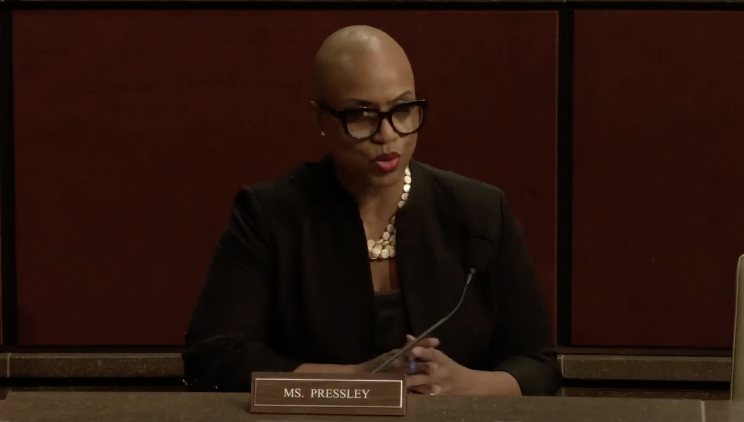
A heated congressional hearing over immigration enforcement turned deeply emotional this week as Rep. Ayanna Pressley delivered a forceful warning about the long-term impact federal immigration operations may be having on children across the country.
Speaking during a session of the House Oversight and Government Reform Committee, the Massachusetts Democrat argued that aggressive immigration enforcement policies are leaving lasting psychological scars on families and communities. Pressley said that after nearly eight years in Congress, few issues have affected her as deeply as what she described as a growing crisis of childhood trauma linked to immigration raids and detentions.
Pressley referenced a number of stories she said illustrate the human cost behind the policy debate. In one example, she described a conversation with a father whose six-year-old son returned home from school worried that his best friend might be deported. The child, she said, begged his parents to offer the classmate a safe place to stay.
“No child should carry that burden,” Pressley told the committee.
She also highlighted cases involving very young children separated from parents during enforcement actions. In one example she cited, a newborn was separated from a parent only weeks after birth. In another case, she referenced a young child who was detained and transferred across state lines.
Pressley argued that the effects of such incidents reach far beyond the families directly involved. Children who witness immigration raids or hear about them in their communities can experience fear and anxiety that affects their behavior, sleep and ability to learn in school.

“Trauma shows up everywhere,” she said, describing how it can affect classrooms, friendships and family life.
Pressley framed the issue as part of a broader conversation about childhood well-being, noting that lawmakers have long debated how government policies affect young people’s mental health and development. She urged Congress to consider the psychological consequences of immigration enforcement, particularly when children are involved.
During the hearing, Minnesota Gov. Tim Walz, who previously worked as an educator and coach, responded to Pressley’s concerns by acknowledging the long-term impact trauma can have on young people.
Walz said that children exposed to traumatic events often experience mental health challenges and disruptions in their education. Those effects, he added, can follow them into adulthood and even affect future economic outcomes.
“As a parent and as an educator, it’s deeply concerning,” Walz said, emphasizing that communities may be dealing with the consequences for years.
Pressley also pointed to research and reporting that suggest immigration enforcement can affect entire communities, not just individuals targeted in operations. She argued that fear and uncertainty can spread through neighborhoods, particularly in areas with large immigrant populations.
Toward the end of her remarks, Pressley challenged what she called the common assumption that children will naturally recover from difficult experiences.
She urged policymakers to move beyond that belief and consider how policies may shape the lives of young people long after the headlines fade.
“Children are not collateral,” Pressley said, urging lawmakers to put the needs of children at the center of policy decisions.
The hearing underscored how immigration enforcement remains one of the most divisive issues in Washington, with lawmakers continuing to clash not only over border security and immigration policy, but also over the human impact those policies may have on families and communities nationwide.



