
Voting headaches in two of Texas’ largest counties shadowed Tuesday’s balloting in what national Democrats had cast as an early proving ground for the party ahead of the 2026 midterms.
Decision Desk HQ projected that state Rep. James Talarico, an Austin-area legislator, won the Democratic nomination for U.S. Senate over U.S. Rep. Jasmine Crockett, a Dallas-based lawmaker whose rapid rise on Capitol Hill and on social media made the contest one of the most watched primaries of the cycle’s opening stage.
With their policy agendas largely overlapping, the matchup was driven more by tone, coalition strategy and questions about how Democrats should compete in a state that supported President Donald Trump by 13 percentage points in 2024. In many corners of the party, the race also became intertwined with debates over race and gender, as Crockett and her allies argued that doubts about her general-election prospects reflected bias.
Talarico, a former middle school teacher who has described his political worldview through his Christian faith and training as a seminarian, built a campaign around economic populism and a call to broaden the Democratic tent. He spent time in rural communities and heavily Republican areas, arguing that Democrats should try to persuade independents and disaffected Republicans rather than limit their appeal to deep-blue strongholds.
At a recent rally in San Antonio, Talarico framed his pitch in class terms: “Whether you’re a Democrat or a Republican, whether you’re a progressive or a conservative, the real fight in this country is not left versus right. It’s top versus bottom,” he said. He also told supporters, “We are not just trying to win an election. We are trying to fundamentally change the politics in this state and in this country,” adding, “Our nation is so divided that we can’t even share the Super Bowl anymore.”
Crockett, first elected to Congress in 2022, entered the statewide contest with a national profile built through combative exchanges in high-visibility hearings and sharp attacks on President Trump and other Republicans. That approach won her fans among Democratic activists, but also fueled persistent chatter among some party leaders and donors about whether her rhetorical style could complicate a general election in a state Republicans have dominated for decades.
Her record of controversies became part of that debate. During a House Oversight Committee clash in 2024, she mocked former GOP Rep. Marjorie Taylor Greene’s “bleach-blonde, bad-built, butch body” after Greene criticized her eyelashes.
Crockett also used the phrase “governor hot wheels” in reference to Texas Gov. Greg Abbott, who uses a wheelchair—later saying she meant Abbott’s policy of sending migrants to Democratic-led areas.

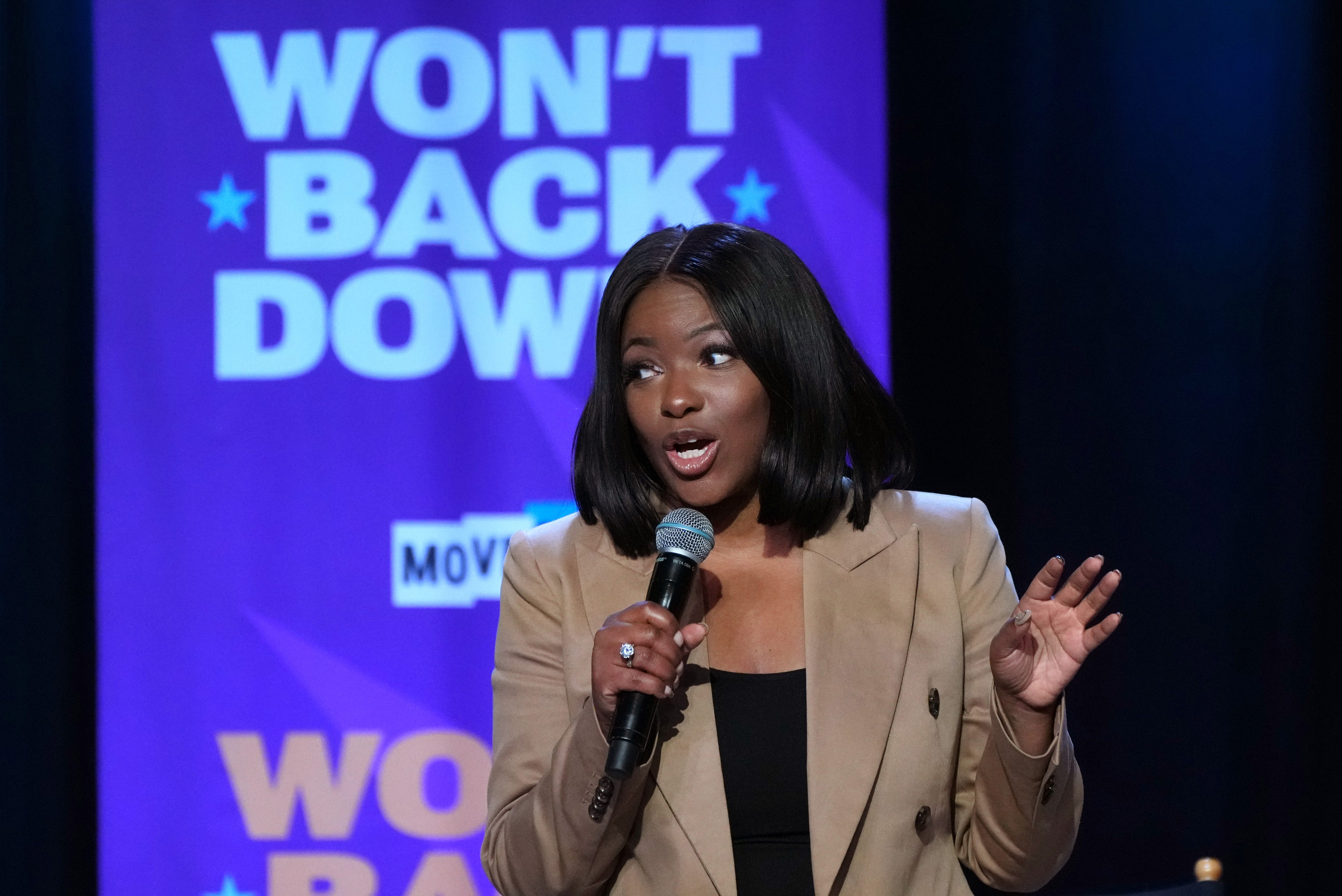
U.S. Rep. Jasmine Crockett, D-Dallas, speaks during a public event hosted by Beto O’Rourke with U.S. Reps. Veronica Escobar, D-El Paso, and Joaquin Castro, D-San Antonio, at the Elmont Event Center’s Grand Ballroom in El Paso on Wednesday, Aug. 20, 2025.
In addition, she defended criticizing a Trump Cabinet official for accepting money from “a Jeffrey Epstein,” though the donor was a Long Island physician with the same name, not the late convicted sex offender. And in the campaign’s closing stretch, a reporter from The Atlantic said armed security escorted the journalist out of a Crockett event—an allegation her campaign denied.
Crockett and her supporters countered that similar behavior by other politicians is often treated differently, and that skepticism about her strategy—particularly her emphasis on turning out new voters rather than courting Trump backers—was tied to her identity.
She also pointed to Abbott spending millions on advertisements targeting her during his own reelection effort as evidence Republicans viewed her as a serious threat. Days before the primary, former Vice President Kamala Harris backed Crockett through a recorded robocall.
At one campaign stop, Crockett addressed the argument that Texas would not elect a Black woman statewide. “Some people say, ‘Listen, there’s no way that Texas will support a Black woman,” she said, according to Politico. “We are a majority-minority state, we can start there. The reality is that I didn’t run because I was a woman. I ran because I’m qualified. At the end of the day. I just happened to be Black and woman, but I am the most qualified person in this. Period.”
Election administration problems complicated the final hours of voting, particularly in Dallas County—Crockett’s political base—and Williamson County, north of Austin. In both places, Republicans ended the use of countywide vote centers, which had allowed residents to cast ballots at any location in the county, and returned to precinct-specific voting.
On Tuesday, reports circulated of voters showing up at the wrong polling sites, prompting both campaigns to call for extended hours.
A judge ordered Dallas County voting to continue for two additional hours. The Texas Supreme Court later temporarily halted that order and instructed that any ballots cast after 7 p.m. Central Time be treated as provisional and kept separate from other Election Day votes.
Speaking briefly Tuesday night, Crockett predicted the delay would push the tally past the evening. “So that’s my news, is that we’re not going to have election results tonight, in my opinion, based upon what specifically is taking place in Dallas County,” she said. “Unfortunately, this is what Republicans like to do. So they specifically targeted Dallas County, and I think we all know why.”
While Talarico generally avoided direct shots at Crockett, he told Politico he was “concerned” by her suggestion that she did not need to win over Trump voters in a state that strongly backed the president in 2024.
Talarico now advances to a general election that will test whether Democrats can crack a statewide losing streak stretching back to 1994, the last time the party won a statewide Texas race.
Democrats argue several dynamics could make the contest more competitive than in recent cycles: President Trump’s weak approval ratings, signs of slippage among Latinx voters who moved toward Trump in 2024, and a turbulent Republican nominating fight.
On the GOP side, no candidate captured an outright majority in a three-candidate primary, setting up a May 26 runoff between Sen. John Cornyn and Texas Attorney General Ken Paxton.
President Trump stayed out of the contest, though Senate Republicans and their campaign apparatus lined up behind Cornyn.
The stakes extend beyond Texas. Republicans currently hold a 53-47 advantage in the U.S. Senate, meaning Democrats looking to reclaim control in 2026 would need to protect vulnerable seats in states including Georgia and Michigan while also netting four Republican-held seats—targets that include Maine and North Carolina, and would likely require breakthroughs in more challenging territory such as Texas.



