
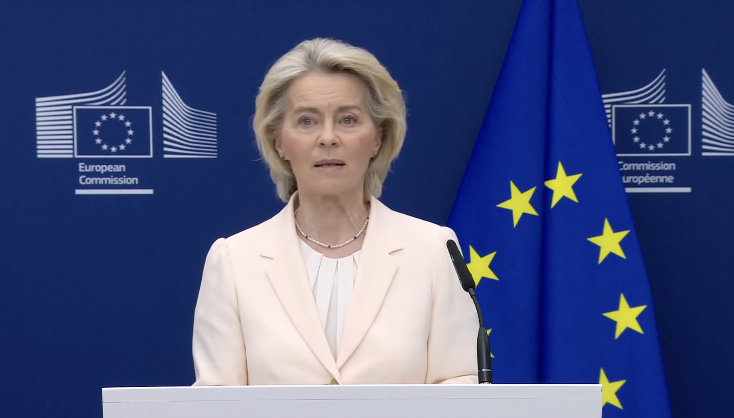
As violence escalates across the Middle East, European Commission President Ursula von der Leyen is calling for urgent de-escalation — warning that the fallout could ripple far beyond the region.
In a statement delivered March 2, von der Leyen described the situation as “volatile” and “deeply concerning,” revealing she had spoken over the weekend with nine Middle Eastern leaders as well as several European counterparts.
Her message centered on three key points: hope for the Iranian people, the need to prevent further escalation, and the importance of a diplomatic path forward.
“Renewed Hope” for Iranians
First, von der Leyen pointed to what she called a moment of renewed hope for the people of Iran, whom she described as long-suffering and oppressed.
“We strongly support their right to determine their own future,” she said, signaling Europe’s backing for self-determination amid rapidly shifting political dynamics following the recent U.S.-Israeli strikes.
While she did not outline specific steps, the tone suggested the European Union is closely monitoring internal developments within Iran as well as the broader regional response.
Condemnation of Regional Attacks
At the same time, von der Leyen condemned a series of retaliatory attacks linked to Iran and its allies. Among them: a reported drone strike targeting a British air base in Cyprus and an attack on a Saudi Aramco oil facility.
She denounced what she called “reckless and indiscriminate” strikes against sovereign territories, warning that such actions risk igniting a wider regional conflict.
Her comments underscore growing fears that the violence could spiral, drawing in additional countries and destabilizing key global energy corridors.

Diplomacy as the Only Way Forward
Despite the rising tensions, von der Leyen insisted that a military solution is not sustainable.
“The only lasting solution is a diplomatic one,” she said.
That, in her view, would require a credible political transition within Iran, including a halt to its nuclear and ballistic missile programs and an end to activities that destabilize neighboring countries.
The European Commission’s Security College is set to convene to assess the broader implications of the crisis — from energy security and nuclear safety to migration pressures and regional stability.
Europe Braces for Impact
Von der Leyen made clear that Europe must prepare for potential consequences, even if the conflict remains geographically distant.
“From energy to nuclear, from transport to migration to security, we must be prepared,” she said.
With oil infrastructure targeted and military bases struck, concerns about supply chains, refugee flows and geopolitical shocks are growing.
As the Middle East stands on edge, Europe’s top official is urging restraint — and reminding world leaders that diplomacy, not escalation, offers the only sustainable path out of the crisis.



