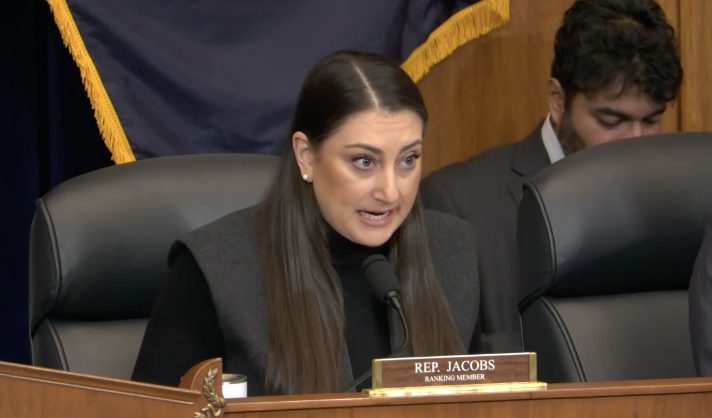
As Washington reels from President Trump’s strikes on Iran, Rep. Sara Jacobs (D-Calif.) is warning that the U.S. could be stumbling into an open-ended conflict without a plan—or a vote.
Appearing on MS NOW, the San Diego congresswoman, who sits on both the Armed Services and Foreign Affairs committees, said Pentagon officials are expected to brief key staff soon. But Jacobs made clear what she wants answered first: What’s the strategy? What’s the endgame? And most critically, is the administration preparing to put American troops on the ground? From her vantage point, the most alarming part isn’t just the operation itself—it’s how little clarity she believes exists about what happens next.
Jacobs also took aim at Republican messaging that frames the strikes as “ending” a decades-long conflict. When the host cited a post from GOP members describing Trump as stopping a “forever war” Iran has waged against America, Jacobs called the argument nonsensical—and pointed to history as a caution sign. She argued that U.S.-backed regime change in Iran long ago helped set the stage for the hardline leadership the world confronts today, and that attempting regime change again could produce the same familiar outcomes: instability, a security vacuum, and the risk of civil war. In her view, calling this an ending is backwards—she believes most Americans can see it looks more like the beginning of another war.

The conversation then turned to politics, including the visible tension inside Trump’s own coalition. Jacobs said she’s hearing from constituents—especially in her district, home to a massive military community—who backed Trump believing he would avoid new wars. Now, she says, some feel “betrayed,” because service members and their families are the ones who ultimately absorb the cost when conflicts expand.
That’s where a looming War Powers vote becomes a pressure point. Jacobs said Democrats are already talking with some Republican colleagues, and she suggested there may be real openness—beyond the usual suspects—to forcing a debate and formal authorization. She emphasized that public opposition matters, urging viewers to contact their representatives ahead of what she indicated could be a floor vote later in the week.
Jacobs also raised another red-flag question: Was this decision made solely for U.S. national security—or could personal business interests be in the mix? She said the mere fact that Americans are asking that question underscores the need for aggressive oversight of Trump-family financial ties in the region.
And on Israel’s role, Jacobs offered a blunt assessment: she said Prime Minister Benjamin Netanyahu has pushed U.S. presidents of both parties toward regime change in Iran for years—arguing Trump is simply the first to go along with it.