
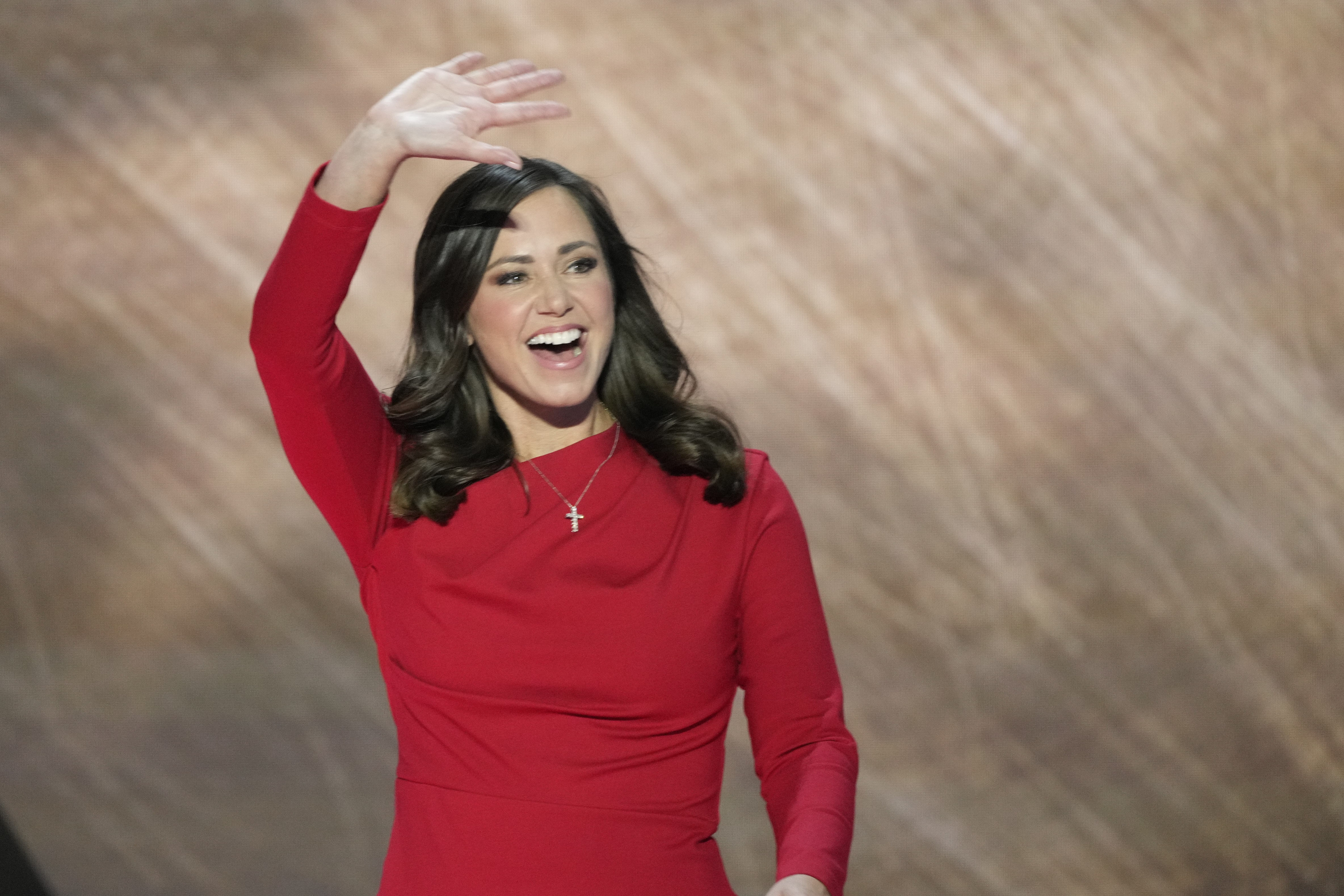
Two years ago, Sen. Katie Britt’s national debut didn’t go as planned.
The Alabama Republican delivered her party’s rebuttal to the president’s State of the Union from her kitchen — a high-profile assignment often dubbed the toughest job in politics. The speech was widely panned, and Saturday Night Live famously lampooned her as a “scary mom,” cementing an early caricature of Britt as an over-the-top partisan firebrand.
But inside the Senate, colleagues say that image doesn’t match reality.

Feb 11, 2025; Washington, D.C., USA; Senator Katie Britt (R-Ala.) questions Jerome Powell, Chair of the Federal Reserve, at the Senate Banking, Housing, and Urban Affairs committee hearing in regards to The Federal Reserve’s Semi-Annual Monetary Policy Report. Mandatory Credit: Jack Gruber-USA TODAY
Instead, Britt has quietly built a reputation as a pragmatic dealmaker — a role now being tested as lawmakers grapple with one of the most contentious issues in Washington: immigration enforcement and funding for the Department of Homeland Security.
With DHS partially shut down for more than 10 days amid a standoff between Democrats and Republicans, Britt has stepped into negotiations over potential changes to how immigration agents operate following deadly shootings in Minneapolis that sparked national outrage.
The moment has thrust the 40-year-old senator — once defined by a viral speech — into the center of high-stakes bipartisan talks.
A front-row education in compromise
Britt’s approach traces back to her years working for longtime Alabama Sen. Richard Shelby, a powerful appropriator known for forging cross-party alliances. She eventually became Shelby’s chief of staff and learned firsthand how trust, relationships and personal rapport can move legislation forward.
Former colleagues recall her methodical effort to build connections, including meeting with nearly every Senate chief of staff shortly after taking the job.
When Shelby retired in 2022, Britt became the youngest Republican woman ever elected to the Senate. Now occupying his old desk — once also used by Lyndon B. Johnson — she has sought to channel Shelby’s style of relationship-driven politics.
That strategy has paid off. Democratic Sen. Tim Kaine credits Britt with helping salvage a government funding deal last fall, saying she kept conversations going when negotiations faltered.
“She’ll say, ‘Let’s keep talking,’” Kaine said in interviews, describing her as someone willing to test ideas rather than retreat to party lines.
A delicate balancing act
Still, navigating today’s hyperpolarized climate is far more complicated than in Shelby’s era.
Britt has voted in line with former President Donald Trump on every piece of legislation he has taken a public position on this year, according to Congressional Quarterly. At the same time, she has occasionally broken ranks — including publicly criticizing a racist video posted to Trump’s social media.
Her role in the DHS funding fight underscores the tightrope she walks.
After images surfaced of a young child detained during immigration enforcement operations in Minneapolis, Britt privately raised concerns with Homeland Security Secretary Kristi Noem, according to reports. Publicly, however, she has focused on pressing Democrats to fund DHS, arguing that frontline workers like TSA agents and FEMA staff should not bear the consequences of political brinkmanship.
Democratic Sen. Chris Murphy, her counterpart on homeland security appropriations, has pushed back, accusing Republicans of overlooking the human toll of enforcement tactics.
For Britt, the challenge is maintaining credibility with her party’s leadership and the White House while preserving the cross-aisle trust she’s worked to build.

Oct 1, 2024; New York, NY, USA; Sen. Katie Britt (R-Ala.) in the Spin Room prior to the CBS News vice presidential debate between Republican JD Vance and Democrat Tim Walz. Mandatory Credit: Jack Gruber-USA TODAY NETWORK via Imagn Images
Political observers say that’s the defining test of her career so far: whether she evolves into a national ideologue — or remains what some in Alabama describe as a facilitator.
“She doesn’t owe Trump anything,” one longtime Alabama political analyst said. “She’ll be there long after he’s gone.”
For a senator once reduced to a late-night punchline, Katie Britt’s next act may prove far more consequential.



