
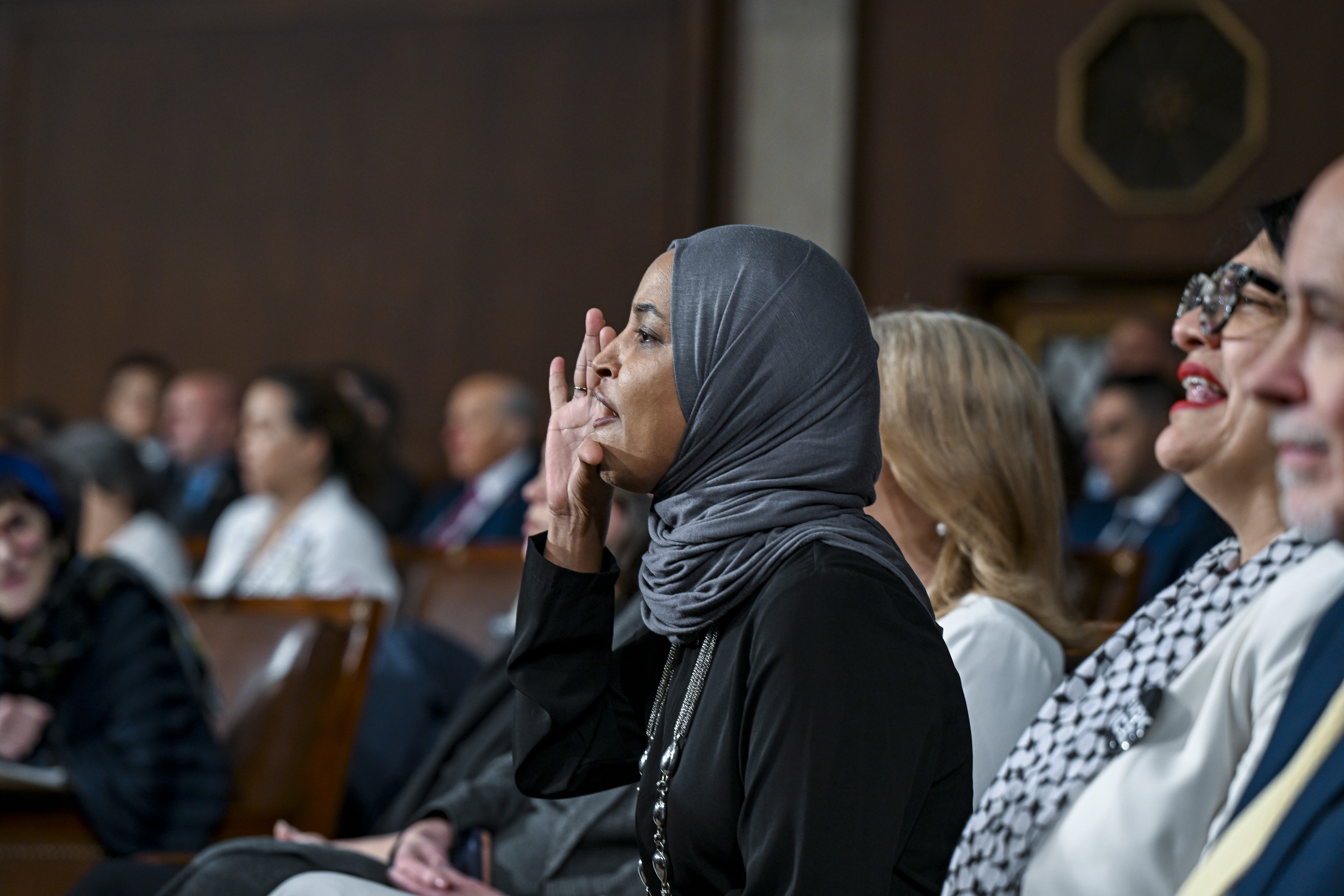
A disabled activist invited to attend President Donald Trump’s State of the Union as a guest of Rep. Ilhan Omar says she never intended to disrupt the speech — and insists she was arrested simply for standing.
Aliya Rahman, a 43-year-old software engineer from Minneapolis, was taken into custody Tuesday night inside the U.S. House chamber and charged with unlawful conduct and disrupting Congress. But Rahman says she did nothing more than rise to her feet during the address.
“I was completely silent,” Rahman said in an interview following her arrest. She said she wore no political clothing, carried no sign, and made no gestures. “My arms were by my side.”
Capitol Police offered a different account, stating that Rahman “started demonstrating” during the speech and refused lawful orders to sit down. Guests at the State of the Union are subject to strict rules, and tickets warn that disturbances can result in removal or arrest. However, the definition of what qualifies as a “disturbance” is not clearly outlined.

Feb 24, 2026; Washington, DC, USA; Representative Ilhan Omar, Democrat of Minnesota, shouts as President Donald J. Trump delivers the first State of the Union address of his second term to a joint session of Congress in the House Chamber of the United States Capitol in Washington on Tuesday. Mandatory Credit: Kenny Holston-Pool Photo via Imagn Images
Rahman’s arrest comes just weeks after another confrontation with law enforcement drew national attention. In January, she was forcibly removed from her vehicle by Immigration and Customs Enforcement agents in Minneapolis while attempting to drive to a doctor’s appointment. Rahman, who suffered a traumatic brain injury in 2024 and says she is disabled, told members of Congress earlier this month that officers broke her car window and dragged her out, injuring her shoulders.
Video of that incident circulated widely online, intensifying debate over federal immigration enforcement tactics.
At Tuesday’s State of the Union, Rahman says she stood at various moments, including when the president acknowledged a 100-year-old World War II veteran. She said other attendees around her were also standing at different points during the speech.
The moment that led to her removal, she says, came when Trump made remarks about Minneapolis’s Somali community — comments she described as “incredibly racist.” When officers instructed her to sit, Rahman says she hesitated because others nearby were also on their feet. She says officers then grabbed her arms despite her warning that her shoulders were already injured.
“They started yanking on my arms,” she said, adding that she asked to be allowed to walk with her cane. She says another officer later intervened and requested a wheelchair.
Rahman was transported to George Washington University Hospital for evaluation before being booked by Capitol Police.
The activist, who has previously worked on racial justice and LGBTQ+ advocacy efforts, says she suspects retaliation for her recent public testimony about ICE enforcement and for being associated with Rep. Omar, a frequent Trump critic.
Rahman is now receiving legal assistance from the MacArthur Justice Center. As debate grows over protest rights, enforcement discretion, and security rules at high-profile political events, her case is likely to fuel further scrutiny.
“I was finally standing up, like many people do,” Rahman said. “If what you think I was doing was demonstrating, you’ll have a lot of people to arrest.”
The incident adds another flashpoint to an already contentious political moment — and raises new questions about how dissent is defined inside the halls of Congress.



