
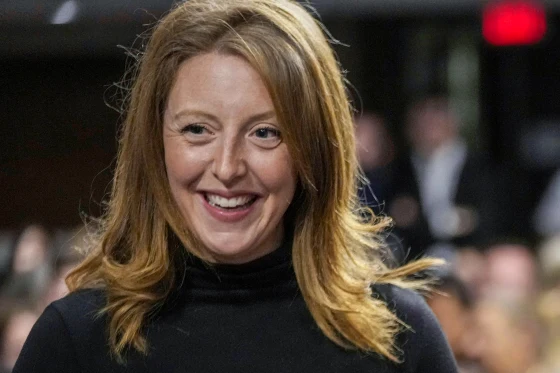
When President Donald Trump announced Dr. Casey Means as his pick for U.S. surgeon general, it marked more than a routine personnel decision. It signaled a dramatic shift in the voice that could soon represent American public health.
Means, a 37-year-old Stanford-educated surgeon turned wellness entrepreneur, has become a prominent advocate for the administration’s “Make America Healthy Again” agenda. Trump praised her “impeccable MAHA credentials” in a Truth Social post and made clear that the nomination carried the blessing of his top health official, Robert F. Kennedy Jr.. “Bobby thought she was fantastic,” Trump told reporters.
Means’ nomination follows the withdrawal of Trump’s first choice, Janette Nesheiwat. With Kennedy reshaping the Department of Health and Human Services, Means’ potential confirmation would further cement the administration’s break from traditional public health orthodoxy.
Raised in Washington, D.C., Means earned her undergraduate degree in human biology and later her medical degree from Stanford. She trained in head and neck surgery and has described performing multiple procedures a day before becoming disillusioned with what she saw as a reactive, profit-driven medical system.
“The system is rigged against the American patient to create diseases and then profit off of them,” she said in a 2024 interview with Tucker Carlson. Means has recounted a turning point during her fifth year of surgical residency, when she realized she could treat symptoms but not address what she believed were the root causes of chronic illness.
At 30, she “put down her scalpel forever,” she later told podcaster Joe Rogan. Instead, she pivoted to metabolic health, co-authoring the New York Times bestseller Good Energy with her brother Calley Means. The book promotes diet, sleep, and exercise as foundational tools to combat conditions such as diabetes, obesity, and dementia.
She also co-founded Levels, a subscription-based company that tracks glucose, diet, and sleep metrics — a business model critics say blurs the line between public health advocacy and private enterprise.
But it is Means’ views on vaccines and federal health policy that have ignited the fiercest debate.
She has advocated research into what she calls the “cumulative effects” of vaccines and questioned aspects of the childhood immunization schedule. In a newsletter, she wrote that there is “growing evidence” the expanding vaccine schedule may contribute to health declines in vulnerable children.
Public health authorities strongly dispute such claims. The Centers for Disease Control and Prevention maintains that vaccines undergo rigorous testing and that receiving multiple vaccines simultaneously is safe. The American Academy of Pediatrics similarly recommends following the standard immunization schedule without delay.
Means has also publicly questioned newborn Hepatitis B vaccinations, suggesting infants are unlikely to face exposure. The CDC counters that infants infected at birth face a 90 percent chance of developing chronic infection, particularly since many mothers may not know they carry the virus.
Her comments extend beyond vaccines. In an appearance with Bill Maher, Means defended the right to consume raw milk, despite warnings from the CDC about serious health risks. She has also described America’s health crisis as a “spiritual crisis,” linking environmental degradation, pesticide use, and even hormonal contraception to broader systemic decline.
Contraceptive medications, she argued in interviews, are “prescribed like candy,” even as she acknowledged their role in women’s liberation.
Her Senate confirmation hearing was initially scheduled for October but postponed after she went into labor with her first child. “This is one of the few times in life when it’s easy to ask to move a Senate hearing,” an HHS spokesperson said.
If confirmed, Means would become the nation’s top public health messenger at a time of deep distrust in institutions. For supporters, she represents a bold rethinking of a system they see as broken. For critics, her nomination raises alarm that vaccine skepticism and wellness ideology may shape federal health policy.



