
President Donald Trump ignited immediate backlash Tuesday night after singling out Minnesota’s Somali community during his State of the Union address, accusing members of widespread fraud and referring to them as “pirates” who had “ransacked” the state.
In a pointed section of his speech focused on government corruption, Trump claimed that individuals within Minnesota’s Somali community were responsible for an estimated $19 billion in fraud against taxpayers. The president framed the allegation as one of the most significant examples of public funds being misused.

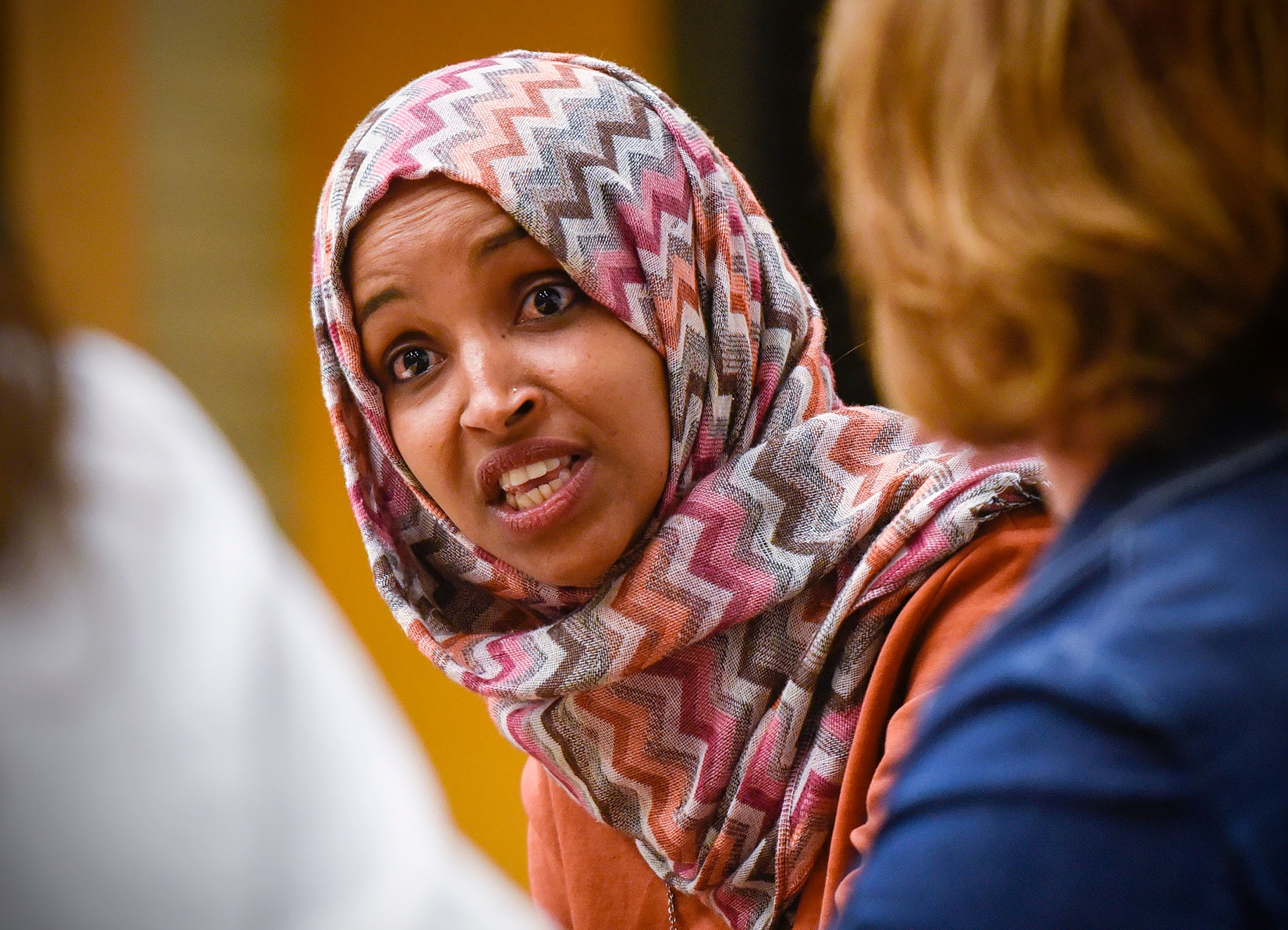
U.S. Rep. Ilhan Omar, D-Minnesota, addresses a town hall in Antioch, Tennessee, on July 12, 2025.
The remarks drew swift reaction inside the chamber, most notably from Rep. Ilhan Omar, a Somali American Democrat who represents Minnesota. Omar was heard calling the president a “liar” in response to the accusation. Her visible and vocal objection underscored the tension that has often defined exchanges between Trump and members of the progressive wing of Congress.
However, independent reporting has raised questions about the president’s figures. The Minnesota Star Tribune has reported that documented and alleged fraud cases tied to Somali-run organizations in the state amount to roughly $200 million — a substantial sum, but far below the $19 billion cited by Trump. The larger figure has not been substantiated through publicly available investigations or court proceedings.
Minnesota has been the site of several high-profile fraud investigations in recent years, including cases involving pandemic relief funds and child nutrition programs. Some of those cases have involved members of the Somali American community, which is one of the largest in the United States. Federal authorities have pursued charges in multiple instances, though those investigations have focused on specific individuals and organizations rather than the broader community.

Hamda Mohamed, director of 161 Childcare, says the daycare center has been the subject of anti-Somali harassment. She says several individuals have tried gaining access to the building as well as have left fake online reviews and hateful voicemail messages.
Trump’s language — particularly his use of the word “pirates” — has been criticized by civil rights advocates and Democratic lawmakers as inflammatory and stigmatizing. Supporters of the president argue that he was highlighting corruption and calling attention to wasteful government spending.
The exchange reflects broader political fault lines. Trump has repeatedly emphasized fraud and immigration in his speeches, while Omar has been one of his most outspoken critics in Congress. Their latest clash unfolded on one of the most high-profile stages in American politics, further intensifying an already polarized debate.
Whether the controversy fades or fuels further confrontation remains to be seen. But the moment served as a reminder that discussions of fraud, immigration, and accountability remain deeply intertwined with questions of rhetoric and representation — particularly when entire communities are invoked in the process.



