
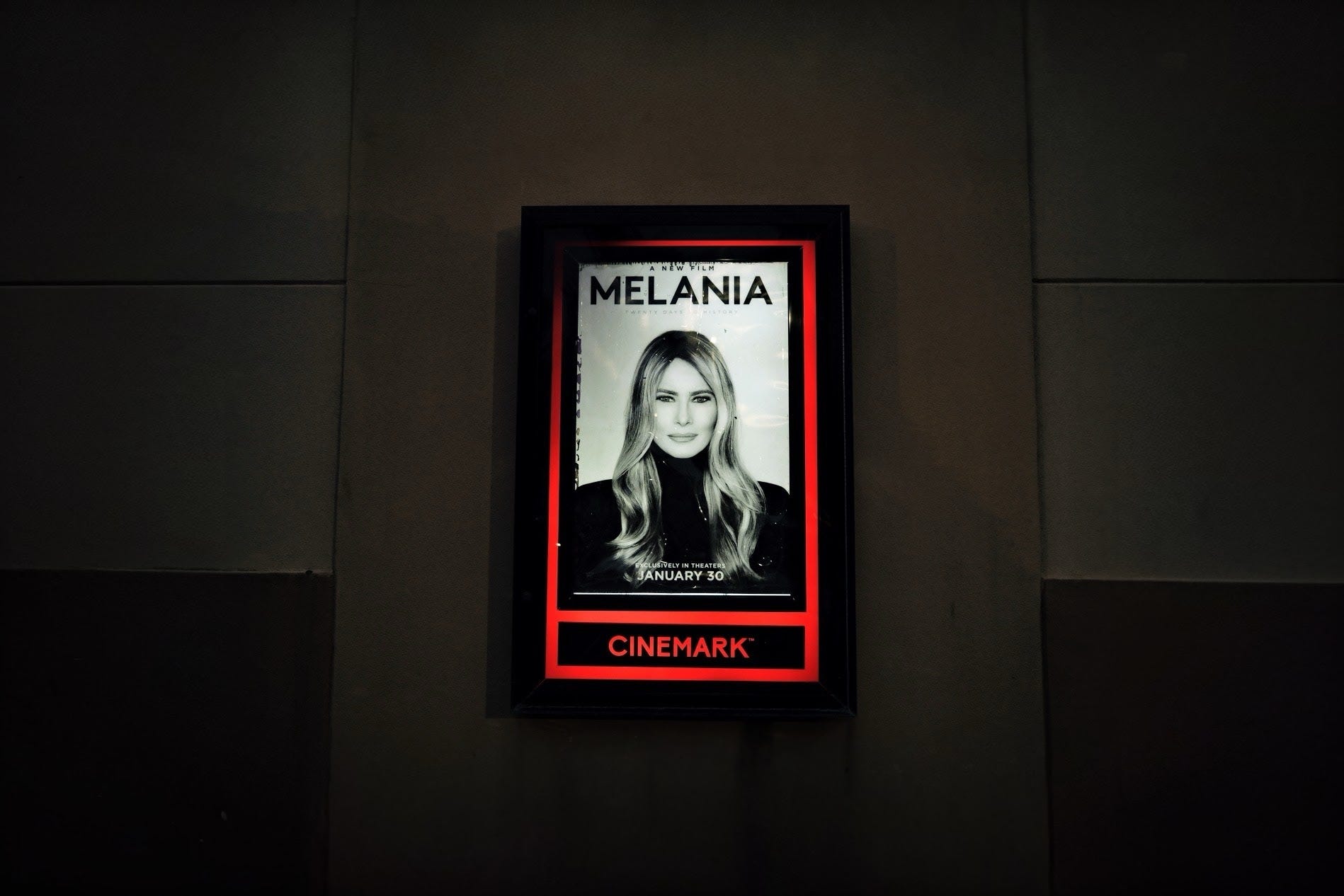
The documentary Melania set out to tell a portrait-driven story about the former first lady in the days leading up to President Donald Trump’s second inauguration. But behind the scenes, producers say the film faced unexpected roadblocks — not over footage or financing, but over music.

President Donald Trump and First Lady Melania Trump visit Fort Bragg on Friday, Feb. 13, 2026.
Marc Beckman, a producer on the project and an advisor to Melania Trump, revealed that several major artists declined to license songs for the film, citing political concerns.
“There was music that we tried to get, but sadly, there were politics to it,” Beckman said in a recent interview.
Among the disappointments, he said, was Guns N’ Roses. According to Beckman, one member of the band approved the request to use a track, while another refused. Because the group requires unanimous approval for licensing decisions, the split effectively killed the deal. Beckman described the outcome as frustrating, noting the team had high hopes for including the song.
Grace Jones was another artist whose music the production sought. Beckman claimed that she declined due to political reservations, despite his insistence that the film itself does not focus on policy or partisan themes. In his view, politics overshadowed artistic collaboration in that case.
The production also attempted to secure a song from the Prince catalog. Beckman said the deal was nearly finalized before a representative of the late musician’s estate intervened, allegedly arguing that Prince would not have wanted his music associated with Donald Trump. Beckman pushed back on that characterization, emphasizing that the documentary centers on Melania rather than the president. Still, the estate declined to move forward.

Soldiers wave and take photos of First Lady Melania Trump during a visit to Fort Bragg on Friday, Feb. 13, 2026.
The soundtrack controversy is not new territory for the film. Earlier, Radiohead guitarist Jonny Greenwood and filmmaker Paul Thomas Anderson publicly objected to the documentary’s use of a musical cue from their 2017 film Phantom Thread. Beckman responded by expressing disappointment at what he saw as artists distancing themselves for political reasons, while maintaining admiration for Radiohead’s work.
At the center of the debate is a larger question: whether cultural figures should separate their art from politics — or whether association alone carries weight.
Melania, directed by Brett Ratner, follows the former first lady during the 20 days leading up to her husband’s 2025 inauguration. The film does not heavily focus on policy, according to its producers, but it exists within an undeniably political orbit.
Financially, the project has drawn attention as well. Amazon MGM reportedly spent $75 million to acquire and promote the documentary. To date, it has earned approximately $16 million worldwide.
For Beckman, the music licensing setbacks reflect what he describes as a broader climate where artistic decisions are increasingly shaped by political affiliation. For critics, the refusals may signal the opposite — that artists are making deliberate choices about where their work appears.
Either way, the soundtrack became a subplot of its own — proof that even a film positioned as personal rather than political cannot easily escape the polarization surrounding its subject.



