
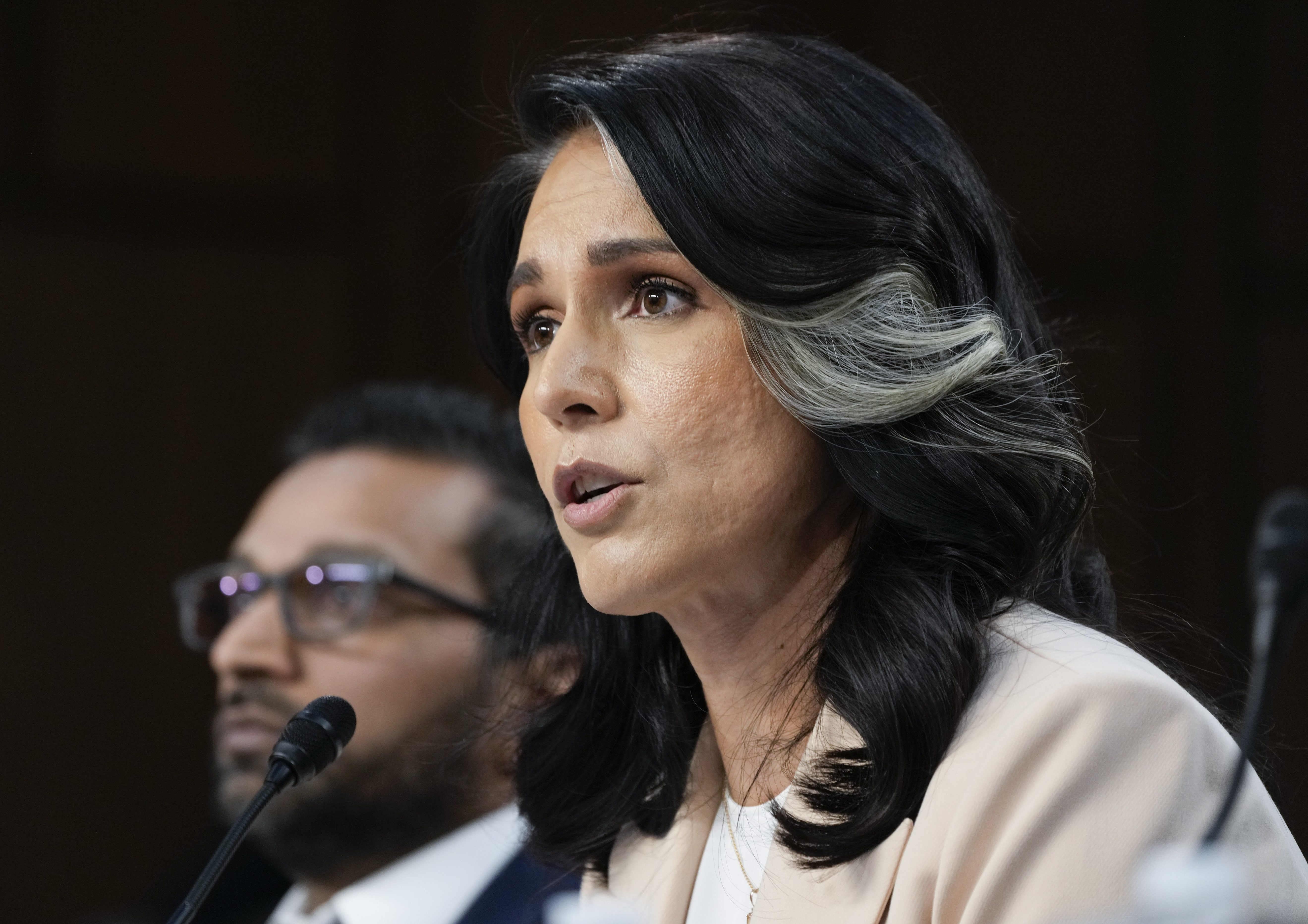
Director of National Intelligence Tulsi Gabbard is touting what she describes as a year of sweeping national security reforms under President Trump, highlighting border enforcement, cartel designations and intelligence community restructuring as key pillars of an “America First” agenda.
In a public message marking roughly one year since Trump returned to office, Gabbard said the administration has focused on confronting major threats while safeguarding Americans’ constitutional rights. She framed the intelligence community’s mission as twofold: defending the country from external dangers and protecting civil liberties at home.
A central theme of her remarks was border security and the fight against transnational criminal organizations. Gabbard pointed to Trump’s decision to designate several drug cartels as foreign terrorist organizations, arguing that the move expanded the tools available to U.S. counterterrorism officials. According to her, the designation enabled the National Counterterrorism Center and other agencies within the Office of the Director of National Intelligence (ODNI) to apply decades of counterterrorism expertise to combating cartels and gangs.
Gabbard claimed that within a year, the new policy prevented more than 10,000 individuals with alleged ties to narcoterrorism from entering the United States. She also cited joint operations with federal, state and local law enforcement that led to arrests of high-profile cartel figures. Among those referenced were an alleged Sinaloa cartel leader accused of overseeing drug trafficking and violent crimes, as well as a CJNG-affiliated trafficker accused of targeting vulnerable women in Mexico. These examples, she said, illustrate progress in disrupting violent criminal networks that threaten communities on both sides of the border.
Beyond external threats, Gabbard devoted significant attention to what she characterized as “insider threats” within government institutions. She accused unnamed “deep state actors” of politicizing intelligence agencies and weaponizing them against American citizens. In particular, she revisited longstanding Republican claims that investigations into alleged ties between Trump’s 2016 campaign and Russia were politically motivated.
Gabbard said the administration has prioritized transparency and accountability, noting that more than half a million government documents were declassified over the past year. She argued that these disclosures exposed what she described as a fabricated “Russia collusion” narrative engineered by officials during the Obama administration. According to her, such actions represented an attempt to undermine Trump’s presidency through investigations, legal challenges and impeachment efforts.

Mar 25, 2025; Washington, DC, USA; Tulsi Gabbard, director of National Intelligence, and Kash Patel, director of the Federal Bureau of Investigation, left, during the Senate Committee on Intelligence hearing to examine worldwide threats on Tuesday, March 25, 2025 in Washington, DC. Mandatory Credit: Jack Gruber-USA TODAY via Imagn Images
In addition to policy and oversight changes, Gabbard highlighted cost-cutting measures within the intelligence community. She said ODNI reduced its workforce by 40 percent, closed certain facilities and terminated contracts deemed unnecessary. These steps, she asserted, are saving taxpayers more than $700 million annually. The restructuring, she added, is intended to create a leaner organization focused squarely on intelligence integration, national security priorities and oversight.
Throughout her message, Gabbard emphasized that significant work remains. She said the administration is committed to eliminating waste, fraud and abuse across government while maintaining a strong national defense posture. The ultimate goal, she argued, is to preserve the integrity of the country’s democratic system and ensure that intelligence agencies serve the public rather than political interests.
Framing the past year as one of decisive action, Gabbard cast the administration’s efforts as restoring both security and trust. She concluded by reaffirming that the intelligence community’s daily mission is centered on protecting the safety, freedom and constitutional rights of the American people, even as it confronts evolving threats at home and abroad.



