
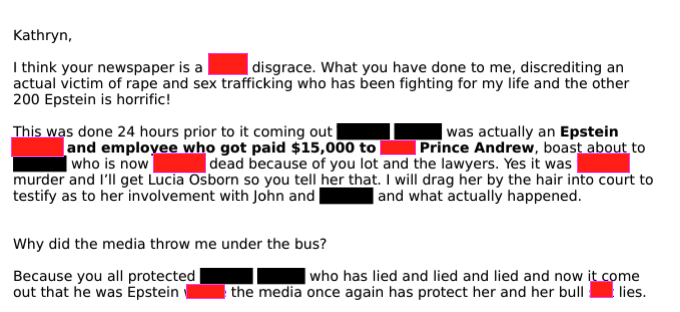
Long after Jeffrey Epstein’s criminal enterprise became the subject of sprawling litigation and relentless press attention, one document buried among the case materials captures a different side of the saga: not testimony shaped for court or statements vetted by lawyers, but a furious, intimate message aimed straight at a reporter.
The email, addressed to a journalist identified only as “Kathryn,” appears within the massive collection of records linked to Epstein — a mix that includes depositions, court pleadings, flight manifests and internal correspondence. Unlike those formal papers, the note reads like someone reaching a limit, lashing out at what she sees as a media betrayal.
From its opening lines, the author accuses the newspaper of shaming itself by, in her view, attacking “an actual victim of rape and sex trafficking.” She casts herself not merely as a survivor but as a person who says she spent years protecting others, writing that she had fought for her own life and for “the other 200 Epstein” victims she claims to have shielded.
She also repeats a claim that another individual was paid $15,000 to have sex with Prince Andrew, an allegation that has circulated in various accounts related to Epstein’s circle. Prince Andrew has denied wrongdoing. He reached a settlement of a civil case in 2022, and did so without admitting liability.

The author argues that key information about the other woman only surfaced recently and contends the newspaper mishandled the shifting picture — not as an error in judgment but as conduct that caused direct damage. “Do you have any idea what you lot have done to me, my family, all the Epstein victims,” she writes, portraying years of fallout that she describes as both reputational and deeply personal.
As the message continues, the writer moves from denunciation to demands. She presses the journalists to meet with her and go through what she describes as years of gathered proof. She names other media figures and calls for the email to be shared with them. She also threatens to force people into court to give testimony about what “actually happened.”
The note is not framed like a pitch for attention; it reads as a private eruption from someone convinced she was publicly mischaracterized and undermined. At one point, she says she would never speak to the outlet again, blaming it for wrecking the lives of victims. She closes with a warning that those involved are “in a huge amount of trouble.”
The significance of the email is less about introducing new allegations than about revealing the emotional wreckage that can sit behind even the most extensively documented cases. Epstein’s scandal is among the most exhaustively chronicled sex-trafficking stories in recent history, yet the paper trail contains contradictions, feuds, shifting roles and people who have been described — at different moments — as victims, witnesses, recruiters, sources, or targets.
In that setting, the fight over what happened did not remain confined to depositions and courtrooms. It moved through headlines, editorial decisions and private inboxes. The writer frames herself as someone who feels abandoned not only by alleged abusers, but by journalists she believes chose sides and helped harden a narrative that harmed others.
Whether the email is read as a justified protest or as evidence of how combustible the Epstein aftermath became, it captures something that sanitized filings rarely convey: the raw, unresolved human conflict still simmering beneath sealed records, public settlements and competing versions of the truth.



