
A late-night Justice Department memo about the long-sought Jeffrey Epstein records has set off a new round of political blowback on Capitol Hill, with Rep. Nancy Mace arguing that federal officials are leaning on legal protections to keep key information from the public long after prosecutors say the case is effectively over.
In a string of posts on social media after the department’s latest filing, the South Carolina Republican disputed the DOJ’s reliance on “work product privilege” to justify withholding portions of the Epstein materials, contending that the rationale would not survive a judicial test. “I want to be abundantly clear about the DOJ memo released tonight: Citing “Work Product Privilege” will NOT save the DOJ from releasing all the Epstein files. I’m not an attorney and even I know this won’t hold up in a court of law,” Mace wrote.
She also challenged the notion that deliberative-process protections can be used to keep basic facts concealed, saying the information missing from public view is the kind of material that should not be covered by that privilege. In her view, the department has already undercut its own position by releasing some content in both redacted and unredacted forms, effectively weakening any remaining claims of confidentiality.
Mace’s criticism rests in part on her assertion that the DOJ has wrapped up its work and does not plan to bring additional cases. Once the government has reached that point, she argued, sweeping privilege assertions are far harder to defend. She went further in a subsequent post, predicting a courtroom loss for the department if the dispute escalates: “TBH, it’s hard to find a legitimate reason not to expose every word in the Epstein files except for and unless you are prosecuting someone. That isn’t happening. DOJ will lose in court if it comes to that.”
A central focus of her thread was the DOJ memo’s statement that the government did not withhold or obscure records to spare anyone embarrassment, protect reputations, or avoid political fallout — including for officials, well-known figures, or foreign leaders. Mace said an internal email suggests something else was happening behind the scenes.
She pointed to what she described as an FBI message dated March 17, 2025, in which agents sought “clear and specific guidance” on how to handle photo redactions involving recognizable people, including former U.S. presidents and a secretary of state. For Mace, the request raises a direct conflict with the department’s public assurances.
“Then explain this: an internal FBI email from March 17, 2025 shows agents requesting ‘clear and specific guidance’ on redacting photographs depicting ‘former U.S. Presidents, Secretary of State, and other celebrities’ from the Epstein files,” she wrote, later adding: “So which is it? You didn’t redact to protect the powerful, or you needed specific guidance on how to do exactly that?”
Mace also alleged that the problem extends beyond a single agency, asserting that multiple parts of the federal government are involved in holding back information. “Your government is withholding information and files whether it’s SDNY, FBI, CBP, CIA, DOJ or elsewhere,” she wrote, while also suggesting that the names disclosed in the latest release were incomplete.

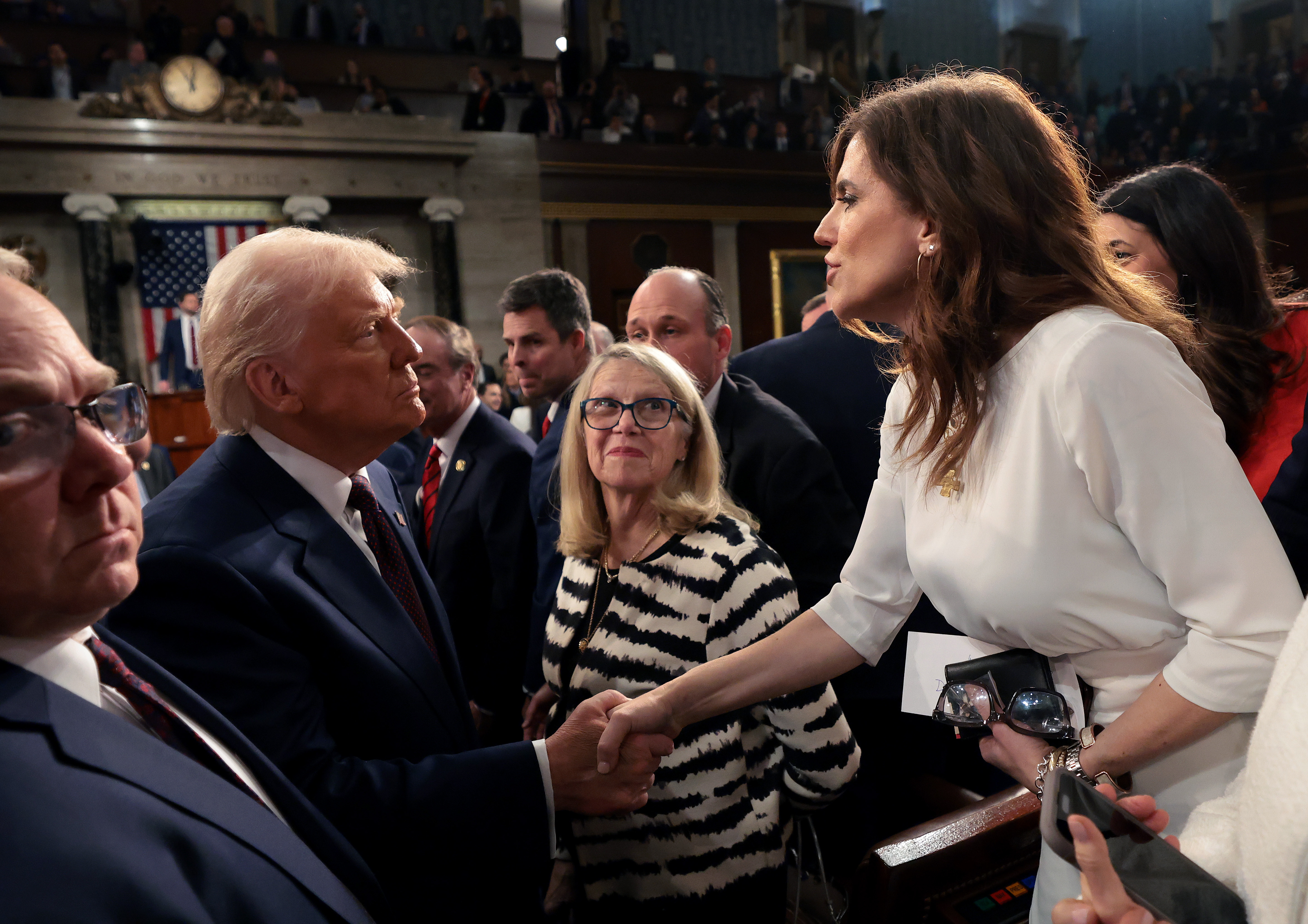
Mar 4, 2025; Washington, DC, USA; U.S. Rep. Nancy Mace (R-SC) shouts as U.S. President Donald Trump arrives to addresses a joint session of Congress at the U.S. Capitol on March 04, 2025 in Washington, DC. President Trump was expected to address Congress on his early achievements of his presidency and his upcoming legislative agenda. Mandatory Credit: Win McNamee-Pool via Imagn Images
In separate posts, Mace raised questions about missing evidence she believes should exist, highlighting references to roughly 2,000 videos. She argued that the number appears too low given longstanding reports that Epstein maintained extensive surveillance systems across different properties. “And where are ALL the videos? If he had as many cameras as has been reported, there would be far more than 2,000 videos. Trust me on this. I know, because I’ve worked with an extensive number of victims in voyeurism cases,” she wrote.
Mace also used her comments to criticize how the government initially handled the matter, saying early mistakes created space for competing political narratives. In one post, she defended President Trump’s conduct, contending he acted appropriately while others did not. “The DOJ screwed this up so badly early on that they let the Left paint the President in a bad light when his actions were the opposite. He was informing law enforcement early on when others were cozying up and covering up. So poorly managed, heads should roll,” she wrote.
Her posts ended with anger over how victims were treated, writing that the department should feel disgraced.
The Justice Department has not issued a public response to Mace’s latest claims.
Epstein’s case has remained a persistent flashpoint since the financier died in federal custody in 2019 while awaiting trial on sex trafficking charges, with demands for broader disclosure of investigative materials continuing to fuel political friction years later.



