
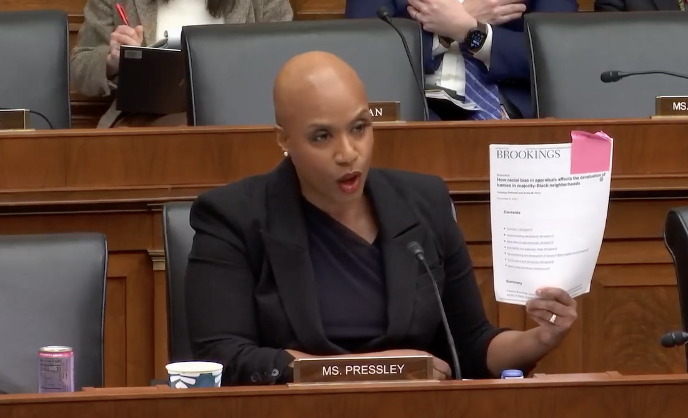

Rep. Ayanna Pressley used a House Financial Services Committee hearing this week to spotlight what she described as persistent racial bias in the U.S. home appraisal system, arguing that unfair property valuations continue to widen the racial wealth gap and deepen the housing affordability crisis.
Speaking during Black History Month, Pressley framed the issue as part of a long history of housing discrimination, saying that Black Americans’ contributions and struggles should not be minimized or ignored. She pointed to research showing stark disparities in household wealth, using Boston as a striking example.
Pressley cited a Federal Reserve Bank of Boston report that found the median net worth for white households in the city is about $247,500, while Black households have a median net worth of just $8. She said the dramatic difference is closely tied to unequal access to homeownership and the long-term effects of discriminatory housing practices.
Pressley questioned economist Dr. Darrick Hamilton, who has worked extensively on the racial wealth gap and policies such as “baby bonds.” Hamilton agreed that homeownership remains one of the most important tools for wealth-building in the United States, noting that it played a central role in creating the American middle class in the mid-20th century.

However, Hamilton emphasized that Black families were largely excluded from that opportunity because of policies and practices such as segregation, redlining, and discrimination in lending. Even for those who were able to buy homes, Pressley argued that the appraisal process often undervalued their properties, limiting their ability to build equity and pass wealth to future generations.
Pressley said this pattern has not disappeared. She referenced data suggesting that Black homeowners in Boston lose billions of dollars in wealth because their homes are valued lower than comparable homes owned by white families. According to the figures she cited, homes owned by Black families can be appraised about 18% less than similar homes nearby, translating to roughly $125,000 in lost value per home. She described this as a serious economic harm that can affect families for decades.
The congresswoman noted that the issue extends well beyond Massachusetts. She entered several studies and reports into the official congressional record, including research from Brookings and an analysis from Freddie Mac, to reinforce her claim that appraisal gaps in majority-Black neighborhoods are a nationwide problem.
Hamilton said the appraisal gap matters not only because it affects individual homeowners, but also because it contributes to broader economic inequality. He argued that many policy debates fail when they ignore historical context, stressing that current disparities did not happen by chance but are rooted in decades of unequal treatment. He suggested that looking at issues like the economy, regulation, and housing without acknowledging that history leads to incomplete and misleading conclusions.

Pressley closed by pointing to legislative efforts aimed at reforming the appraisal system. She said she has partnered with Sen. Elizabeth Warren on a proposal to modernize appraisals by strengthening transparency and accountability, as well as improving the ability of consumers to appeal valuations they believe are unfair.
While her time expired before she could go into detail, Pressley made clear that she views appraisal reform as a necessary step toward reducing racial wealth disparities and creating a fairer housing market.



