
The trick is called “disaster,” and for good reason.
When freeskiing star Eileen Gu decided to build her Olympic slopestyle run around it, she knew exactly what she was risking. Miss it, and the run unravels. Land it, and the entire sport shifts forward.
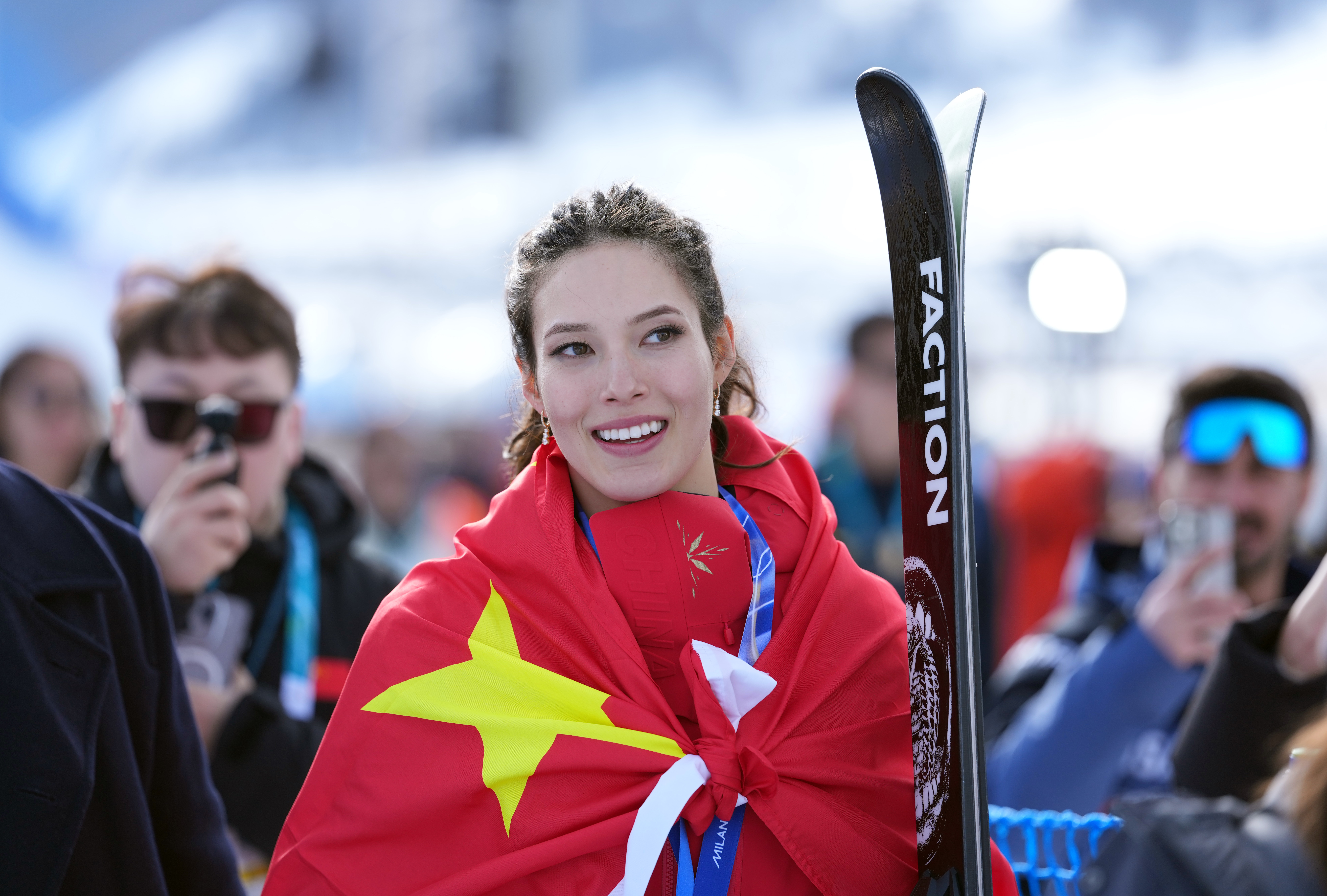
On Monday in Milan-Cortina, Gu landed it once — just enough to secure a second straight Olympic silver medal, and just enough to leave a permanent mark on women’s slopestyle skiing.
She didn’t land it again. And because of that, gold stayed out of reach.
For the second Olympics in a row, that top spot belonged to Switzerland’s Mathilde Gremaud, whose winning run was so clean, so daring, and so complete that it was being hailed within minutes as the greatest women’s slopestyle contest the sport has ever seen.
“That was definitely the best slopestyle run I’ve ever done,” Gu said.
Gremaud didn’t hesitate. “It’s the best one I’ve ever done in my life,” she said.
Canada’s Megan Oldham added to the spectacle, throwing back-to-back 1260-degree spins to earn bronze in a field that felt less like a podium and more like a line drawn in history.
The final margin between gold and silver was just .38 points — almost identical to the gap between Gremaud and Gu four years ago in Beijing. Yet the way they got there could not have been more different.
Two weeks before the Games, Gu tore up her slopestyle plan and rebuilt it from the top down, focusing on the rails section — the technical, unforgiving opening of the course. On the very first feature, she chose a longer rail that none of the other 11 finalists touched.
That’s where “disaster” lives.
The trick requires skiing backward, launching over part of the rail, twisting in an unnatural direction, and landing squarely on steel. Miss it, and you’re airborne with nowhere to go.
“It can go really, really bad,” said U.S. coach Ryan Wyble.
When it goes right, it’s transformative.
Gu landed it clean on her first run — the same trick that had haunted her in training and caused a fall in qualifying two days earlier. Judges rewarded it heavily, giving her the highest rails score of the day and the top mark on the opening jump.
“To be able to put it down when it counts,” Gu said, “that’s a testament to my mental strength.”
But slopestyle isn’t won at the top of the course alone.
The jumps — the soaring, crowd-stopping bottom half — are where Gremaud built her gold. In her winning run, the 26-year-old world champion skied backward into a double flip with a spin, then followed it with two massive 1260s in opposite directions. It was the first time she’d ever completed that sequence in competition.
“Definitely the most intense run I’ve ever done,” Gremaud said.
Gu couldn’t land the disaster trick on her second or third attempts. After her final fall, she planted her poles, took a breath, then skied out smiling. The moment turned Gremaud’s last run into a victory lap, flag trailing behind her as she floated down the course.
“I was not happy for you that you didn’t land the third run,” Gremaud told Gu afterward, laughing. “But I was happy for myself that I didn’t have to send it again.”
Gu laughed too. She understood exactly what had happened.
Did she want more? Absolutely. Did she have bigger plans? Yes. But disappointment wasn’t part of the equation.
“The first run I landed was the run I came here to do,” Gu said. “I’m proud of my skiing.”
On a day when medals were decided by fractions and risks were measured in inches, the real victory belonged to the sport itself.
“You are literally watching women’s skiing evolve in real time,” Gu said. “And how special is that?”
On a course built for danger, disaster never stood a chance.



