
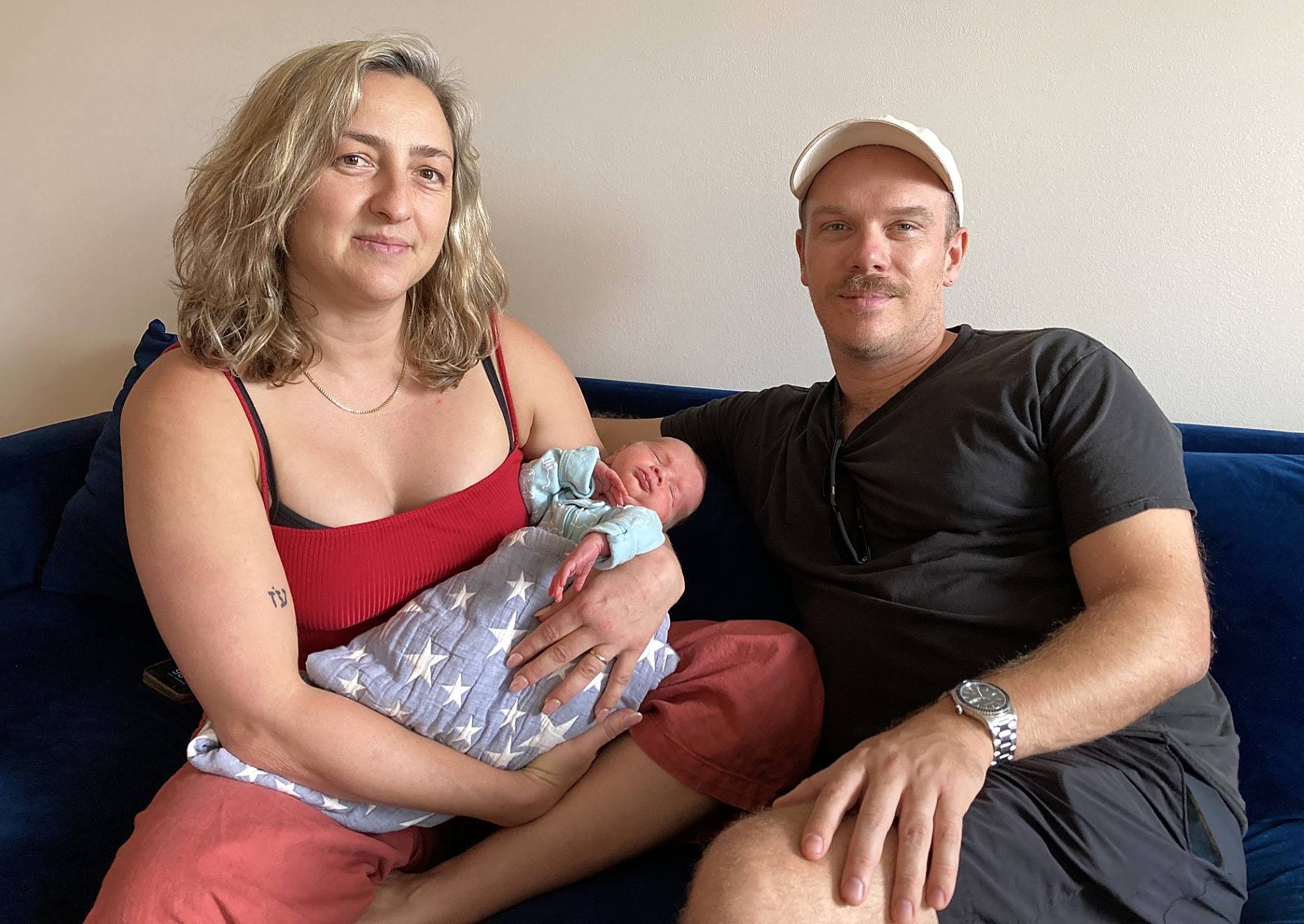

Rocky Moore, born June 23, sits with his mother, USA Olympic sailor Sarah Newberry Moore, and his father, Emmett Moore, at the Miami family’s temporary residence in downtown Erie. Rocky was born when Newberry Moore’s water unexpectedly broke while on a family vacation in Erie.
OlympiSarah Newberry Moore once assumed that becoming a mother would automatically end her career as an elite sailor. Despite being a five-time national champion, she rarely saw examples of women reaching the Olympics while raising children, even though many male athletes continued competing at the highest level after starting families.
That mindset began to shift during the COVID-19 pandemic. When sailing competitions and the 2020 Olympic Games were delayed, Newberry Moore found herself in a rare pause from the usual pressure of constant training and travel. Instead of viewing motherhood and elite sports as an either-or decision, she began questioning why she had ever believed she couldn’t do both. She decided she would continue chasing her Olympic dream while also starting a family. In 2021, she gave birth to her son, Iren. Three years later, he was in Paris cheering for her as she competed for the U.S. Sailing Team at the 2024 Summer Olympics.
Her story reflects a broader issue in sports: while women have been allowed to compete in the Olympics since 1900, the Olympic system has been slow to recognize pregnancy and parenthood as a normal part of an athlete’s life. Policies and resources for mothers remain limited, and many athletes still have to fight for basic support.
Newberry Moore said that while more athlete-mothers are now bringing their children to the Olympics, doing so remains difficult. Traditionally, families and children have not been allowed inside the Olympic Village. Athletes who stay there receive free housing and meals, but parents who want their children nearby must pay for outside accommodations and child care on their own.
The 2024 Paris Olympics introduced a major first: a nursery space for athletes with diaper-aged children, along with private breastfeeding areas. However, Newberry Moore’s events took place in Marseilles, far from Paris, and the satellite village where she stayed did not offer those services. As a result, she only saw her son briefly when her husband could bring him to visit. Because family members couldn’t enter her housing, visits were short and uncomfortable, especially in the extreme heat. She later skipped the closing ceremony just to reunite with her family. Out of 13 U.S. Sailing Team athletes, she was the only mother.
Looking ahead, the situation may be even harder. The International Olympic Committee confirmed there will be no designated family space at the 2026 Winter Olympics in Milan-Cortina, and no permanent breastfeeding facilities—only bookable rooms that may be used for that purpose.
Olympic medalist and advocate Alysia Montaño has worked to change these conditions through her nonprofit For All Mothers+. The organization offers financial support through its “Bring the Babies Changemaker Grant,” providing $5,000 to help athlete mothers cover travel, lodging, and child care costs. Newberry Moore received the grant in 2024, and five athletes preparing for the 2026 Games have received it as well. Montaño describes the grants as a temporary fix for a system that still fails to support parents properly.
Several athlete-mothers shared how expensive and emotionally challenging the current setup remains. Skeleton athlete Kelly Curtis said she will avoid staying in the Olympic Village to be with her daughter, but the hotel costs will be about 700 euros per night for 17 nights. Curling athlete Tabitha Peterson Lovick said even short visits with her baby will be essential for her mental health. Bobsledder Kaillie Humphries Armbruster described the grant as a major relief and said being reunited with her baby after races is what she looks forward to most.

Feb 12, 2022; Yanqing, China; Kelly Curtis (USA) in the women s individual skeleton during the Beijing 2022 Olympic Winter Games at Yanqing Sliding Centre. Mandatory Credit: Harrison Hill-Imagn Images
The challenges go beyond logistics. Research from For All Mothers+ found that most mother-athletes experience lost or reduced funding during pregnancy, and many need outside jobs to support their families. While the U.S. Olympic and Paralympic Committee has improved protections since 2022—allowing stipends and health coverage to continue through pregnancy and postpartum—athletes say more permanent support is still needed.
Newberry Moore, now pregnant again, says the lack of formal protections remains risky. She believes clearer policies must be put in writing so women don’t have to rely on goodwill to keep their careers alive.



