
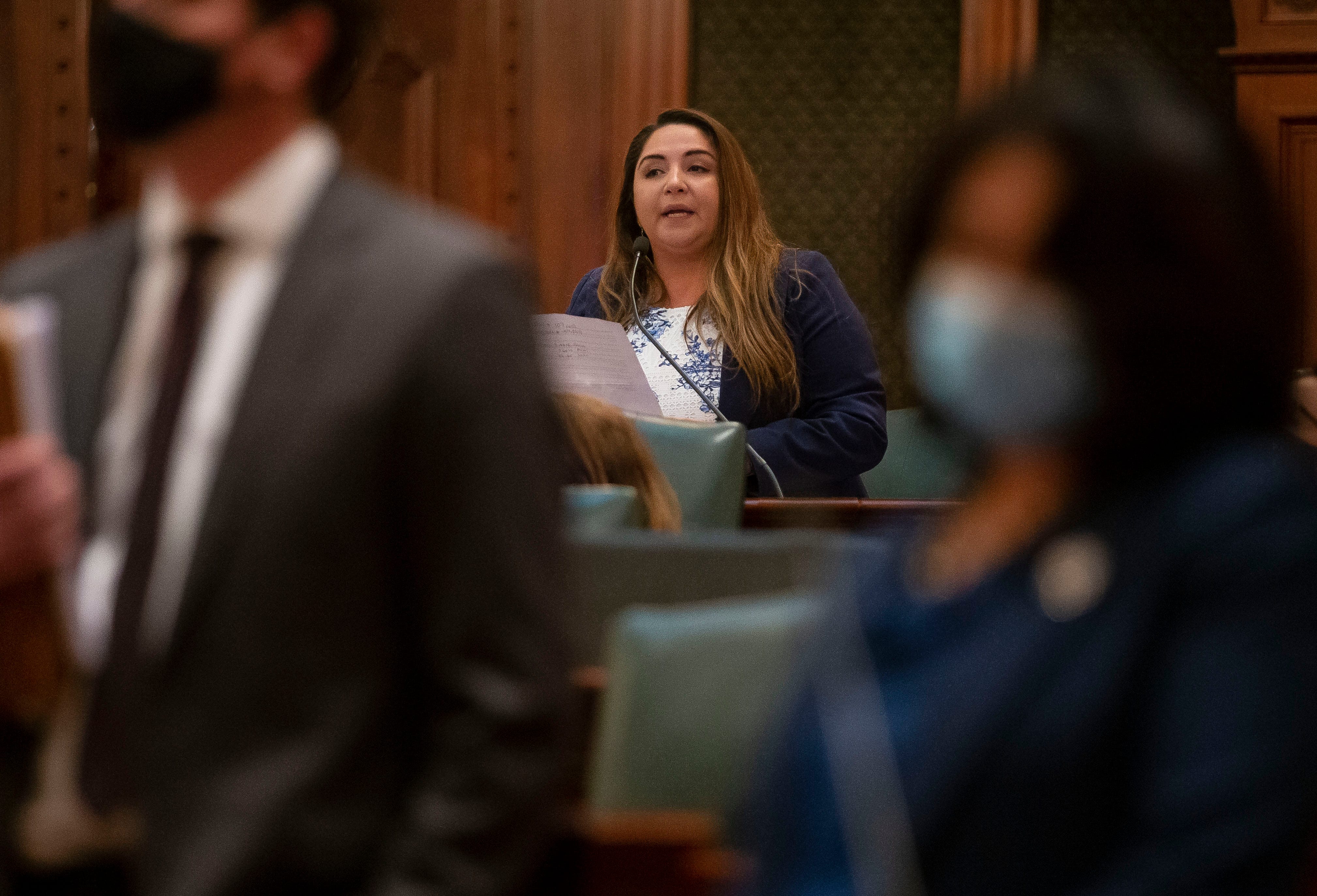
A progressive House Democrat warned Tuesday that the Department of Homeland Security has itself become the most serious threat to Americans’ safety, accusing the agency of operating with unchecked power under President Donald Trump and Homeland Security Secretary Kristi Noem.
Speaking at a press conference as Congress prepares to debate funding for DHS and ICE, Rep. Delia Ramirez said lawmakers must confront what she described as systemic abuse baked into the agency’s design. A continuing resolution funding DHS is set to expire on Feb. 13, setting up a high-stakes showdown in both chambers over immigration enforcement and civil liberties.
“Let me be very blunt, I’m gonna just say it: The greatest threat to the homeland is called the Department of Homeland Security,” Ramirez said. “We have seen the danger in infusing resources into DHS’s abuse of power.”
Ramirez is leading an effort in the House to introduce articles of impeachment against Noem, arguing that the agency she oversees has been allowed to act without meaningful oversight. She rejected the notion that DHS has gone “rogue,” instead insisting that it has operated exactly as intended. “DHS is not rogue because when it was built, it was built to violate our rights and has been empowered to act with impunity,” she said. “Congress needs to send a message that we do not consent, nor will we enable DHS and ICE’s lawlessness.”
In comments posted to social media, Ramirez pointed to the fatal shootings of Alex Pretti and Renee Good by federal agents as evidence that the agency’s problems extend beyond any single administration. She noted that both officers involved had years of experience at DHS and were considered highly trained. “The problem isn’t training,” she wrote. “DHS was built to violate our rights and has been empowered to act with impunity.”
While DHS has traditionally enjoyed bipartisan support on Capitol Hill, concerns about civil liberties and surveillance have followed the agency since its creation after 9/11. Critics across the political spectrum have long warned about its sweeping powers, from warrantless wiretapping under the Bush administration to aggressive immigration enforcement tactics today.
Ramirez represents the far edge of the Democratic caucus on ICE funding, but opposition to approving money for the agency without major reforms is widespread among Democrats. In the Senate, Democrats broadly share those concerns, though it remains unclear whether they are willing to block DHS funding entirely to extract concessions. Republicans have dismissed that possibility and remain firmly opposed to reforms such as warrant requirements for ICE arrests or bans on masked agents and roving raids.
In the House, Republicans could theoretically pass DHS funding without Democratic votes, but their slim majority leaves little room for defections or absences. In the Senate, where a 60-vote threshold still applies, GOP leaders will need Democratic support to pass any funding measure, including a short-term extension.
Some Democrats are drawing hard lines. Rep. Angie Craig, whose state is currently experiencing a major ICE enforcement surge, said she will not support any funding unless the agency pulls out entirely. “Short of Kristi Noem’s ICE getting the hell out of Minnesota, I’m not voting for a damn penny to ICE,” Craig said, recounting an incident in which her brother-in-law was surrounded by ICE agents outside a convenience store because he is Latino.
As the funding deadline approaches, the fight over DHS is shaping up to be more than a budget dispute. It is a referendum on the scope of federal power, the future of immigration enforcement, and whether Congress is willing to rein in an agency critics say has operated for too long without accountability.



