
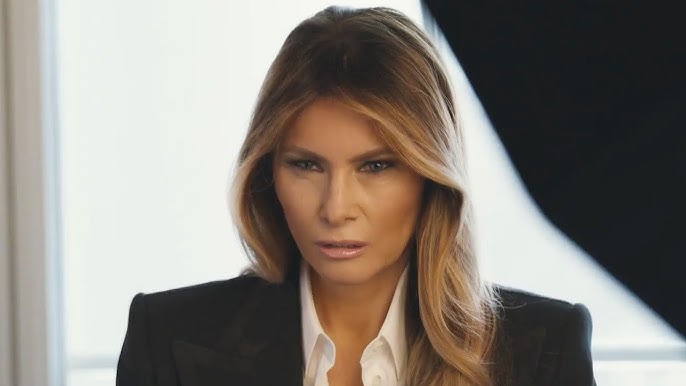
If you’ve watched television lately, you’ve likely seen the ads. Melania, a glossy, big-budget film centered on First Lady Melania Trump, premieres today with a red-carpet event at the newly renamed Trump Kennedy Center in Washington, D.C. It opens this weekend on 1,500 screens nationwide — a rollout so aggressive it has left industry veterans openly baffled.
According to a source with direct knowledge of the deal, Amazon acquired the film for $40 million and is spending an additional $35 million on marketing. For a project billed as a documentary — or something close to it — the numbers are staggering.

“It’s just hard to imagine why this number is justified for ‘Melania,’” said Jason Spingarn-Koff, a journalism professor at UC Berkeley and former Netflix executive who has worked on hundreds of documentaries. He noted that even Oscar-nominated nonfiction films now struggle to secure theatrical runs, let alone launches of this size.
The White House and Mrs. Trump’s personal office declined to answer questions about how much she is personally earning from the film or whether the inflated budget could be interpreted as an effort to curry favor with President Donald Trump.

The film follows Melania Trump for 20 days in January as she prepares to re-enter the White House. In one of the trailer’s most teased moments, she looks directly into the camera while entering the U.S. Capitol for her husband’s second inauguration. “Here we go again,” she says. Later, she calls him “Mr. President,” prompting him to ask, “Did you watch it?” Her reply — “I did not, yeah, I will see it on the news” — is left deliberately unexplained.
In a recent interview on Fox & Friends, Mrs. Trump said she was “very involved in leading the production and choosing the trailer,” adding that she wanted viewers to see “communications and private communications between me and my husband.”

Amazon declined to release advance screeners to critics, a standard practice in film promotion, and all scheduled Thursday preview screenings were abruptly canceled. Ticket sales were already anemic, drawing mockery across social media and late-night television.
Despite its documentary framing, Melania lists the first lady as an executive producer — a distinction that troubles industry observers. “Once the subject of the film has editorial input or control,” Spingarn-Koff said, “we’re in the realm of public relations. In this case, it seems like myth-making.”

The director is Brett Ratner, best known for the Rush Hour franchise and largely ostracized from Hollywood after sexual misconduct allegations surfaced in 2017, which he denies. Ratner is not a documentary filmmaker. Mrs. Trump said she chose him specifically to deliver a cinematic vision.
That partnership has already paid dividends. Ratner is reportedly returning to direct Rush Hour 4 after intervention by Trump ally David Ellison, CEO of Skydance Paramount.
Behind the scenes, the picture appears far less polished. Rolling Stone reported that roughly two-thirds of the New York crew asked to have their names removed from the film’s credits. Several sources described the production as chaotic, exhausting, and deeply uncomfortable.
One crew member called Ratner “slimy,” while another said he was “the worst part of working on this project.” Complaints included grueling hours, denied meal breaks, and behavior described as dismissive and demeaning. Multiple sources said they hope the film “flops,” with one adding they felt uneasy about its “propaganda element.”
Melania Trump herself was described by one crew member as “boring but totally nice,” though another remarked, “Some people never let their guard down.”

Kate Bennett, a former CNN reporter and author who has covered Melania Trump for years, said the film capitalizes on the mystery the first lady has long cultivated. “I don’t think the public will ever really know the deep inner thoughts of Melania Trump, by design,” Bennett said, adding that Melania is also, at heart, a marketer who has rarely appeared without financial upside.
Early box-office signals are grim. According to The Guardian, just one ticket was sold for a mid-afternoon screening in London ahead of the film’s international debut, with multiple major theaters reporting zero advance sales.




