

Feb 12, 2022; Yanqing, China; Katie Uhlaender (USA) in the women s individual skeleton during the Beijing 2022 Olympic Winter Games at Yanqing Sliding Centre. Mandatory Credit: Harrison Hill-Imagn Images
Shockwaves are rippling through the skeleton racing world as American superstar Katie Uhlaender claims she’s been robbed of her sixth shot at Olympic glory. The 41-year-old, whose name is virtually synonymous with U.S. skeleton racing, is pointing the finger at what she says are shady tactics and a broken qualification system that has left her dreams shattered just weeks before the 2026 Winter Games in Milan-Cortina.
Uhlaender, hailing from Breckenridge, Colorado, was deep in the hunt at the IBSF World Championships held at the iconic Mt. Van Hoevenberg track in Lake Placid, New York, in early March 2025. It was supposed to be her big moment—to lock in enough crucial points to book her ticket to Italy and stamp her name in history as one of the rare athletes to compete in six Winter Olympiads. Instead, the finish line vanished before her eyes thanks to a move by the Canadian team that’s got the whole sled-racing community in an uproar.

Feb 12, 2022; Yanqing, China; Katie Uhlaender (USA) in the women s individual skeleton during the Beijing 2022 Olympic Winter Games at Yanqing Sliding Centre. Mandatory Credit: Andrew P. Scott-Imagn Images
The seasoned American speedster brought the scandal into the spotlight with a fiery post on X this past Sunday, blasting what she called a betrayal of the Olympic spirit. “This is about the integrity of sport,” she posted. “The code of ethics has to uphold sportsmanship, fair play, respect, and community. I deserved a fair chance.”
So what exactly caused this ice-cold controversy? The answer lies in the complex, cutthroat world of Olympic qualification points. Every twist, turn, and hair-raising descent at Lake Placid was more than just a race—it was a high-stakes battle for precious ranking points. But as skaters buckled their helmets and officials prepared the track, Team Canada made what some are calling a game-changing play: the sudden, eleventh-hour withdrawal of four of its women athletes from the skeleton event. The fallout was immediate and dramatic. With fewer competitors in the field, the points pool shrank—and so did Uhlaender’s mathematical shot at Milan-Cortina.

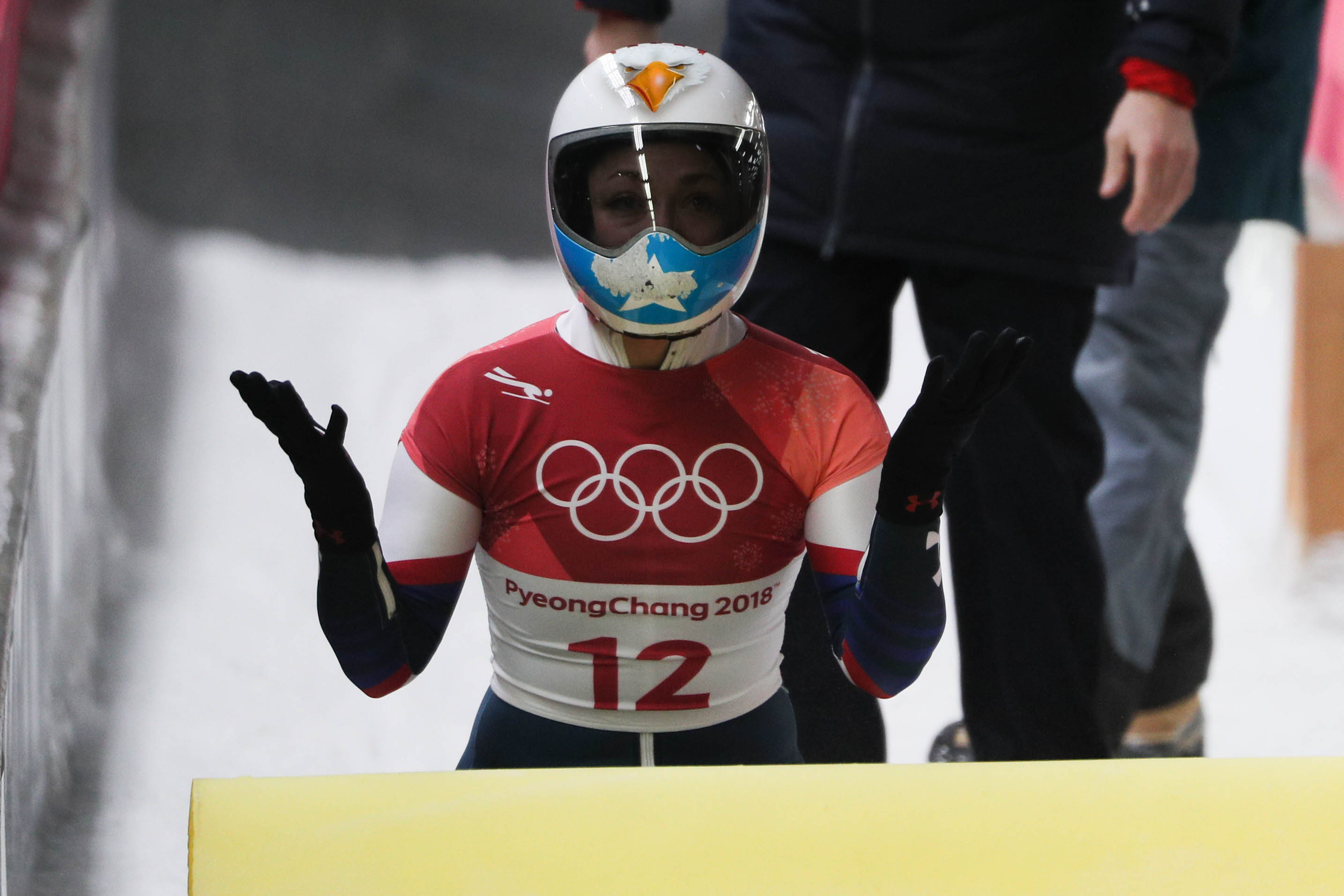
Feb 16, 2018; Pyeongchang, South Korea; (Editor s Note: Multiple exposure photo.) Katie Uhlaender (USA) competes in the skeleton ladies individual run 1 during the Pyeongchang 2018 Olympic Winter Games at Olympic Sliding Centre. Mandatory Credit: Soobum Im-Imagn Images
Critics weren’t shy about their opinions. Social media exploded with accusations. Fans and fellow athletes lambasted Team Canada, arguing their withdrawal was an intentional ploy to manipulate the quota system and keep their rivals, like Uhlaender, out of Olympic contention. What was at stake wasn’t just one woman’s lifelong dedication, but the very reputation of skeleton racing on the world stage.
Canadian officials fired back with a swift denial. A spokesperson for the nation’s skeleton program stated, “Canada abides by every rule and competes with integrity. Any suggestion otherwise is completely unfounded.” Still, the damage was done—the sledding world had been pulled into a diplomatic incident worthy of Olympic drama.
The International Bobsleigh and Skeleton Federation (IBSF) wasn’t about to let the maelstrom go unchecked. The governing body, responsible for upholding fairness in the sport, launched a formal review into whether the Canadians had crossed the line from strategy into sabotage. “A late withdrawal of athletes, especially at a competition with such high stakes, inevitably raises concerns about possible manipulation,” the IBSF admitted in a statement that sent shivers down the spines of competitors everywhere.
But when the ruling finally came down on January 15, 2025, Uhlaender’s hopes were dashed again. The IBSF ultimately sided with Canada, stating that the last-minute withdrawals, while unusual, did not violate any explicit rule and therefore could not be punished retroactively. “There was no evidence of a rule breach, so the results and qualifications stand,” the Federation declared. The decision left many in the skeleton community—Uhlaender especially—furious at what they see as a system loophole unfit for a sport built on milliseconds and split-second glory.
The ruling effectively locked Uhlaender out of Olympic contention, ripping away the milestone she has been chasing for most of her life. The veteran racer, who has battled back from injuries, heartbreak, and near misses in multiple past Olympics, is not backing down without a fight. She’s now calling on the International Olympic Committee to step in with a “wild card” entry—a special dispensation that would give extraordinary athletes like her one last dance on the world’s grandest icy stage.
Supporters have flocked to her side, arguing that the IOC needs to look beyond technicalities and correct what they say is a glaring injustice. “There are moments when the Olympics need to remember what they’re about—champions fighting against all odds, not bureaucratic loopholes,” tweeted one longtime sportscaster. Others have noted that wild cards have been used before in various sports to ensure the best athletes don’t get left out because of technical snafus or behind-the-scenes machinations.
As the clock ticks down to the Winter Games, pressure is mounting. Will the IOC wield its power to give a trailblazer like Uhlaender one last shot? Or will this chapter end with a cloud of controversy that overshadows the thrills and spills of the skeleton track? One thing’s for sure: the world will be watching—not just for who wins gold in Milan, but for how the deciders play the game behind the scenes.

Feb 17, 2018; Pyeongchang, South Korea; Katie Uhlaender (USA) competes in ladies skeleton heat 4 during the Pyeongchang 2018 Olympic Winter Games at Olympic Sliding Centre. Mandatory Credit: Soobum Im-Imagn Images
For Uhlaender, the saga has become more than just a personal crusade. It’s a fight for every racer who dreams of the Olympics, a struggle against the hidden traps and bureaucratic twists that sometimes decide whose names get etched in sports history. If the Olympic motto is truly about “Citius, Altius, Fortius”—faster, higher, stronger—then maybe the system itself needs to catch up.
Uhlaender, for now, is left out in the cold, but her battle has sparked a red-hot debate about fairness and the true spirit of the Games. Whether the IOC listens to her plea or not, her story is a blazing reminder that the Olympic journey is sometimes as perilous as the snow-and-ice tracks themselves.



