
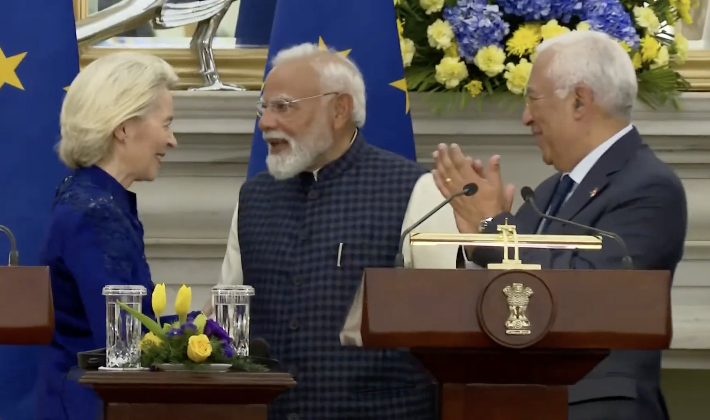

At the EU-India Summit, European Commission President Ursula von der Leyen put herself front and center as the dealmaker-in-chief, framing Europe’s pitch to India as a big, pragmatic bet on partnership in an unsteady world. Her headline line—calling the newly signed EU-India Free Trade Agreement “the mother of all trade deals”—set the tone: bold, oversized, and designed to signal momentum.
The ceremony brought together von der Leyen, Indian Prime Minister Narendra Modi, and European Council President António Costa. Modi opened by welcoming both leaders and describing the moment as historic, arguing that India and the EU—two major democratic powers—were entering a “new era.” He highlighted the scale of existing ties, including €180 billion in trade and a large Indian diaspora across EU countries. He presented the agreement as India’s “largest ever” free trade deal, saying it would help farmers and small businesses reach European markets more easily, create opportunities in manufacturing, expand services cooperation, and strengthen global supply chains. He also emphasized a new mobility framework meant to open more pathways for Indian students, workers, and professionals.
Then von der Leyen took the mic and drove home what she wanted the world to hear: Europe is choosing cooperation, and India is a strategic cornerstone of that choice. She described the agreement as the “tale of two giants”—the world’s second and fourth largest economies—joining forces in a “win-win” model. In practical terms, she said the deal creates a market of two billion people, cuts up to €4 billion in annual tariffs for exporters, and should generate jobs on both sides. She leaned hard into the idea of economic complementarity: India’s skills, services, and scale matched with Europe’s technology, capital, and innovation. She also cast the agreement as a strategic tool—reducing “dependencies” at a time when, in her words, trade is increasingly “weaponized.”

But von der Leyen didn’t stop at commerce. She described a broader package aimed at security, technology, and people-to-people ties. A key announcement was the launch of the first-ever EU-India security and defense partnership, which she framed as a trust-based platform focused on shared threats. She pointed to potential cooperation on maritime security (including joint naval exercises to tackle piracy), cyber and hybrid threats, counterterrorism, and even space security, from situational awareness to secure connectivity. She also noted negotiations toward a “security of information” agreement—another sign, she suggested, of deeper strategic trust.
On innovation, von der Leyen struck a values-based note, stressing “freedom of research and science.” She said the EU and India would expand collaboration on “human-centric” and “trustworthy” AI and announced work toward India’s association with Horizon Europe, the EU’s major public research program. To make the partnership feel tangible, she mentioned planned EU-India innovation hubs and a startup partnership to encourage joint ventures.
Finally, she returned to mobility—calling people “our greatest wealth”—and spotlighted an agreement to facilitate movement of students, researchers, seasonal workers, and highly skilled talent. Her closing metaphor, drawn from India’s seasonal traditions, was meant to underline a shared message: a pivot from uncertainty toward growth—anchored, in her telling, by a refreshed EU-India friendship led by dealmaking and strategic alignment.



