
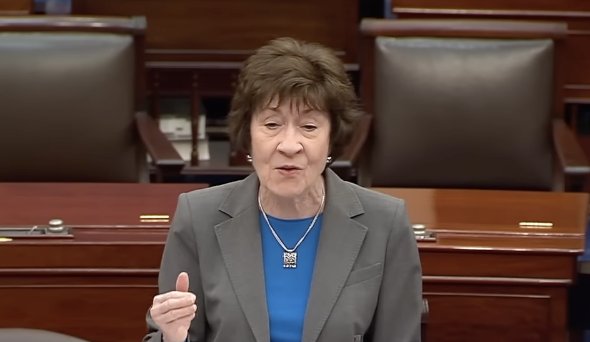

Sen. Susan Collins used a floor speech this week to frame the stakes of an unusually consequential moment in the Senate, as lawmakers prepare to vote on a sweeping package of six appropriations bills that would fund major parts of the federal government through fiscal year 2026. Speaking calmly but firmly, Collins emphasized both the urgency of the moment and the need for bipartisan cooperation, particularly as debate intensifies around funding for the Department of Homeland Security (DHS).
Collins began by noting that the Senate is facing a pivotal decision: whether to proceed to final consideration of the remaining six appropriations bills already passed by the House of Representatives. Together, the bills cover full-year funding for a wide range of federal functions, including the Departments of Defense, Homeland Security, Labor, Health and Human Services, Education, State, Transportation, and Housing and Urban Development, as well as Financial Services and National Security-related programs.
She described the package as the result of months of detailed work by members of both parties and both chambers of Congress. According to Collins, Senate subcommittees alone reviewed more than 31,000 funding requests related to these six bills, weighing competing priorities and making difficult trade-offs under a spending cap that is lower than what would be allowed under a continuing resolution. The process, she said, required compromise and careful alignment between House and Senate priorities, as well as coordination with the administration.
The outcome of that work, Collins argued, was a set of fiscally responsible bills that earned bipartisan support in the House. She urged the Senate to meet that moment by completing the job and avoiding what she called a “harmful, unnecessary, and disastrous” government shutdown that could occur if Congress fails to act.
While Collins said she plans to discuss individual provisions in greater detail later in the week, she directly addressed one issue that has come to dominate the conversation: the Department of Homeland Security funding bill. The recent death of Alex Pretti, she acknowledged, has intensified scrutiny of DHS and refocused public and congressional attention on how the department is funded and overseen. Collins said she recognizes and shares the concerns raised in the wake of that tragedy.

At the same time, she urged colleagues to closely examine the contents of the DHS bill before drawing conclusions. Collins emphasized that the legislation includes multiple safeguards and that more than 80 percent of DHS funding is allocated to functions unrelated to immigration or border enforcement. She highlighted several areas she described as essential and widely supported, including funding for the Federal Emergency Management Agency (FEMA), which she noted is especially critical following recent severe storms. She also pointed to funding for the Transportation Security Administration (TSA), cybersecurity initiatives, physical infrastructure protection, and the U.S. Coast Guard—programs that directly affect public safety and state-level priorities, including in her home state of Maine.
Throughout her remarks, Collins struck a measured tone, balancing acknowledgment of public concern with a broader view of government operations and responsibilities. Rather than minimizing the controversy surrounding DHS, she framed it as one part of a much larger funding package that supports disaster response, national security, transportation safety, and infrastructure resilience.
She closed by appealing to her colleagues to approach the week ahead constructively, warning against allowing disagreements over individual issues to derail the entire appropriations process. Her stated goal, she said, is to work with senators on both sides of the aisle to ensure continuity of government operations and prevent a shutdown that would disrupt services and create uncertainty nationwide.
As debate continues, Collins signaled that further discussion is inevitable—and necessary—but urged the Senate to keep its focus on completing its work responsibly. “This is a very important week,” she reminded her colleagues, underscoring both the complexity of the task and the consequences of inaction.



