
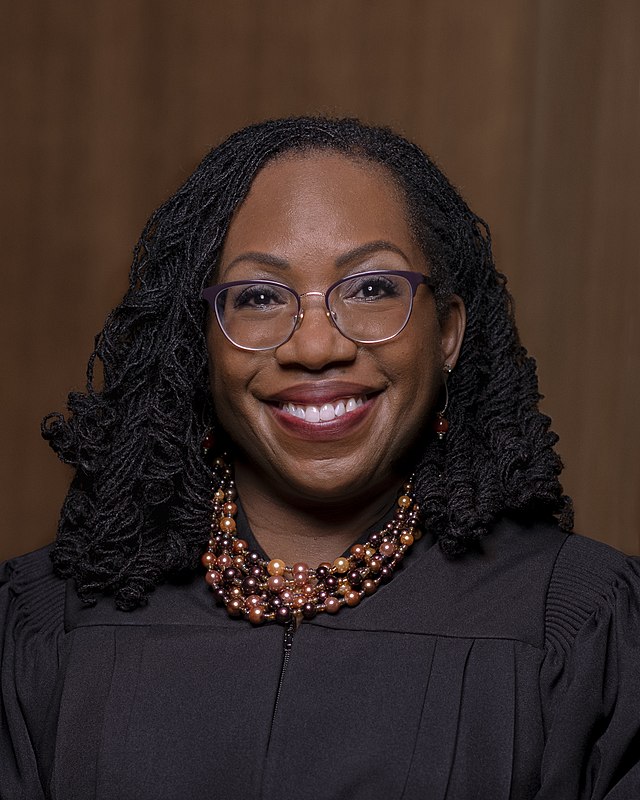
Ketanji Brown Jackson issued a sharp rebuke of her colleagues this week, dissenting from three Supreme Court decisions and labeling one of them flatly “intolerable.”
At issue was the Court’s decision to deny an inmate’s request to file future petitions without paying the Court’s docketing fee, effectively cutting him off from access unless he can afford hundreds of dollars in costs. The Court rejected a petition for a writ of certiorari filed by Danny Howell, an Indiana inmate serving a 70-year sentence, and ordered the clerk not to accept any future noncriminal petitions from him unless the required fee is paid in full.

The majority argued that Howell had “repeatedly abused this Court’s process.” Jackson disagreed — both with the premise and the punishment.
Howell filed six petitions over a 14-year period, Jackson noted in her dissent, a number she did not consider extraordinary enough to justify what she described as a categorical, forward-looking filing ban. “A categorical, forward-looking filing bar is a questionable restriction as to any litigant who cannot afford to pay a filing fee,” she wrote. “For me, it is an intolerable one as to incarcerated individuals.”
Howell was sentenced in 2004 to 60 years for child molesting and an additional 10 years for sexual misconduct with a minor, according to Indiana Department of Corrections records. He is currently housed at New Castle Correctional Facility. His petition raised claims of judicial bias and alleged prosecutorial failure to correct a witness’s testimony — issues Jackson emphasized were never reached because the Court declined to hear the case.
A writ of certiorari, the mechanism Howell sought, allows the Supreme Court to review lower court records. Denying it is routine. What troubled Jackson was the added step: permanently blocking an indigent prisoner from filing again unless he pays the fee, regardless of whether future claims might have merit.
“Even if Howell were to identify meritorious grounds for habeas relief or wanted to bring a justifiable challenge to his conditions of confinement,” Jackson wrote, “he will now be prevented from doing so unless he pays the filing fee—no matter what.”

The Court majority framed the restriction as an administrative necessity. In its order, the Court said Howell had abused the system and directed the clerk not to accept future petitions unless they comply with fee and formatting rules. Jackson rejected that logic, warning that convenience was being prioritized over justice.
“The future is famously hard to predict,” she wrote. “So the justification for a permanent filing bar—even one related to the Court’s administrative convenience—is murky at best.”
Jackson also dissented from two additional orders issued Tuesday that imposed similar filing bans on other petitioners. Taken together, she argued, the decisions reflect a troubling shift toward reflexively closing courthouse doors to prisoners who lack financial resources.
“I believe that when balancing prisoners’ access to judicial review, on the one hand, and reducing our administrative burden, on the other, we should err on the side of keeping our courthouse doors open,” she wrote. “For a system designed to administer justice, reflexively rejecting (potentially meritorious) petitions from incarcerated litigants has a cost that is much too high.”
While the dissents did not change the outcome, they sharpened a familiar divide on the Court — one between efficiency and access, finality and review. Jackson’s message was clear: when the justice system bars the poor from even knocking, the price paid is not administrative, but moral.



