
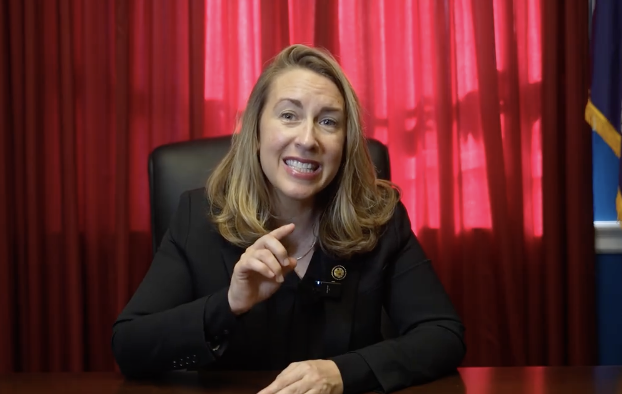

In a recent episode of Straight Talk with Scholten, Rep. Hillary Scholten offered a candid overview of why Congress has struggled to function effectively during the current legislative session. Speaking directly to constituents in West Michigan, Scholten framed the discussion around a sense of frustration many Americans share when watching Washington fall short on delivering results.
Scholten pointed to the sheer volume of legislation introduced in the 119th Congress as a starting point. More than 17,000 bills have been filed across the House and Senate, yet only 69 have become law. For her, that gap illustrates a deeper problem. While introducing bills is part of the process, she argued that the low number of enacted laws reflects stalled debate, limited floor action, and structural challenges that prevent ideas from moving forward.
A major factor, according to Scholten, is the unusually narrow margin of control in the House of Representatives. With just a handful of seats separating the two parties, the majority has little room for internal disagreement. She explained that when margins are this tight, a small group of lawmakers can block progress entirely. While that reality makes governing more difficult, Scholten stressed that it does not make it impossible. In her view, leadership decisions play a decisive role in whether Congress adapts or remains stuck.
Scholten noted that House leaders have cited the narrow majority as the primary reason for the slowdown, but many lawmakers across party lines see a broader issue: a breakdown in trust and leadership. She highlighted that the House has held fewer votes than any first session of Congress in the 21st century, making it one of the least productive in recent history. Instead of bringing bills to the floor for debate, she said, leadership has often declined to schedule votes altogether.
This dynamic has led members to rely more heavily on procedural workarounds. Scholten discussed the growing use of discharge petitions, a rarely used tool that allows a majority of House members to force a vote without leadership approval. Since the current Speaker took office, seven discharge petitions have succeeded—matching the total number used over the previous four decades combined. Scholten described this as a clear sign that the regular legislative process is not functioning as intended.

She cited two recent examples. One involved extending Affordable Care Act subsidies to help families afford health insurance, which only reached the floor after a discharge petition gained enough support. Another concerned legislation requiring the Department of Justice to release records related to the Epstein investigation. In both cases, Scholten said, members from both parties joined together to bypass leadership and allow debate.
Scholten also raised concerns about how legislation is increasingly packaged into large, all-or-nothing bills. These sweeping measures often combine dozens of policies, limit amendments, and reduce transparency. When bills stretch hundreds of pages, she argued, it becomes harder for lawmakers and the public to fully understand what is being approved.
Beyond legislation, Scholten emphasized Congress’s oversight role. She pointed to a long-term decline in the number of hearings, saying that fewer opportunities to question agencies and examine programs weaken accountability. When oversight becomes more partisan or less thorough, she warned, the public ultimately bears the cost.
Scholten closed by calling for a “common-sense majority” willing to prioritize transparency, accountability, and open debate. While acknowledging current limitations, she said she will continue pushing for reforms that allow Congress to better represent the people it serves and encouraged constituents to stay engaged and share their concerns.
Source: Congresswoman Hillary Scholten on YouTube, “Congress in Crisis”



