
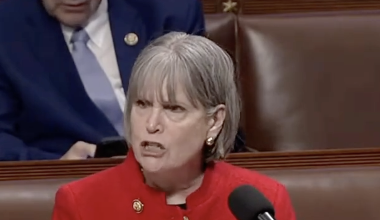

Rep. Betty McCollum of Minnesota delivered remarks on the House floor opposing the Department of Homeland Security Appropriations Act of 2026, arguing that federal funding should not continue without stronger protections for constitutional rights and oversight of enforcement practices. Speaking as the ranking member and senior member of Minnesota’s congressional delegation, McCollum framed her opposition around recent events in her state and broader concerns about civil liberties.
McCollum said that Minnesota has experienced what she described as a period of severe disruption and fear connected to federal immigration and law enforcement activity. In her remarks, she accused the Trump administration and the Department of Homeland Security (DHS) of carrying out actions that she believes amount to widespread civil rights violations. According to McCollum, these actions include racial profiling, aggressive detentions, and arrests carried out by masked federal agents in public spaces and residential neighborhoods.
She cited several incidents to illustrate her concerns. One involved what she described as federal agents using a young child to draw family members out of a home before detaining them in front of the child. McCollum characterized this as deeply traumatic and inappropriate, particularly given the presence of minors. She also said that some of the individuals taken into custody in such operations were later found to have no criminal record and to be lawfully present in the United States.
Another example McCollum shared involved a woman she identified as a U.S. citizen. According to McCollum, the woman was taken into custody after being removed from her vehicle while warming it up in cold weather. McCollum said the woman was transported between multiple detention facilities and required medical treatment for a head injury, with possible lasting damage to her wrists. McCollum emphasized that this case involved a citizen, underscoring her argument that enforcement actions are affecting people beyond undocumented immigrants.

McCollum described these incidents as part of a larger pattern rather than isolated cases. She characterized the situation as one of the most serious examples of mass civil rights violations by the federal government in recent history. In her remarks, she said that the actions she described have created fear within communities and raised significant questions about due process and lawful enforcement.
She also referenced a fatal shooting in Minneapolis involving a woman named Renee Good, which occurred during a period of heightened tension over federal enforcement activity. McCollum linked the incident to broader concerns about the use of force and the consequences of aggressive tactics, although she did not provide details about any ongoing investigations related to the shooting.
Throughout her speech, McCollum repeatedly returned to the question of funding. She argued that Congress has the power and responsibility to withhold appropriations when agencies violate constitutional protections. In her view, continuing to fund DHS without addressing these concerns would make lawmakers complicit in the actions she criticized.
As her allotted time concluded, McCollum requested and was granted an additional 30 seconds to restate her position. In that time, she urged her colleagues to vote against the bill, framing the vote as a choice about constitutional rights and due process rather than a routine funding decision.
McCollum closed by calling on lawmakers to oppose the appropriations measure until DHS practices are brought into compliance with the Constitution. Her remarks highlighted the tension between national security and enforcement priorities on one hand, and civil liberties and congressional oversight on the other, placing the responsibility on Congress to decide how federal power should be checked and funded.
Source: Congresswoman Betty McCollum on YouTube: “Not One Penny of our Taxpayer Dollars Should go to DHS While They Violate our Constitutional Rights”



