
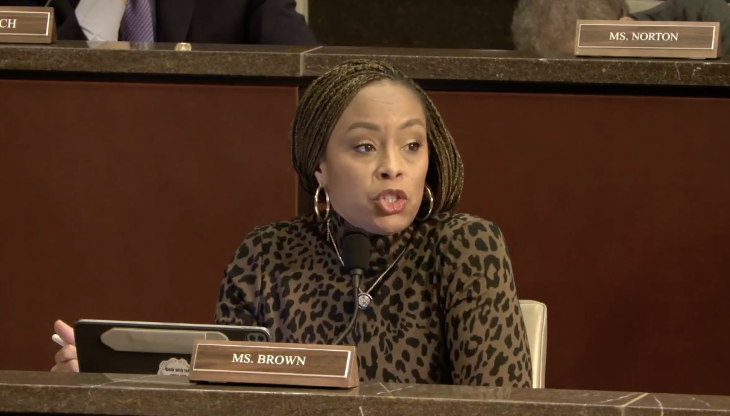

During a hearing of the House Committee on Oversight focused on the Jeffrey Epstein files, Rep. Shontel Brown delivered remarks criticizing both the structure of the meeting and the broader handling of the case by the federal government. Her comments centered on transparency, legal compliance, and the treatment of survivors, rather than on individual political figures.
Brown opened by questioning the purpose of the hearing, describing it as political theater rather than a genuine effort to uncover new information about Epstein’s crimes. She emphasized that Democratic members of the committee have consistently supported hearing from anyone with relevant knowledge, regardless of party or status. As an example, she noted that former President Bill Clinton and former Secretary of State Hillary Clinton had offered to cooperate by submitting sworn statements, an offer she said was declined by the committee’s majority.
According to Brown, the hearing instead focused on holding two private citizens in contempt, despite their stated willingness to cooperate and their public support for releasing all Epstein-related records. She argued that this approach distracted from what she characterized as a more serious issue: the Department of Justice’s failure to comply with federal law governing the release of the Epstein files.
Brown outlined specific legal deadlines established by the Epstein Files Release Act, which she said passed Congress with broad bipartisan support and was signed into law by President Trump. Under the statute, the Department of Justice was required to release the Epstein files by December 19, 2025. As of the hearing, she said, more than a month had passed beyond that deadline, yet only a small fraction of the records had been made public.
She described the partial release as inadequate, noting that only approximately 1 percent of the material had been disclosed. In her remarks, Brown argued that this level of disclosure did not meet the law’s transparency requirements. She also raised concerns about the nature of the released documents, pointing to extensive redactions that she characterized as unusual and potentially unlawful.
In addition to the document release, Brown highlighted another statutory requirement: a report from the Department of Justice to Congress explaining its compliance with the law. That report, she said, was due by January 3, 2026. At the time of the hearing, she stated that Congress had not received it.
Brown argued that if the committee’s goal were truly oversight and accountability, its focus would be directed toward the Department of Justice and the attorney general. She questioned why no subpoena had been issued to the attorney general, why no hearing had been scheduled to examine the missed deadlines, and why the extensive redactions had not been formally addressed.
Throughout her remarks, Brown framed the situation as a failure of institutional responsibility rather than a partisan dispute. She warned that focusing on contempt votes against cooperating individuals risked diverting attention from what she described as noncompliance by a federal agency. She also stressed that delays and limited disclosures ultimately affect survivors, whom she said deserve full transparency and accountability.
Brown concluded by urging the committee to shift its efforts toward enforcing the law, releasing the remaining files, and prioritizing justice over political conflict. She then yielded her remaining time to the ranking member.
Source: Congresswoman Shontel Brown on YouTube: “Rep. Brown’s full remarks during the Committee on Oversight’s Hearing on the Epstein files”



