
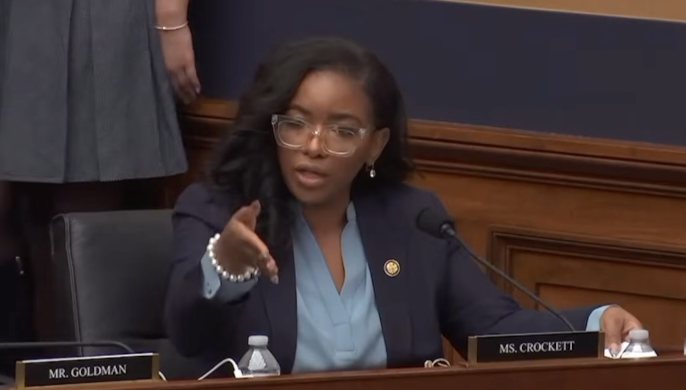

In a House committee hearing, Rep. Jasmine Crockett questioned a former federal prosecutor about the investigation into President Donald Trump, using the exchange to focus on the legal record surrounding Trump’s conduct before and after the 2020 election. Rather than debating political motives, Crockett framed her remarks around court rulings, documented evidence, and findings laid out in official reports.
Crockett began by noting that Republican members of the committee did not spend significant time disputing Trump’s underlying conduct or criminal exposure. Instead, she argued, their questioning largely focused on whether the prosecutor had been properly authorized to conduct the investigation. The witness responded that his appointment was consistent with longstanding legal precedent and supported by prior Supreme Court decisions, a position that has been argued in court filings.
From there, Crockett outlined what she described as a broader pattern of legal issues involving Trump. She referenced the number of allegations brought across multiple jurisdictions and pointed to Trump’s criminal convictions, emphasizing that those outcomes followed jury trials where evidence was presented and evaluated. She argued that these facts made it unreasonable, in her view, to treat allegations about January 6, 2021, as implausible or unprecedented.
A central point of Crockett’s remarks focused on language from the special counsel’s report addressing presidential immunity. She quoted a passage stating that Department of Justice policy prohibits the indictment and prosecution of a sitting president, regardless of the seriousness of the alleged crimes or the strength of the evidence. According to the report, prosecutors believed that, if not for Trump’s election and return to the presidency, the admissible evidence would have been sufficient to secure and sustain a conviction at trial. Crockett interpreted this to mean that Trump’s candidacy and victory effectively halted a prosecution that was otherwise expected to proceed.
The exchange also addressed events surrounding January 6. Crockett challenged what she described as efforts to downplay or reinterpret the attack on the U.S. Capitol. She cited testimony indicating that some members of Congress feared for their safety that day and referenced deposition excerpts describing lawmakers’ reactions during the attack. She also noted that phone records of certain members were subpoenaed, not because of party affiliation, but because investigators determined they were relevant to the inquiry.
Turning to the election itself, Crockett asked the witness to confirm several factual points: that Trump lost the 2020 election to Joe Biden, that dozens of state and federal courts found no evidence of widespread election fraud, and that senior Trump administration officials acknowledged the loss. The witness agreed with those statements. Crockett further summarized findings that Trump pressured state officials, supported alternate elector plans, and encouraged supporters to “fight like hell,” actions that culminated in violence at the Capitol.
She concluded by emphasizing that responsibility for January 6 extended beyond one individual. Crockett noted that 147 Republican members of Congress voted to overturn the 2020 election results and argued that accountability should be based on evidence and documented actions, not political affiliation.
Source: Congresswoman Jasmine Crockett YouTube:
“Rep. Jasmine Crockett: Trump Ran for President to Avoid Prison”



