
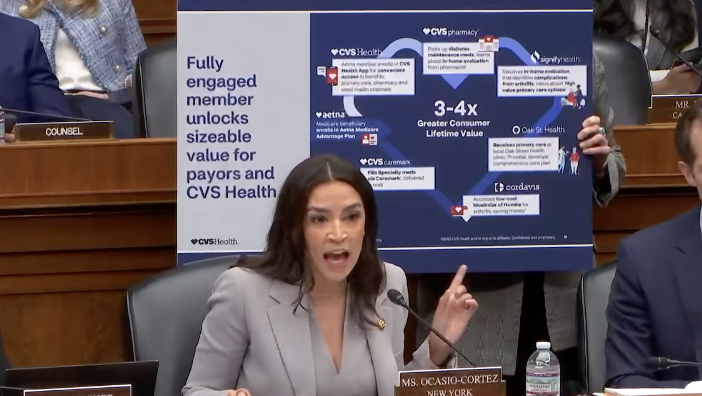

During a congressional hearing on health care oversight, Rep. Alexandria Ocasio-Cortez questioned CVS Health’s business model, focusing on the company’s extensive vertical integration and its implications for patients. Her remarks centered on how consolidation within the health care industry may affect costs, competition, and access to care.
Ocasio-Cortez began by establishing the scope of CVS Health’s operations through a series of questions to CEO David Joyner. She noted that CVS owns Aetna, one of the nation’s largest health insurance providers, as well as Oak Street Health clinics, CVS pharmacies, and CVS Caremark, a major pharmacy benefit manager (PBM). CVS Caremark processes close to 30 percent of all prescriptions in the United States, giving it a significant role in determining how much patients pay for medications.
To illustrate how this structure works in practice, Ocasio-Cortez referenced an example CVS itself used in an investor call. In that scenario, a patient with Aetna insurance visits an Oak Street Health clinic, receives a prescription from a doctor employed by the CVS-owned clinic, and fills that prescription at a CVS pharmacy. The pricing and reimbursement for that medication are influenced by multiple CVS-owned entities, including the insurer, PBM, pharmacy, and, in some cases, a drug manufacturer also tied to the company. Ocasio-Cortez described this as a “captive” model, where a patient remains within a single corporate ecosystem for nearly every step of care.
When asked whether this level of integration constituted excessive market concentration, Joyner disagreed, arguing that the model benefits consumers by improving coordination and efficiency. Ocasio-Cortez countered that while the structure may be profitable and streamlined for CVS, it raises concerns about reduced competition and higher costs for patients. She cited findings from the Federal Trade Commission suggesting that vertically integrated health care companies may charge more for medications filled within their own systems, including large markups for specialty drugs used to treat conditions such as cancer and HIV.
Ocasio-Cortez framed her critique as one that could resonate across ideological lines, noting that concerns about monopolies are not limited to any single political philosophy. She argued that when insurers, pharmacies, PBMs, and care providers are owned by the same parent company, there is a greater risk of self-dealing and limited consumer choice. In such systems, she suggested, companies may have incentives to steer patients toward in-house services, even if less expensive or more appropriate options exist elsewhere.
The discussion also touched on regulatory safeguards such as the Affordable Care Act’s medical loss ratio requirements, which mandate that insurers spend a large share of premium dollars on patient care. Ocasio-Cortez questioned how those safeguards function when the insurer also owns many of the entities providing that care, effectively paying itself across different parts of the system.
Drawing a historical parallel, she compared the current health care landscape to the banking industry prior to the Great Depression, when high levels of consolidation contributed to systemic risk. She referenced the Glass–Steagall Act, which separated commercial and investment banking, as an example of how lawmakers previously addressed excessive concentration. While not proposing a specific bill during the hearing, she suggested that Congress should consider whether similar structural reforms are needed in health care to restore competition.
Ocasio-Cortez concluded by urging lawmakers to align health policy with the principle of fair competition, emphasizing that oversight and potential reforms should focus on ensuring affordability, transparency, and patient choice. Her remarks highlighted an ongoing debate in Congress about how consolidation in the health care industry affects consumers and whether existing laws adequately address the balance between efficiency and market power.
Source: Congresswoman Alexandria Ocasio-Cortez



