

Staff at Norway’s largest women’s health organisation say they are seeing a rise in the number of women reporting domestic abuse and sexual assault ahead of the upcoming rape trial of a member of the Norwegian royal family, with advocates hoping the case will help break long-standing taboos.
Marius Borg Høiby, the 28-year-old son of Crown Princess Mette-Marit, is scheduled to stand trial in February on 32 criminal charges. The allegations include four counts of rape, domestic abuse of a former partner, and the illegal filming of multiple women without their knowledge or consent.
Høiby’s attorney, Petar Sekulic, has said his client denies all charges of sexual abuse and most of the allegations related to violence. Sekulic said Høiby plans to present his own detailed account of events during the trial. If convicted of the most serious charges, Høiby could face up to 10 years in prison.
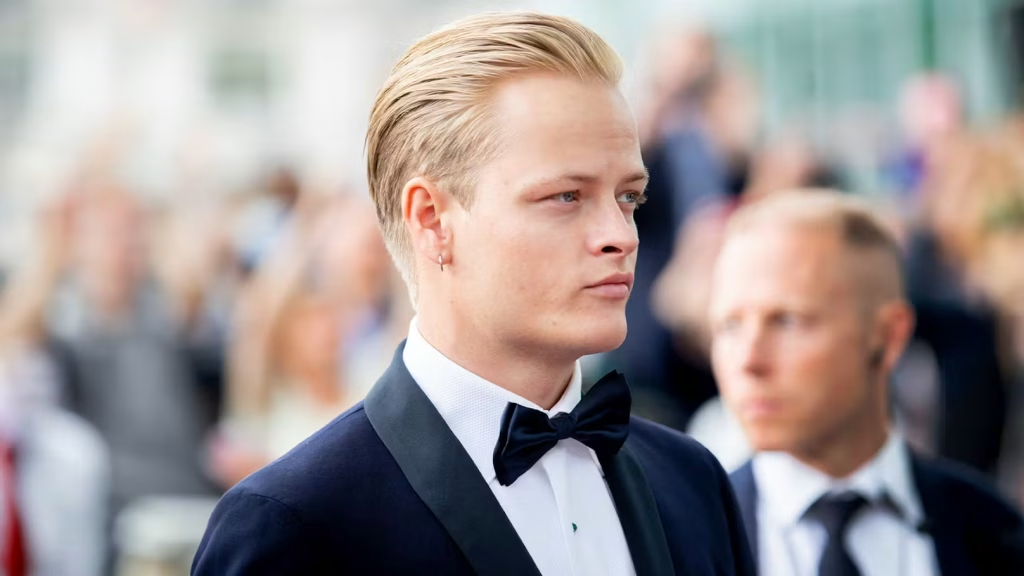
Høiby is not a formal member of the royal household but is the son of Mette-Marit and the stepson of Crown Prince Haakon, Norway’s heir to the throne.
May Britt Buhaug, secretary general of the women’s public health organisation Sanitetskvinnene, said staff at the group’s women’s health centres have recorded a noticeable increase in women reaching out for help.
“Staff at our women’s health centres have seen an increase in women who make contact to ask for help and advice after experiences of violence and sexual assault,” Buhaug said. “Media coverage of cases such as Høiby’s lower the threshold to ask for help. That women ask for help more easily is a positive effect. Openness breaks taboos.”
Buhaug added that her organisation expects the number of disclosures to rise further once the trial begins.
Statistics from the Norwegian Centre for Violence and Traumatic Stress Studies show that one in 10 women in Norway has experienced serious violence from an intimate partner.
“Although tragic, it seems that this case can contribute to break the silence around intimate partner violence and rape,” Buhaug said.
The allegations against Høiby have also reverberated beyond public health circles. A recently published book — which Høiby unsuccessfully sought to block — claims he sold drugs on the streets of Oslo. He has denied those allegations.
The steady stream of negative headlines has energized Norway’s republican movement, which opposes the monarchy. King Harald V, who has ruled since 1991, is now 88. Due to primogeniture laws in place until 1990, his second child, Haakon, is next in line to the throne rather than his elder daughter, Märtha Louise.
Craig Aaen-Stockdale, leader of the advocacy group Norge som republikk, said membership in the organization has more than tripled over the past two years, largely driven by the accusations against Høiby.
“In an otherwise democratic, egalitarian and liberal country, the Norwegian royal family occupies a blind spot and has traditionally enjoyed high levels of support,” Aaen-Stockdale said. “Many Norwegians are now reconsidering their position on the royal family, which was previously viewed as relatively harmless.”



