

For years, Janessa Goldbeck imagined worst-case scenarios most Americans preferred to dismiss as alarmist fiction. Military coups. Troops in city streets. National Guard units deployed not for disasters, but for politics.
Then Donald Trump returned to power — and the nightmare crossed the line from theory into reality.
“It’s a little surreal to see something that we’ve been talking about and thinking about and stressing out about,” Goldbeck said in an interview from her home in San Diego, California. “When we first did War Game, the film, people asked if we were scaring folks. It doesn’t feel good to say I told you so.”
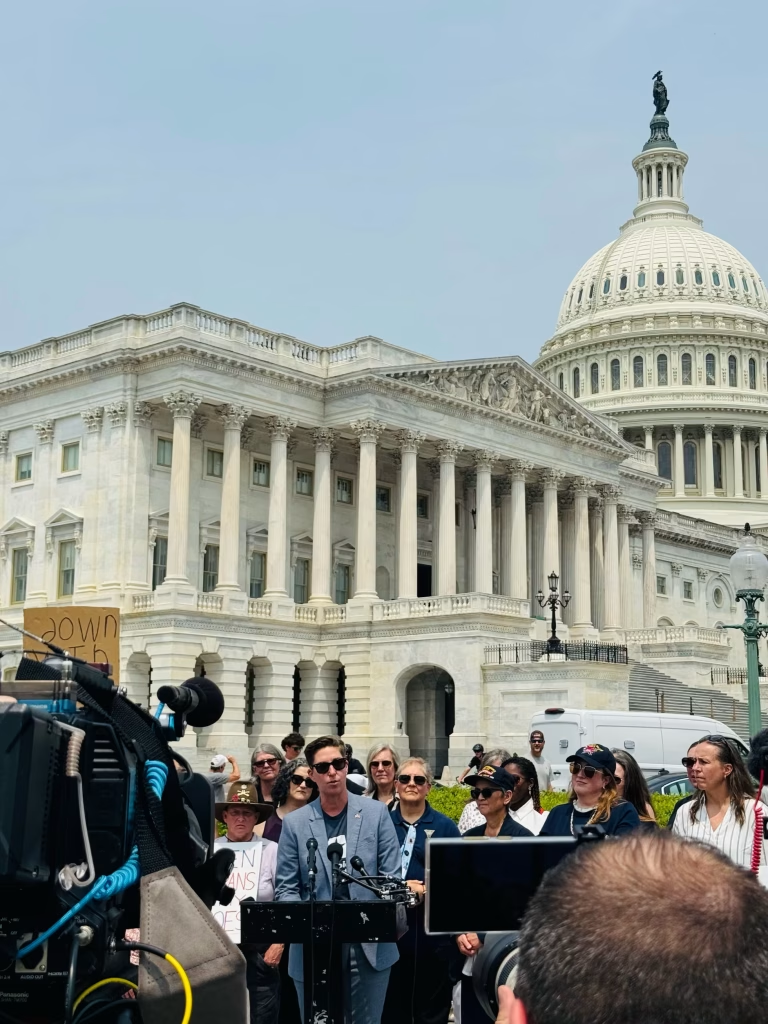
Goldbeck is the chief executive of the Vet Voice Foundation, an organization that mobilizes veterans and military families to defend democratic norms. Since Trump’s return to the White House in January, that mission has taken on an urgent, almost surreal relevance.
Trump has deployed thousands of National Guard troops to Chicago, Los Angeles, Memphis, New Orleans, and Washington, D.C., framing the move as immigration enforcement and public safety. Local officials have protested. Residents have marched. Courts have stepped in to restrict the Guard’s role in most cities to guarding federal property.
Goldbeck says she saw it coming the moment she read Project 2025.
Last year, Vet Voice quietly ran scenario exercises with governors’ offices, mayors, activists, and journalists, preparing for aggressive federal deployments under a second Trump term. Now those hypotheticals have become daily crisis calls.
“This year the vast majority of our work has been supporting litigation to halt or slow down National Guard deployments,” Goldbeck said. “We’re providing retired generals as expert witnesses, advising governors and mayors, and training activist groups on who the Guard is and who they are not.”
One misconception, she stressed, is that Guard members are eager participants in Trump’s political agenda.
“There’s a wide range of feelings,” she said. “A lot of boredom. A lot of anger. These folks didn’t sign up to be ICE. They didn’t sign up to police their neighbors or be dropped into places where governors and local police say, ‘We don’t want you here.’”
Many Guard members, she noted, earn more in their civilian jobs than while deployed and are pulled away from families for missions they see as pointless or politically toxic.
That frustration turned deadly last month when two West Virginia National Guard members were ambushed near the White House. Twenty-year-old Sarah Beckstrom was killed. Her colleague survived.
Goldbeck doesn’t mince words about responsibility.
“Is the president putting these folks in danger unnecessarily?” she asked. “Absolutely yes. They’re not trained for these missions, and they’re targets of opportunity for anyone who wants to create chaos.”

Oct 28, 2025; Washington, DC, USA; United States National Guard troops patrol along the tidal basin near the Jefferson Memorial and the Washington Monument, seen in the distance, in Washington, DC, on Tuesday, October 28, 2025. Mandatory Credit: Jack Gruber-USA TODAY via Imagn Images
Then there’s the humiliation. In Washington, Guard members have been photographed picking up trash, assisting commuters, and feeding squirrels.
“One guardsman told his mom they’re calling us the national gardeners online,” Goldbeck said. “This is a combat vet. That’s humiliating. It shows a deep disdain for people in uniform.”
Goldbeck fears these deployments are part of something larger: an effort to normalize military presence in civilian life ahead of the next election.
“I absolutely think this president wants to remain in power for as long as he can,” she said. “My fear is this is a lead-up to using the Guard or even the military around the next election cycle. That’s not hypothetical. It’s been talked about openly by senior officials.”
To Goldbeck, elections with troops in the streets aren’t just troubling. They’re authoritarian.
Her own path to this moment defies stereotypes. Raised in San Diego by vegetarian pacifist parents, she studied journalism and African studies at Northwestern University before becoming a leader in the Darfur advocacy movement. Exposure to the gap between humanitarian workers and security forces pushed her toward the Marine Corps at age 25 — a decision that horrified her parents far more than when she came out as gay.
Goldbeck served seven years as a Marine Corps officer, advocating for women and LGBTQ service members while training allied forces overseas. She left the service in 2019, citing her mother’s illness and Trump’s election.
“I couldn’t stay silent in uniform,” she said.
That silence-breaking led to a congressional run, then to leadership of Vet Voice, which now represents millions of veterans and military families. The group has fought to protect public lands, defend abortion access for service members, and safeguard voting rights for veterans — many of whom rely on absentee ballots due to disability or frequent moves.
Goldbeck sees those efforts converging under a single threat: the erosion of the military’s apolitical identity.
“This administration is doing generational harm to the professionalism of the armed forces,” she said.
She reserves particular scorn for Defense Secretary Pete Hegseth, who has railed against “woke” culture, mocked senior officers, and argued women should not serve in combat roles.
“Pete Hegseth is unequivocally the least qualified person who has ever led the Department of Defense,” Goldbeck said.
For Goldbeck, the stakes are no longer abstract. The war games are over. The pieces are on the board. And the troops, she warns, are already in the streets.



