
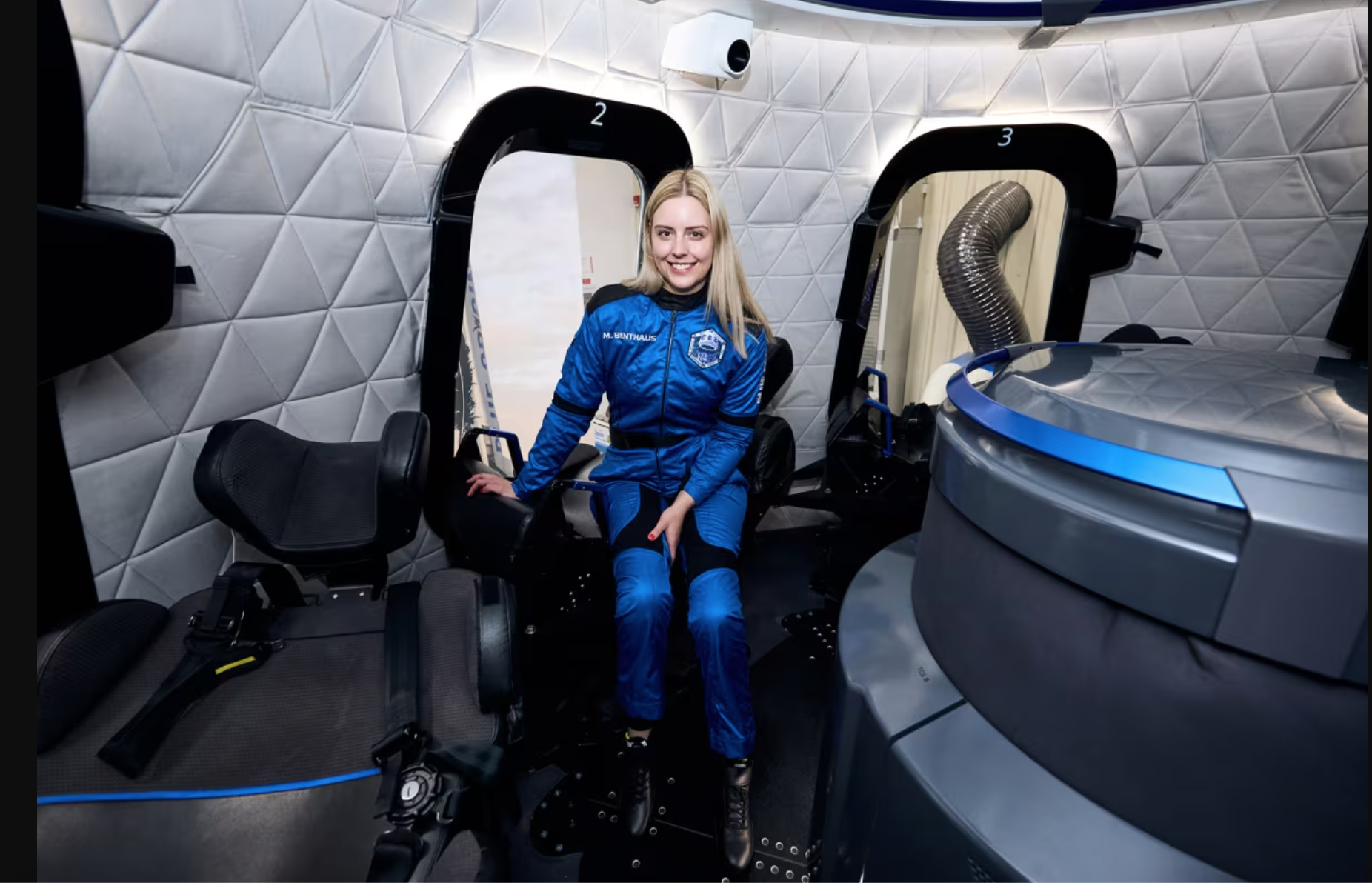
For decades, spaceflight has been sold as the final frontier — thrilling, dangerous, and reserved for bodies that meet an unforgiving ideal. On Saturday morning in West Texas, that image cracked wide open.
Michaela Benthaus, a 33-year-old German aerospace and mechatronics engineer, became the first wheelchair user ever to travel beyond the Kármán Line, the internationally recognized boundary of outer space. Her flight aboard a Blue Origin New Shepard capsule lifted off near Van Horn, Texas, carrying her and five crewmates more than 62 miles above Earth.
The mission, known as NS-37, lasted roughly 10 minutes. But its significance will echo far longer.
“I always wanted to go to space,” Benthaus said before the launch. “But I never really considered it something which I could actually do.”

Benthaus sustained a spinal cord injury in a mountain biking accident in 2018, an event that reshaped her body but sharpened her focus. Rather than retreat from adventure, she redirected her drive into engineering, research, and the kinds of challenges that don’t disappear when mobility changes.
Before securing her seat on the capsule, Benthaus wrestled with doubts that are all too familiar to people with disabilities. She questioned whether space was only accessible to those whose bodies could still approximate an able-bodied norm. A spinal cord injury, she wondered, might be “way too disabled.”
Saturday proved otherwise.
New Shepard’s rocket engines propelled the capsule to more than three times the speed of sound before cutting off, allowing the spacecraft to arc into suborbital space. At the top of the trajectory, Benthaus experienced several minutes of weightlessness as Earth curved below her.
To prepare, she used a custom strap to secure her legs before leaving her seat during microgravity — a solution she later said worked “quite well.” Rather than flipping through the cabin, Benthaus focused on the view.
“I did really love the view and the microgravity phase,” she said after landing. “But I also loved all the going up. That was so cool to feel every stage of going up.”
The flight wasn’t gentle. Passengers experienced intense G-forces, including up to 5Gs during descent — forces strong enough to test even seasoned flyers. Benthaus acknowledged before launch that it was unclear whether she would be able to return to her seat without help in zero gravity.
A fellow passenger, a former spaceflight executive and longtime friend, was trained to assist if needed. After the mission, he admitted the experience exceeded his expectations.
“It was more intense than I thought,” he said. “The movements are slower, but they’re more forceful.”
Benthaus plans to use the lessons from her flight to help improve accessibility for future space travelers with disabilities. Her mission also served a broader purpose: raising funds for spinal cord injury research through the nonprofit Wings for Life.
The reaction from the space community was swift and celebratory. NASA’s incoming administrator called the mission inspirational, writing that Benthaus had given millions a reason to look up and rethink what’s possible.
In an industry long defined by exclusion — economic, physical, and cultural — Benthaus’ flight reframed the question of who space is for. Not as a luxury for the perfect few, but as a frontier that expands when someone dares to insist they belong.
For ten minutes above the Earth, gravity loosened its grip. On old assumptions about who gets to go to space, it may never fully return.



