
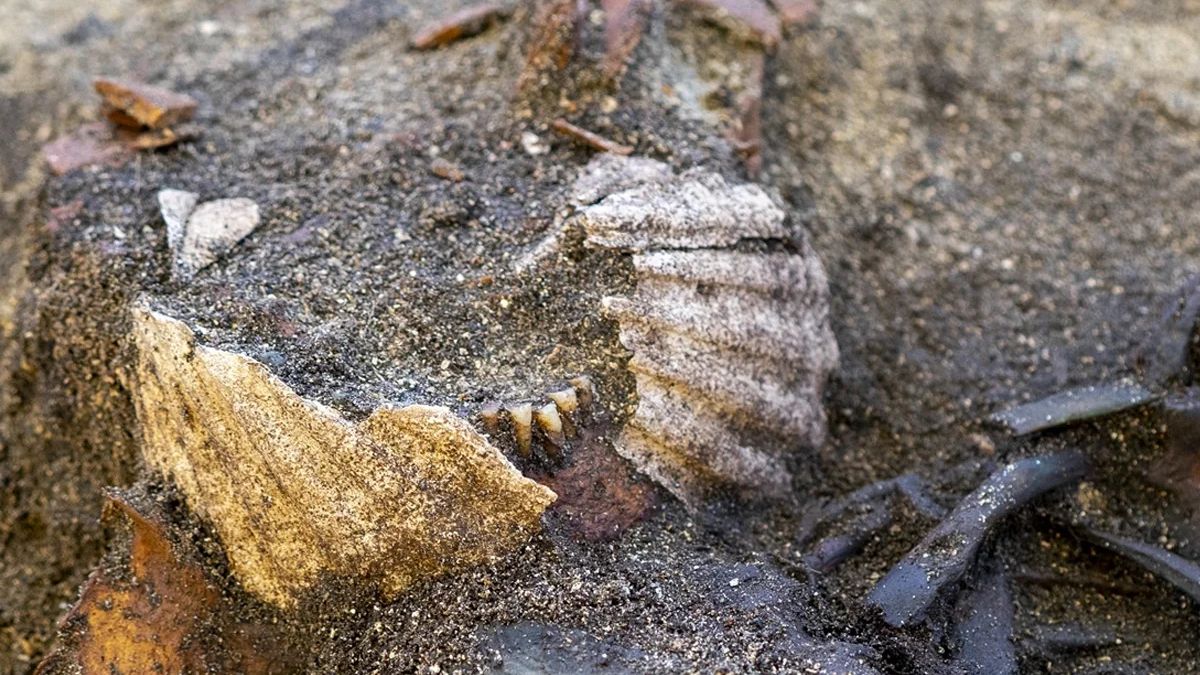
Norwegian archaeologists have been thrown for a loop after a curious burial site from the Viking Age was unearthed, revealing an ancient woman laid to rest with scallop shells obscuring her mouth – a puzzling practice never before recorded in the region. The striking discovery, made in Trøndelag County by metal detector enthusiast Roy Søreng, has researchers at the Norwegian University of Science and Technology scratching their heads over the strange ritual.
Raymond Sauvage, head engineer at NTNU’s Department of Archaeology and Cultural History, described the skeleton as belonging to a woman clad in classic Viking dress and adorned with jewellery dating back to the 9th century. ‘All signs point to her status as a free, likely married woman, possibly the lady of the local farm,’ he said. But it’s the pair of scallop shells, carefully covering her mouth with the curved sides outward, that has truly baffled experts.
Shell symbolism is murky territory, especially given that this practice hasn’t shown up in any pre-Christian Norwegian burials. While scallop shells are linked to St James and pilgrimage traditions in Medieval Europe, their appearance in a Viking grave is practically unheard of.

That’s not all – the burial was accompanied by an array of trinkets: two oval brooches fastened to the straps of her dress, a delicate ring buckle at her petticoat’s neckline, and even bird wing bones, which researchers believe might have carried hidden meaning for mourners present at her funeral.
The site itself has become a hotspot for historical intrigue. An earlier dig yielded the bones of an individual from two or three generations before the woman, raising hopes of finding family connections through advanced DNA analysis. Sauvage and his team are determined to get to the bottom of the mystery, preserving artefacts, dating samples, and exploring any ties between Trøndelag’s ancient residents.
With every new shovel of earth, this enigmatic grave pushes scientists to rethink Viking mortuary customs – and the secrets those bygone Norwegians may have taken to their graves.



