
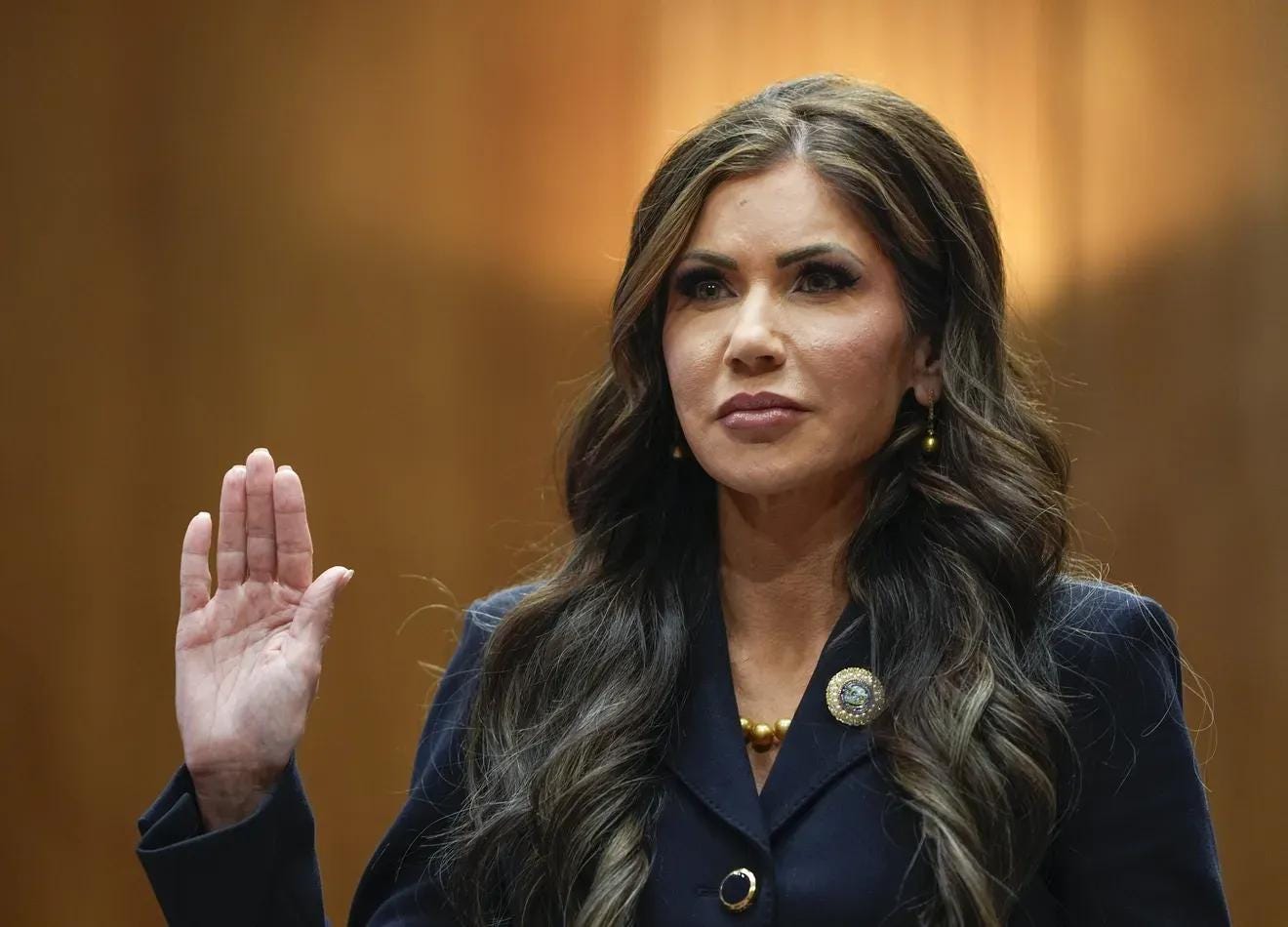
A nearly $1 billion Homeland Security contract meant to encourage migrants to leave the United States voluntarily is now at the center of a widening controversy over political favoritism, fast-tracked deals, and blurred ethical lines inside the Trump administration.
According to records reviewed by The Washington Post, the Department of Homeland Security rushed through a massive contract for a program known as Project Homecoming — awarding it to a company led by a donor to a pro-Trump nonprofit, while political appointees allegedly helped steer the process behind the scenes.

Yessenia Ruano, a former Milwaukee Public Schools teacher’s aide who self-deported to El Salvador, holds her U.S. employee authorization card and Wisconsin instruction permit, October 29, 2025, in Tamanique, El Salvador.
The contract went to Salus Worldwide Solutions, an Arlington-based firm incorporated in June 2023 that had never before held a federal contract. Project Homecoming offers migrants cash bonuses, free flights, and a so-called “concierge service” at airports to facilitate what the administration calls “self-deportation,” following an executive order signed by President Donald Trump on the first day of his second term.
The speed and structure of the deal raised alarms.
Although DHS said it paused immediate enforcement action for 90 days to allow negotiations, internal emails obtained by The Post show that political appointees — not just career procurement officials — coordinated aspects of the process. A lawsuit filed by a competing aviation firm alleges DHS shared nonpublic information with Salus, giving it an unfair advantage.
At the center of the deal is William Walters, Salus’s CEO and a donor to the America First Policy Institute, a pro-Trump nonprofit that does not publicly disclose its donors. Walters was honored with a “Patriot Award” at the group’s 2024 gala. He also donated $10,000 to a pro-Trump super PAC run by allies of Homeland Security Secretary Kristi Noem.

Walters leads another company, Daedalus Aviation, which separately received a $140 million DHS contract to purchase six Boeing 737 aircraft for deportation flights — a deal The Post reported on last week.
Federal law bars government contractors from making political donations, but Walters and his companies were not contractors at the time of the contributions, and the restriction does not apply to nonprofit donations.
Walters declined to comment through his attorney, citing ongoing litigation.
Salus’s role is now being challenged in federal court by CSI Aviation, a company that previously operated deportation flights for DHS. CSI alleges the agency conducted an “impossibly short” bidding process with only a handful of preselected vendors, excluding others that expressed interest.
According to court filings, DHS officials exchanged at least 40 emails with Salus between February and April, discussing budget figures and program design. An internal investigation allegedly found that Salus had an unfair advantage by helping shape the contract it later won — findings cited in filings that remain under seal.
After that investigation, DHS abandoned plans for a sole-source award and instead launched a rushed, abbreviated competition. Six vendors were given documentation on a Friday in mid-May and told to submit proposals by 10 a.m. the following Monday.
Emails indicate that Rob Law, DHS undersecretary for policy and a former employee of the America First Policy Institute, helped coordinate the process. One message from DHS Chief Procurement Officer Paul Courtney stated that “Rob Law is leading this effort for the front office,” referring to the agency’s political leadership.
DHS denied Law’s involvement.
“DHS follows strict ethics and recusal protocols, and there was no role for Mr. Law in this procurement action,” the agency said in an unsigned statement, adding that its contracting decisions are controlled by career professionals and subject to oversight.
The agency declined to answer specific questions, citing ongoing litigation, and said protests over large contracts are common. Its general counsel’s office said it reviewed the process and found “zero indication” of wrongdoing.

9/17/19 1:07:14 PM — Washington, DC, U.S.A — Corey Lewandowski, former campaign manager for President Trump, appears before the House Judiciary committee during a hearing on Presidential Obstruction of Justice and Abuse of Power on Sept. 17, 2019 in Washington alongside empty chairs of Rick Dearborn, former White House Deputy Chief of Staff, and Robert Porter, former Assistant to the President, both refused to appear before the committee under subpoena. — Photo by Jack Gruber, USA TODAY Staff ORG XMIT: JG 138260 Lewandowski 9/17/2019 (Via OlyDrop) Xxx Jg 138260 Lewandowski 9 17 2019 Jmg 7279 Jpg A Usa Dc
The Project Homecoming deal adds to a growing list of DHS spending decisions that have drawn scrutiny from congressional Democrats. Other controversial awards include a $77 million advertising contract to a firm linked to former Trump campaign manager Corey Lewandowski, $143 million routed through a company connected to the husband of DHS spokeswoman Tricia McLaughlin, and $200 million spent on two Gulfstream private jets for Secretary Noem’s use.
Whether Noem personally approved the fast-track process remains unclear. Records show officials prepared a memo to notify her, but no response appears in the documents reviewed by The Post.
For now, the billion-dollar contract sits under a legal cloud, sealed filings piling up as questions linger about who knew what — and when.
What was billed as an orderly, voluntary exit program has instead become a case study in how federal money moves when politics, loyalty, and urgency collide behind closed doors.



