
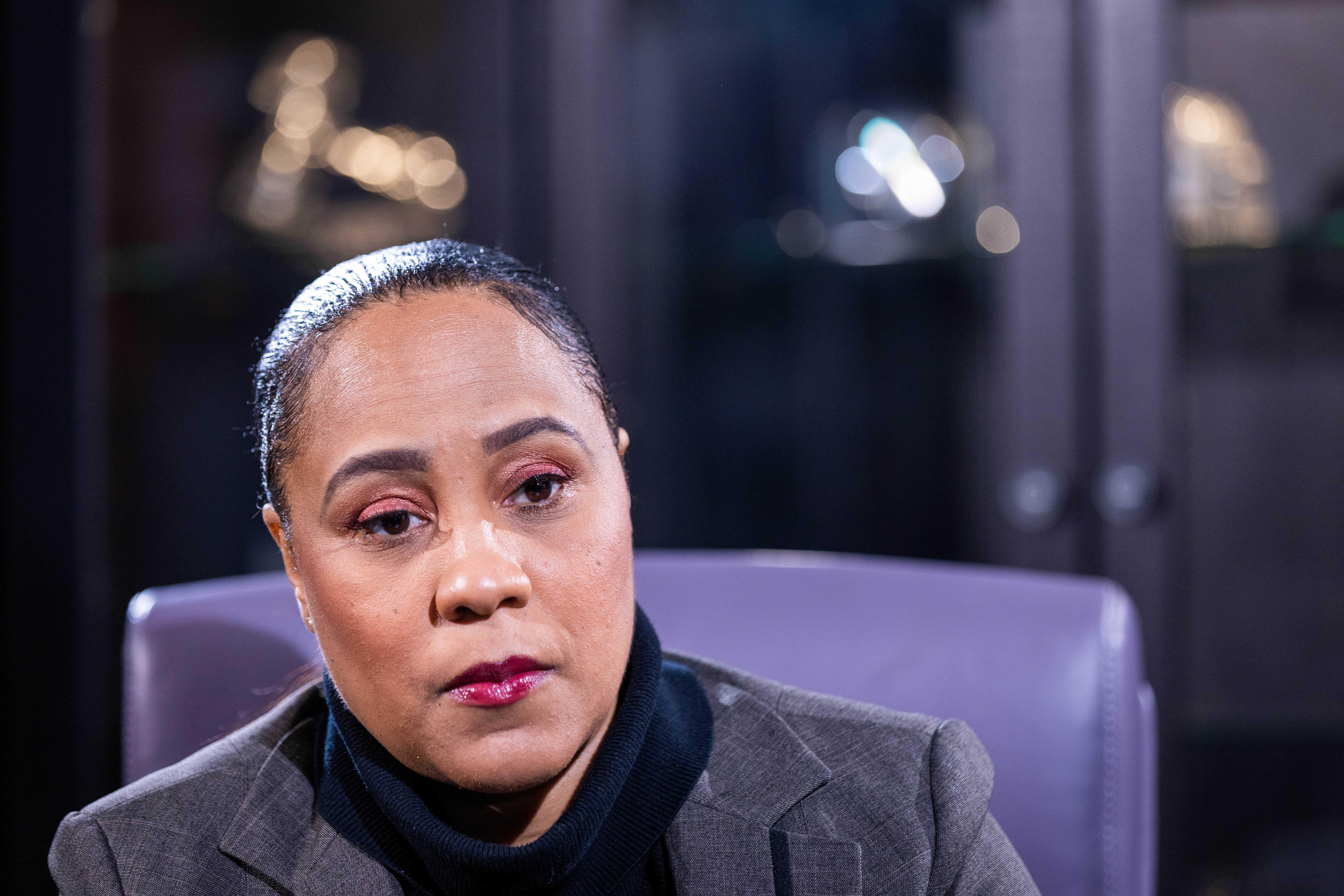
Fani Willis did not come to the Georgia Statehouse to apologize.
The Fulton County district attorney who once led the most ambitious criminal case against Donald Trump instead arrived swinging Wednesday, clashing with Republican lawmakers investigating her decision to prosecute the former president and his allies for trying to overturn Georgia’s 2020 election.

March, 1, 2024; Atlanta, GA, USA; Fulton County District Attorney Fani Willis looks on during a hearing on the Georgia election interference case, Friday, March, 1, 2024, in Atlanta. The hearing is to determine whether Fulton County District Attorney Fani Willis should be removed from the case because of a relationship with Nathan Wade, special prosecutor she hired in the election interference case against former President Donald Trump. Mandatory Credit: Alex Siltz/Pool via USA TODAY NETWORK
In a fiery appearance before a GOP-led state senate committee, Willis accused Republicans of staging a political spectacle designed to intimidate prosecutors and rewrite the history of her investigation.
“You’re trying to create QAnon committees that will judge prosecutors,” Willis snapped, dismissing the hearing as a “damn joke” and rejecting claims that she targeted Trump before taking office in January 2021.
“I didn’t know he was going to commit a crime prior to me taking office,” she said. “That’s factually impossible.”
The hearing followed the collapse of Willis’s sweeping racketeering case against Trump, which accused him and more than a dozen allies of running a criminal enterprise to subvert Georgia’s election results through fake electors, pressure campaigns against election officials, and attempts to access voting machines.
Several defendants had already pleaded guilty before the case unraveled.
Willis was ultimately disqualified after a prolonged legal battle over her relationship with Nathan Wade, a special prosecutor she hired who later became a romantic partner. After her removal, the case was reassigned to Peter Skandalakis, head of the Prosecuting Attorney’s Council of Georgia, who recommended dismissal. A judge agreed last month, ending what had been a historic prosecution.
But Republicans weren’t done.
At Wednesday’s hearing, lawmakers pressed Willis over her motives, her hiring decisions, and allegations that she coordinated with President Joe Biden’s administration and congressional investigators probing the Jan. 6 attack.
Willis pushed back hard.
“You have been trying to intimidate me for five years,” she told the committee, accusing Republicans of working in concert with Trump and his allies to pressure her office. She cited thousands of threats, repeated swatting incidents at her home, and racial slurs hurled at her after securing the grand jury indictment.
“I’m not Marjorie Taylor Greene,” Willis said. “I’m not going to quit in a month after someone threatened me.”
She challenged lawmakers to investigate the harassment she endured instead of her prosecutorial decisions.
“Why didn’t you investigate how many times my house has been swatted?” she asked. “How many times they’ve called me the [racial epithet]?”
Willis defended her hiring of Wade, saying her office was overwhelmed with major cases and that she made the call she was elected to make.
“Every lawyer I had with that level of experience had a huge project,” she said. “The people of Fulton County elected me to make that decision, and I did.”

March 15, 2024; Atlanta, GA, USA; The Lewis R.Slaton Courthouse is seen on Friday, March 15, 2024 in Atlanta, GA. Fulton County Superior Court Judge Scott McAfee who is overseeing the Georgia election interference case against former president Donald Trump and his allies ruled that Fulton County District Attorney Fani T. Willis (D) could continue with the prosecution but only if Nathan Wade, the lead prosecutor she appointed and had a romantic relationship with, exits the case. Mandatory Credit: Elijah Nouvelage/Pool via USA TODAY NETWORK
Republicans pointed to Wade’s billing records showing travel to Washington, D.C., suggesting coordination with federal officials. Willis dismissed the insinuation, saying Wade likely went to gather information on defendants she later indicted.
“You’re trying to imply wrongdoing where none exists,” said her attorney, former Georgia governor Roy Barnes, who repeatedly urged Willis not to answer questions he called irrelevant and improper.
“This has always been a witch hunt,” Barnes said, visibly frustrated. At another point, he asked, “What are we doing?” noting that the committee veered into relitigating the 2020 election rather than focusing on professional conduct.
Despite the case’s dismissal, Willis made clear she stands by her actions.
“I took an oath to do the right thing,” she said. “People came into my community and committed a crime, and I indicted them. And if someone else comes into my community and commits a crime, I will indict them again.”
For Republicans, the hearing was an autopsy of a prosecution they long called politically motivated. For Willis, it was something else entirely: a public line in the sand.
The Trump case may be over. The fight over who gets blamed — and who gets silenced — clearly is not.



