
Sarah Palin’s long-running legal war with The New York Times hit another dead end Monday, when a federal judge rejected her bid for a new libel trial and refused her request that he remove himself from the case.
U.S. District Judge Jed S. Rakoff ruled that Palin had already received a fair trial and that there was no legal basis to reopen the case or question his impartiality. His decision leaves intact a jury’s verdict from last April finding that the Times did not libel the former Alaska governor and Republican vice presidential nominee in a 2017 editorial.
“I was scrupulous in affording Ms. Palin a fair trial,” Rakoff wrote, pushing back on claims that his conduct tainted the proceedings.

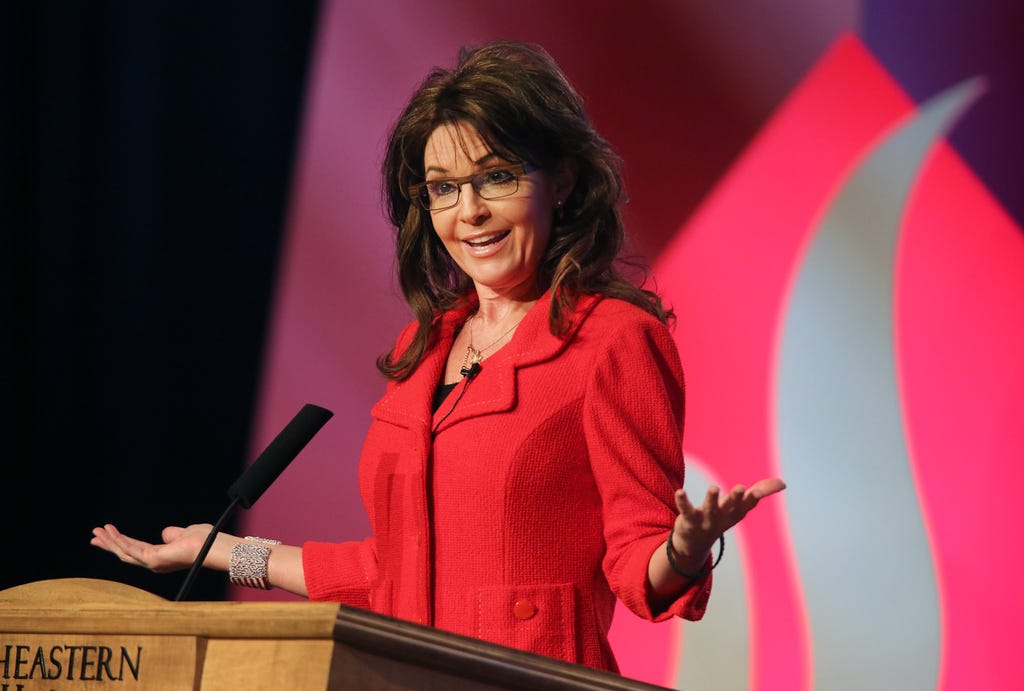
Sarah Palin, former governor of Alaska, speaks to attendees during the second day of AmericaFest 2021 hosted by Turning Point USA on Sunday, Dec. 19, 2021, in Phoenix. Turning Point USA Day 2, Sarah Palin
It was the second jury to reach the same conclusion. Palin’s lawsuit has already been through one trial and one appeal, after the 2nd U.S. Circuit Court of Appeals ordered a retrial following Rakoff’s unusual move in February 2022. During jury deliberations in the first trial, Rakoff announced that he intended to dismiss the case because Palin had failed to prove the Times acted with actual malice — a key standard in libel cases involving public figures.
Despite the appellate court’s intervention and a second trial, the outcome did not change.
Rakoff also rejected Palin’s demand that he recuse himself, noting that trial transcripts showed he frequently ruled in her favor and gave her ample opportunity to present her case.
The New York Times welcomed the ruling.
“The jury reached the right verdict in rejecting Palin’s libel claim, and today’s decision reaffirms the jury’s decision,” said newspaper spokesperson Danielle Rhoades Ha in an emailed statement.

Sarah Palin, vice presidential hopeful with Republican candidate John McCain, speaks at the Asheville Civic Center on October 26, 2008. Imgj53hdf7 1
Palin filed the lawsuit in 2017, nearly a decade after she burst onto the national stage as Sen. John McCain’s running mate in the 2008 presidential election. The suit centered on a Times editorial published after Rep. Steve Scalise was wounded in a mass shooting at a congressional baseball practice in Virginia.
In that editorial, the Times wrote that Palin’s political action committee had helped fuel an atmosphere of violence prior to the 2011 shooting that critically wounded Rep. Gabby Giffords and killed six others in Arizona. The article referenced a map circulated by Palin’s PAC that placed stylized crosshairs over the districts of Giffords and other Democrats.
The Times corrected the editorial less than 14 hours after publication, acknowledging that it had incorrectly suggested a link between political rhetoric and the Giffords shooting and had mischaracterized the map.
At trial, former Times editorial page editor James Bennet offered a tearful apology to Palin, telling jurors he was tormented by the mistake and moved quickly to fix it after readers raised concerns.
Palin testified that the damage, in her view, had already been done. She said the editorial led to a spike in death threats and left her shaken and demoralized. A journalism major in college, Palin told jurors she understood the power of words — and the harm she believed the error caused.
But jurors ultimately sided with the newspaper, finding that while the editorial was flawed, it did not meet the legal threshold for defamation.
With Monday’s ruling, Palin’s case appears effectively over, closing the book on one of the most closely watched libel battles between a prominent political figure and a major American news organization.
After years of court hearings, appeals, apologies, and testimony, the verdict stands: the Times did not act with malice — and Palin does not get another day in court.



