
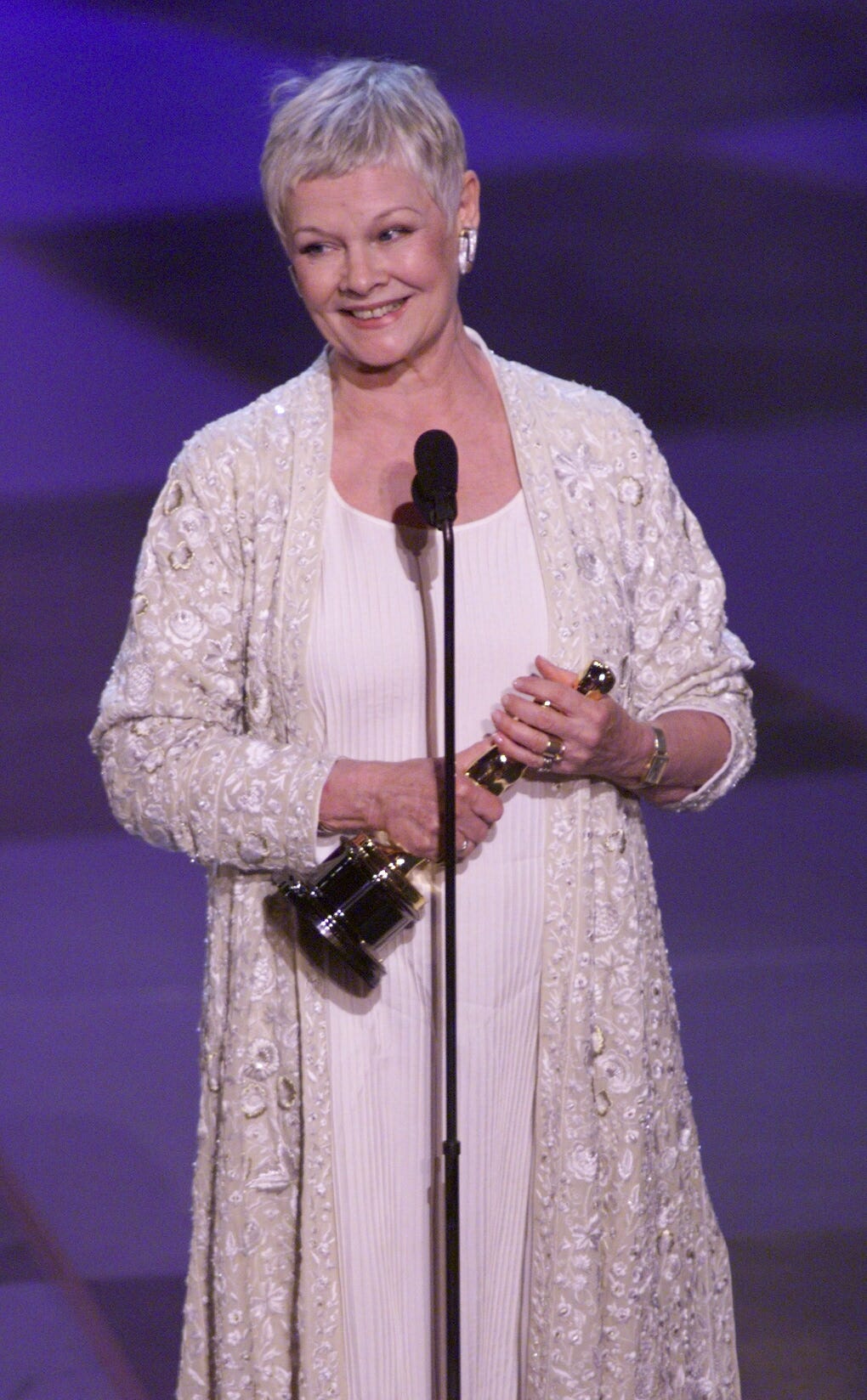
Judi Dench is facing an intense wave of public backlash after suggesting that Harvey Weinstein, the disgraced movie mogul convicted of multiple sexual assaults, has “done his time.” Her comments, made in a new interview with The Radio Times, have reopened old wounds and reignited criticism of Hollywood’s history of complicity with powerful abusers.
Dench, now 90, was among the earliest prominent actors to condemn Weinstein when accusations against him surfaced in 2017. At the time, she called his behavior “horrifying,” even as she acknowledged that he had played a major role in advancing her film career over two decades. She said then that she had been “completely unaware of these offenses.”

July 19, 2024; New York, NY, USA; Former media executive and producer Harvey Weinstein appears in Manhattan court. Mandatory Credit: Steven Hirsch/Pool via USA TODAY NETWORK
But her position has now shifted. Citing personal feelings about forgiveness, Dench said she believes Weinstein—who uses two walking sticks in prison—has effectively served his time. “I don’t know, to me it’s personal — forgiveness,” she said. “I knew Harvey and I knew him well and worked with him, and I had none of that experience — very fortunately for me.”
Weinstein, 73, is currently serving a 16-year sentence in California following his 2022 conviction on three counts of rape and sexual assault. His 2020 conviction in New York was overturned, and a retrial this year resulted in a mixed verdict: he was convicted of an assault but acquitted on several additional charges.
Dench’s remarks struck a nerve. On social media, critics accused her of ignoring the suffering of Weinstein’s many victims. One user wrote, “Ma’am, I need you to speak to his victims before you say these things.” Another lamented that her influence made the comments especially harmful: “These words reinforce the misogynistic reality we all live under and are a slap in the face of all abused.” A third called her stance a “stunning lack of compassion.”
Not all reactions were condemnatory. One defender described her comments as “personal and nuanced,” arguing that Dench was speaking only to her own experience and framing it through forgiveness rather than public condemnation.
The interview stirred further conversation when Dench revealed she maintains contact with Kevin Spacey, the exiled Hollywood star acquitted of sexual assault charges in a 2023 U.K. trial and cleared of separate allegations in a New York court. “Kevin has been exonerated and I hear from Kevin, we text,” she said.

Jun 11, 2017; New York, NY, USA; Host Kevin Spacey speaks at the 71st TONY Awards at Radio City Music Hall. Mandatory Credit: Robert Deutsch-Imagn Images
This is not Dench’s first time defending artists whose careers imploded amid sexual misconduct scandals. In a 2019 interview, she argued that Weinstein’s and Spacey’s creative legacies should not be erased entirely. “Are we just not going to see all those films that Harvey produced? You cannot deny somebody a talent,” she said then, likening calls to reject their work to avoiding Caravaggio or Noel Coward because of their personal transgressions.
Dench’s latest comments revive the cultural rift between those who separate art from the artist and those who say doing so erases the harm inflicted by powerful men. For many, the question is not simply whether Weinstein has “done his time,” but whose time—and whose pain—counts in that calculation.



