
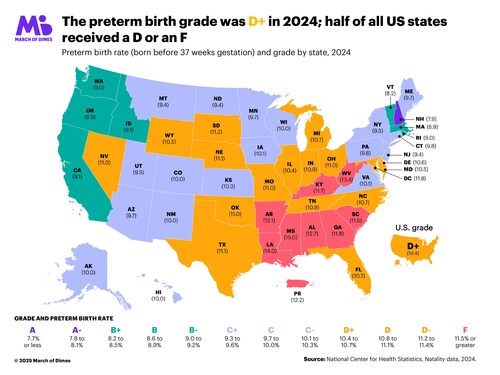
The United States has once again received a D+ grade for maternal and infant health in the 2025 March of Dimes Report Card—its fourth straight year at this dangerously low rating. For women and babies across the country, this grade is more than a statistic; it reflects a system that continues to fail mothers at every stage of pregnancy, childbirth, and postpartum life.
With a 10.4% preterm birth rate and persistent racial and economic disparities, the data highlights what women and advocates have been saying for years: America’s maternal health system is stuck in crisis.
Preterm Births Remain High—and Inequities Deepen
For the fourth year in a row, nearly 1 in 10 babies in the U.S. was born too soon. Preterm birth remains one of the greatest threats to infant survival and long-term health, yet the national rate has not budged.
The numbers are even more alarming for women of color. Babies born to Black mothers face a preterm birth rate of 14.7%, almost 1.5 times the national average. These inequities are not new—but the fact that they are worsening underscores systemic failings that disproportionately affect marginalized women.
Insurance status also plays a major role. Babies born to mothers covered by Medicaid experienced an 11.7% preterm birth rate, significantly higher than mothers with private insurance. Low-income women face both higher medical risk and deeper barriers to early and consistent prenatal care.
Pregnant Women Are Getting Care Later—and Sicker
The Report Card shows a fourth consecutive year of decline in early prenatal care. Nearly 25% of pregnant people did not begin care in the first trimester, often due to cost, lack of access, transportation challenges, or provider shortages.
At the same time, chronic conditions among pregnant women—such as hypertension and diabetes—are rising sharply. These conditions significantly increase the risk of preterm birth and severe maternal complications.
The infant mortality rate remains unchanged at 5.6 deaths per 1,000 births, with over 20,000 babies dying before their first birthday in 2023. Maternal mortality sits at 18.6 deaths per 100,000 births, with stark racial disparities: Black, American Indian/Alaska Native, and Pacific Islander mothers continue to die at two to three times the rate of white mothers.
A Patchwork of State Outcomes
The national numbers mask vast differences from state to state.
- 19 states improved, including South Dakota, which saw a notable 10% reduction in preterm births.
- 21 states worsened, with Washington, Michigan, Kentucky, Ohio, Virginia, Louisiana, and Connecticut among the hardest hit.
- Washington, D.C., saw an 8% increase, the steepest rise this year.
With so many regions lacking maternity care providers—or “maternity care deserts”—these state disparities reflect differences in access, economic stability, racial equity, and political priorities.
What Women Need: Access, Support, and Policy Change
March of Dimes leaders were blunt about this year’s findings: the U.S. maternal and infant health system is not improving, and in key areas, it’s slipping backward.
To address these failures, the organization is pushing a multipronged approach:
1. More research into preterm birth
March of Dimes is expanding its Prematurity Research Centers, including a new collaborative in Texas.
2. Bringing care directly to women
Mom & Baby Mobile Health Centers® offer prenatal and postpartum care in underserved communities—especially crucial in rural and low-income regions.
3. Strengthening national policy
Priority legislation includes:
- The Preventing Maternal Deaths Act
- Reauthorization of the PREEMIE Act
- Nationwide Medicaid postpartum expansion
- Increasing access to midwives and doulas
- Improved maternal mental health screening
- Expanded telehealth for rural maternity care
The Bottom Line
The U.S. is stuck in a maternal and infant health crisis—and women, especially women of color and those with lower incomes, continue to bear the heaviest burden. While the March of Dimes Report Card is a wake-up call, it also offers a roadmap: invest in early care, address chronic disease, expand insurance coverage, and eliminate the inequities that make pregnancy and childbirth far more dangerous than they should be.
Every mother and every baby deserves a healthy start. Right now, too many aren’t getting one.
Source: PR Newswire; March of Dimes Inc.



