
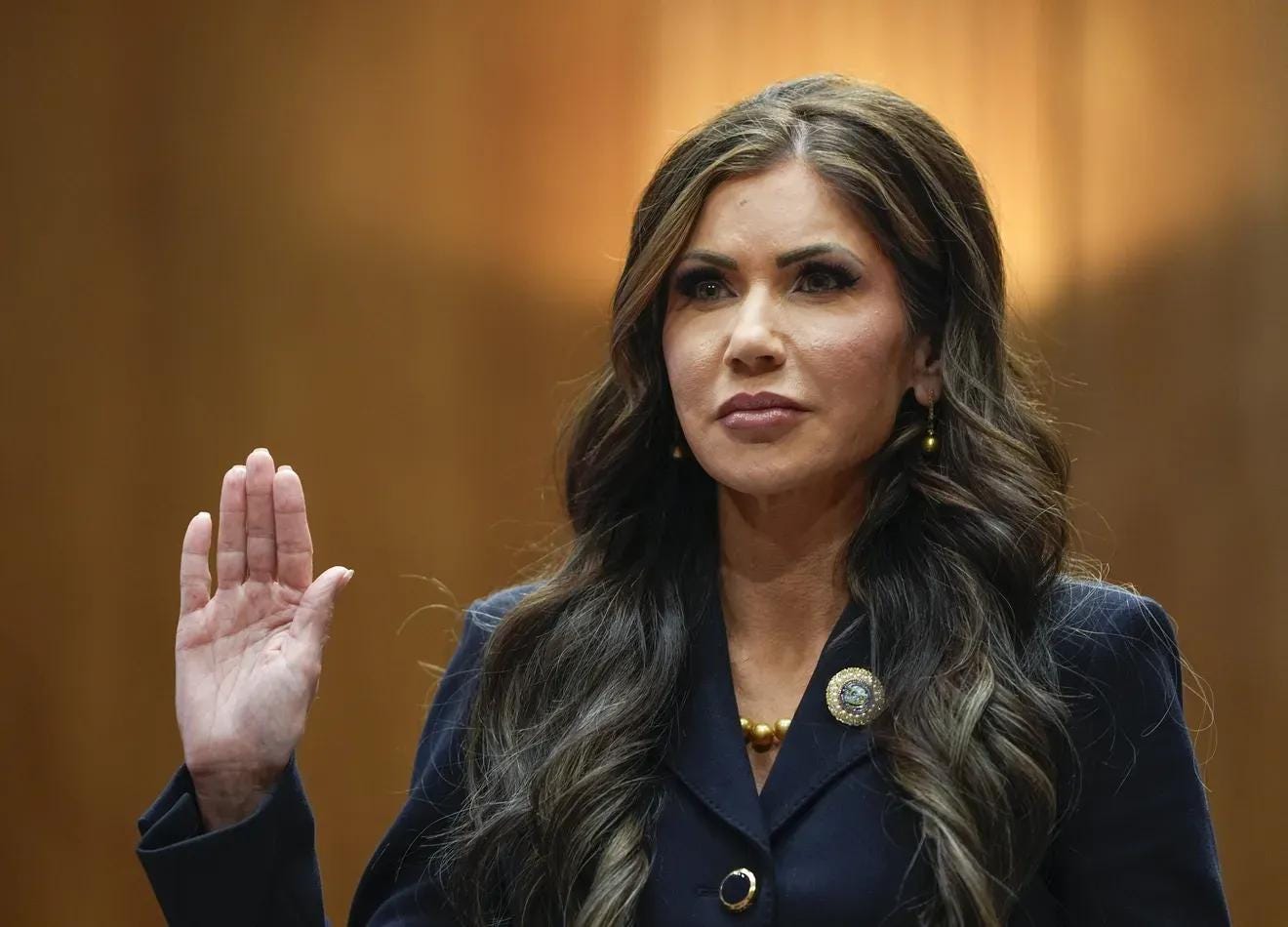
Following the reopening of the federal government, Homeland Security Secretary Kristi Noem announced $10,000 bonuses for select TSA officers who remained on duty during the 43-day shutdown. Her announcement came as the administration also promoted similar payments for air traffic controllers with perfect attendance. Although federal operations resume once a shutdown ends, the return to normal pay has historically been far from simple. Past shutdowns left employees waiting months or even years for full compensation due to complicated payroll systems and unresolved disputes over overtime. Unions, agency officials and workers may continue to grapple with the practical and financial fallout of the shutdown for some time.
Bonus Rollout Amid Complicated Pay Recovery

U.S. Secretary of Homeland Security Kristi Noem held a press conference in Bradenton Monday, Oct. 20, 2025, to highlight the department efforts in the first nine months of the Trump Administration.
Noem made her announcement at George Bush Intercontinental Airport in Houston, where she distributed the first round of bonus checks to TSA officers identified as having exceeded expectations during the shutdown. TSA staffing had recently been strained as many employees sought outside work to cover missed income. Although Noem emphasized exceptional service, she did not clarify the metrics used to evaluate performance. Her announcement occurred while other federal workers, especially air traffic controllers, faced an intricate process to recover lost wages. Transportation Secretary Sean Duffy said controllers would receive most of their back pay within days, but past shutdowns suggest that these payments can be difficult to calculate and slow to finalize.
Eligibility Questions and Union Concerns

Rep. Emilia Sykes, D-Akron, consoles Nicole Jones – a TSA employee of 10 years at the Akron-Canton Airport during a special food pantry for federal employees affected by the ongoing government shutdown in partnership with the Akron-Canton Regional Foodbank, Oct. 20, 2025, at the MAPS Air Museum which hosted the event in Green, Ohio.
Unions representing TSA officers and air traffic controllers reacted cautiously to the bonus announcements. While union leaders welcomed recognition for dedicated employees, they noted that all frontline workers experienced hardship during the shutdown. Many TSA personnel had absorbed multiple missed pay periods, and some had been absent because they needed temporary jobs to stay afloat — circumstances that could disqualify them from receiving bonuses if attendance is a factor. Similar concerns arose among air traffic controllers, whose compensation includes numerous pay categories such as overtime, night shifts, training periods and weekend differentials.
Past Shutdowns Show Back Pay Is Not Simple

Cincinnati police officer Princess Davis, right, serves green beans to a TSA officer at the Cincinnati/Northern Kentucky International Airport Friday. Cincinnati police brought a meal to the TSA officers to support them while they work unpaid during the partial government shutdown. 17a0181
Although federal officials promised a more efficient process this time, employees have fresh memories of the 2018-2019 shutdown, when back-pay distribution stretched on for years. Dozens of air traffic controllers sued the government after delayed or missing compensation, eventually securing a settlement. Some controllers received settlement checks mere weeks before the newest shutdown began. One controller recounted how he had to calculate all of his different wages due by hand after the 2019 shutdown ended. For some employees, it took months to receive full payment, illustrating how shutdown repercussions often continue long after the government reopens.
Disputes Over Messaging During the Shutdown

U.S. Secretary of Homeland Security Kristi Noem speaks during a press conference at Nashville International Airport announcing new express TSA lanes for military families as part of the “Serve With Honor, Travel With Ease” initiative Thursday, July 17, 2025.
As the shutdown dragged on, Noem faced criticism over agency-produced airport videos that attributed the lapse in funding to congressional Democrats. Some airports declined to show the recordings, citing concerns about political messaging in public facilities and possible conflicts with federal restrictions on government communications. Senate Democrats later asked the Government Accountability Office to review whether agencies had released partisan material during the shutdown. The questions surrounding the videos emerged as federal workers continued reporting without pay and as aviation staffing shortages contributed to long wait times and delayed service.
Workers Brace for a Complex Payroll Aftermath

Shari Hubbard, directory of community relations for Second Harvest of the Big Bend, left and Cynthia Douglas, agency relations coordinator for Second Harvest, right, help Transportation Security Administration employee Karen Buggs get a box of chicken and wild rice soup as Second Harvest provides food for 45 Transportation Security Administration employees at the Tallahassee International Airport as they work without pay through the government shutdown Thursday, Jan. 17, 2019. Second Harvest Food For Tsa 011719 Ts 057
With operations restored, federal employees prepared for their next paychecks, expected by mid-November. Duffy said air traffic controllers would receive the bulk of their back pay within 48 hours of reopening, with the remainder arriving roughly a week later. Controllers had missed two full paychecks and part of a third, and many remained uncertain about whether the calculations would fully account for the full range of differential pay that they were due. While bonuses offered additional relief for some employees, the broader payroll process highlighted how recovering from a lengthy shutdown involves time-consuming and often frustrating financial reconstruction.
Sources: The Hill, The New York Times, WESH, NPR



