
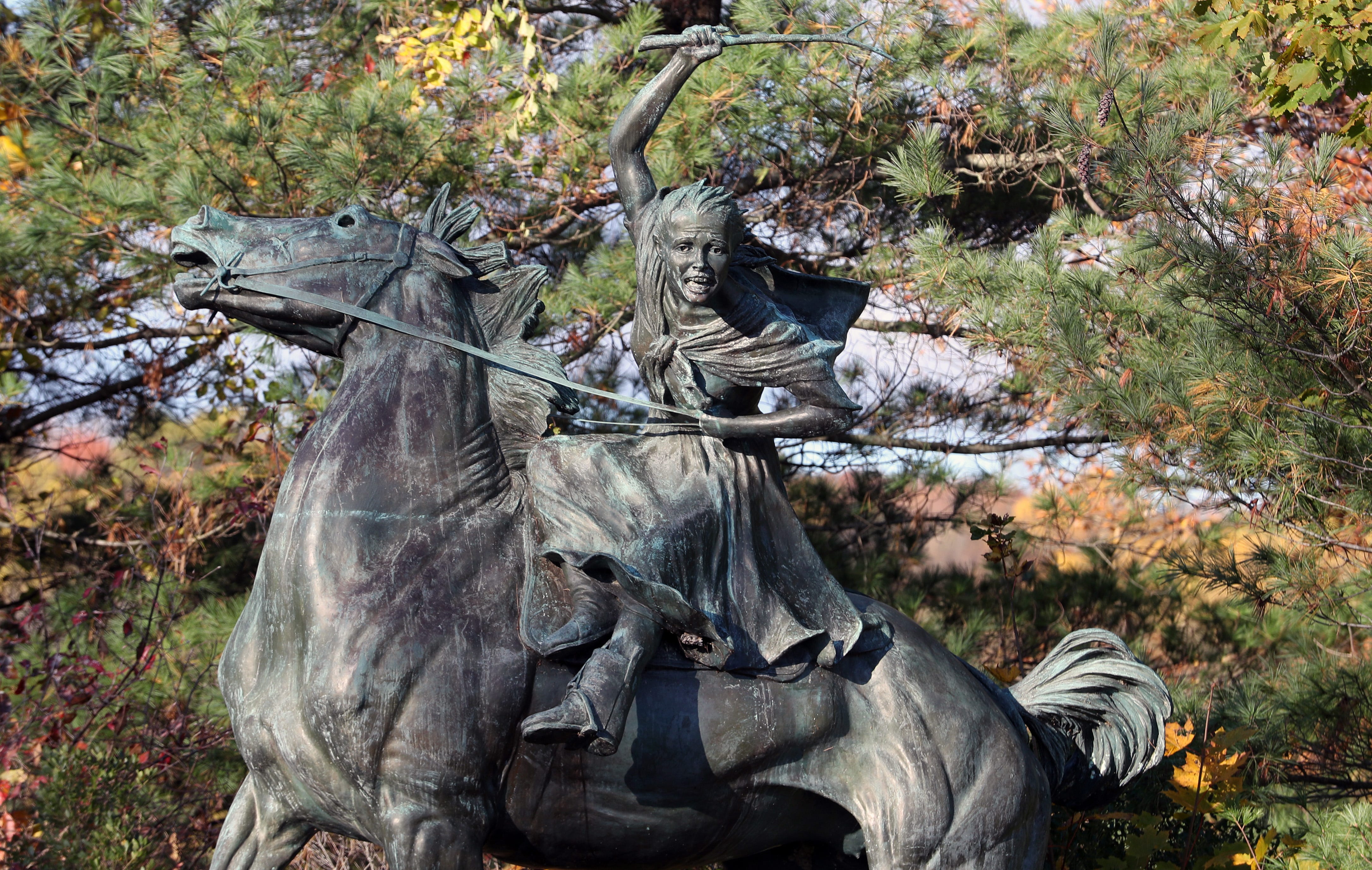
In the annals of American Revolutionary history, few names inspire as much intrigue as Sybil Ludington. Often compared to Paul Revere, the 16-year-old daughter of a New York militia colonel is said to have ridden through a stormy night in 1777 to warn of an impending British attack. Her story, though lacking firm documentation, has endured as a powerful symbol of women’s bravery during the Revolution. Whether fact, legend or something in between, Ludington’s tale reflects the struggles and contributions of women who played unseen roles in the fight for independence, as well as how later generations chose to celebrate them.
A Night Ride Through History

According to a story that’s gained steam over the past several decades, Sybil Ludington mounted her horse on April 26, 1777, to alert local militia forces that British troops were marching toward Danbury, Connecticut. Riding nearly 40 miles through wind and rain, she is said to have rallied her father’s regiment across Putnam County, New York. Her father, Colonel Henry Ludington, commanded about 400 militiamen. Though the British ultimately succeeded in burning Danbury, American forces regrouped at nearby Ridgefield and drove them back. Unlike Paul Revere, Sybil reportedly evaded capture during her ride. Her story is often used to represent a young woman’s courage in a time when female heroism was rarely recorded.
The Myth and the Mystery

Despite its prominence in folklore, Sybil Ludington’s ride was not documented until nearly a century after it supposedly occurred. The first known written account appeared in 1854, nearly two decades after her death, when her nephew tried to have her included in a ceremony for Revolution-era heroes. The next known appearance of her story was in an 1880 textbook and cited no original sources. Even basic details remain uncertain: the exact route she took, whether her horse was named Star and even the spelling of her own name, which appears in records as Sibyl, Sibbell, Cybal and Sebil. Modern historians debate how much of the story is verifiable, but many agree it reflects a deeper truth about how Revolutionary-era women were remembered or forgotten.
Rediscovering a Revolutionary Woman

The rediscovery of Ludington’s story in the late 19th century coincided with a renewed interest in women’s contributions to the Revolution. Like the tales of Betsy Ross and Molly Pitcher, her legend served to highlight the patriotism of women whose efforts had gone unrecorded. In the 20th century, the Daughters of the American Revolution and, later, historian Vincent Dacquino helped bring her name back into public consciousness. Dacquino’s research unearthed letters from family members, including that 1854 note by her nephew crediting her with warning General Israel Putnam. Though no other documentation exists, Ludington’s reputation as a symbol of female patriotism took firm root in both local history and national lore.
Life Beyond the Legendary Ride

After the war, Sybil Ludington’s life was marked by both hardship and resilience. In 1784, she married Edmond Ogden, with whom she had a son, Henry. When her husband died of yellow fever, she supported herself and her child by running an inn in Catskill, New York. Her son later became a lawyer and a state legislator. Late in life, Ludington applied for a widow’s pension under her husband’s military service, but her request was denied for lack of paperwork. She died in 1839 and was buried near her father, never knowing how enduring her story would become. (She’s now become such a fixture of “forgotten” Revolutionary history that her tale has even made it into an episode of “Drunk History” on Comedy Central.)
True or Not, Her Story Continues to Fascinate

Over time, Sybil Ludington’s name has become intertwined with both myth and memory. She has been honored with a U.S. postage stamp, a bronze equestrian statue in Carmel, New York, and an ultramarathon tracing her supposed 40-mile route. Her story continues to inspire organizations that celebrate women’s leadership and courage, including the National Rifle Association’s Sybil Ludington Women’s Freedom Award. While historians continue to debate the accuracy of her midnight ride, the legacy she represents — a young woman stepping forward when her country needed her — remains powerful. Whether historical fact or patriotic folklore, Sybil Ludington’s legend endures as a reminder of the countless women whose acts of bravery shaped the American Revolution.
Sources: American Battlefield Trust, Smithsonian Magazine



