
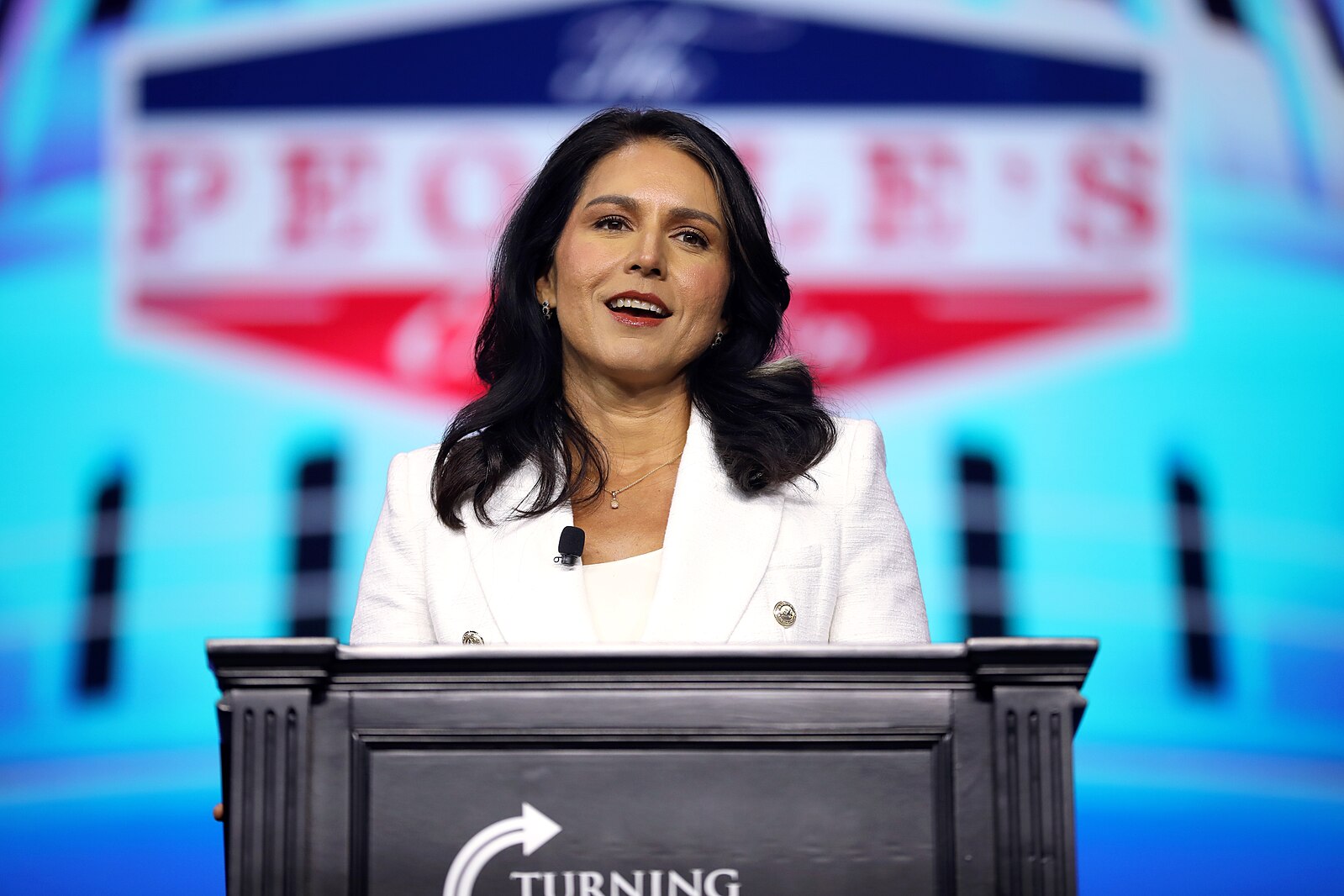
Director of National Intelligence Tulsi Gabbard told a security summit in Bahrain on Friday that the United States has ended its decades-long policy of “regime change or nation building,” marking what she described as a permanent shift in American foreign strategy under President Donald Trump’s second term.
Speaking at the Manama Dialogue, an annual security conference hosted by the International Institute for Strategic Studies, Gabbard said that Washington’s new approach prioritizes regional stability and economic prosperity over attempts to export democracy or impose U.S.-style governance abroad. Her comments reinforced Trump’s own framing of America’s global role — a dramatic break from the interventionist doctrines that shaped U.S. policy from Iraq to Libya over the last 25 years.
“For decades, our foreign policy has been trapped in a counterproductive and endless cycle of regime change or nation building,” Gabbard said. “It was a one-size-fits-all approach — of toppling regimes, trying to impose our system of governance on others, intervening in conflicts that were barely understood, and walking away with more enemies than allies.”
“The results,” she continued, “were trillions spent, countless lives lost, and in many cases, the creation of greater security threats.”
Those words, coming from a longtime critic of U.S. military interventionism, echoed Trump’s own disavowal of the foreign wars that followed the Sept. 11, 2001, terror attacks. During his first term, Trump negotiated the U.S. withdrawal from Afghanistan — a process that culminated under President Biden in 2021 — and he has since positioned himself as a realist focused on immediate security and economic interests.
In recent months, that shift has included brokered ceasefires in the Israel-Hamas conflict and the 12-day war between Israel and Iran, the latter following limited American airstrikes on Iranian nuclear facilities. Gabbard pointed to those events as evidence of what she called a “new phase of engagement” in which diplomacy and deterrence have replaced open-ended military campaigns.
Still, the strategy’s limits were clear in her remarks. Gabbard acknowledged that the ceasefire in Gaza remained “fragile,” and said Iran’s nuclear ambitions continued to pose a major challenge for regional stability. The International Atomic Energy Agency has recently detected renewed movement at Iranian nuclear sites, underscoring what she called the “constant balancing act” of the administration’s policy.
While Gabbard emphasized the end of America’s regime-change era, she made no mention of U.S. naval deployments off South America or reported CIA operations targeting Venezuela — actions that critics say contradict Trump’s stated rejection of interventionism.
“The road ahead will not be simple or easy,” Gabbard said, “but the president is very committed down this road.”
Hours later, Bahraini activist Abdulhadi al-Khawaja ended his hunger strike after receiving letters from European officials.



