
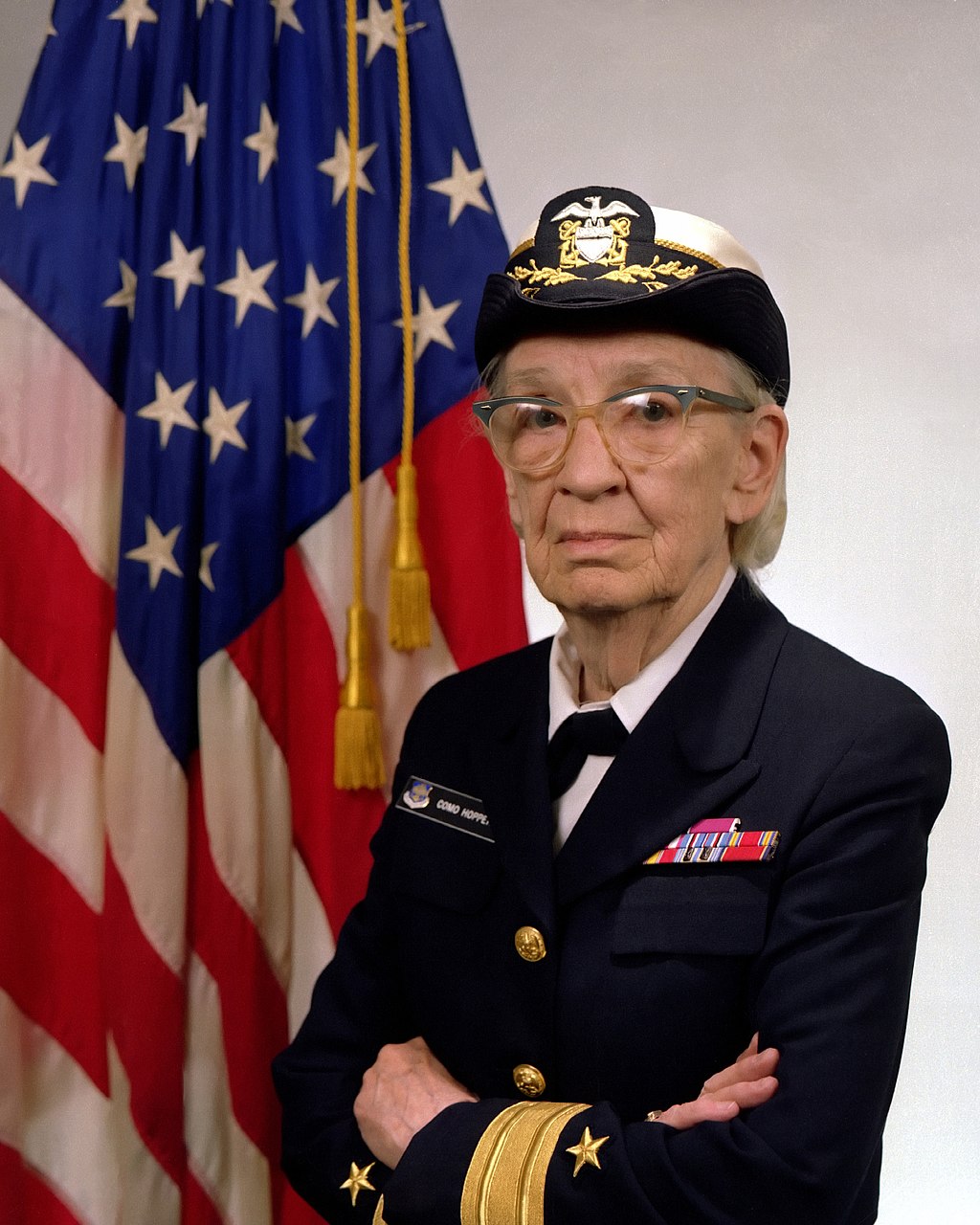
Grace Brewster Murray Hopper transformed computing through her work with the U.S. Navy after the beginning of World War II. Born in 1906 in New York City, she grew up curious about how things worked, once dismantling alarm clocks just to see their mechanisms. That curiosity shaped a career that redefined technology itself. A mathematician, programmer and naval officer, Hopper developed the first computer compiler and helped create COBOL, one of the most widely used programming languages in history. Nicknamed “Amazing Grace,” she bridged the worlds of academia, industry and military service, paving the way for generations of computer scientists, and especially for women in technology.
Early Life and Education

Grace Murray Hopper at the UNIVAC keyboard, c. 1960. Grace Brewster Murray: American mathematician and rear admiral in the U.S. Navy who was a pioneer in developing computer technology, helping to devise UNIVAC I. the first commercial electronic computer, and naval applications for COBOL (common-business-oriented language). Flickr: Grace Hopper and UNIVAC, CC BY 2.0 https://creativecommons.org/licenses/by/2.0, via Wikimedia Commons
Credit: Unknown (Smithsonian Institution)
Grace Hopper’s fascination with mathematics began in childhood, encouraged by her parents. She attended private schools in New Jersey before entering Vassar College, where she graduated Phi Beta Kappa in 1928 with degrees in mathematics and physics. Believe it or not, she was originally rejected from Vassar due to low Latin scores at age 16, but she was finally admitted one year later. Hopper then earned her master’s and doctorate in mathematics from Yale University, completing her Ph.D. in 1934. While teaching at Vassar, she also studied with mathematician Richard Courant at New York University. Her deep understanding of logic and numerical systems later became the foundation for her groundbreaking work in computer programming and systems design.
World War II and the Mark I

When the United States entered World War II, Hopper left her post at Vassar to join the Navy Reserve. Initially rejected for being underweight and overage, she persisted, was admitted in 1943, and was commissioned as a lieutenant junior grade in 1944. Assigned to Harvard University, she joined the Bureau of Ordnance Computation Project, where she worked on the Harvard Mark I, the first large-scale electromechanical computer in the United States. Hopper helped program the Mark I to perform complex wartime calculations and authored its 500-page operating manual. Her work established many of the programming principles that would guide the emerging field of computer science for decades.
Building the Modern Computer Language

After the war, Hopper remained at the forefront of computer development. In 1949, she joined the Eckert-Mauchly Computer Corporation, contributing to the creation of the UNIVAC, which was a successor to the ENIAC and was the first commercial electronic computer. There, she invented the first compiler, a program that translates human instructions into machine code. Her innovation made programming faster and more accessible. Hopper went on to develop FLOW-MATIC, the first English-based programming language, which directly influenced the creation of COBOL in 1959. By transforming code into something people could read and write in plain language, Hopper made computers usable for businesses, government agencies and eventually the public.
A Naval Leader and Educator

Though she retired from the Navy Reserve in 1966, Hopper was soon back on active duty, helping standardize the Navy’s computer systems. She continued to be promoted and became a leading voice for modernization and education of military technology, mentoring generations of officers and programmers. Her intellect and insistence on clarity made her an effective teacher and communicator. Hopper retired again in 1986 as a rear admiral and was the oldest active-duty officer in the Navy at that point. Throughout her life, she emphasized the importance of curiosity and experimentation, famously encouraging young people to challenge old assumptions. She noted that her proudest accomplishment was being able to train so many younger people.
Legacy of “Amazing Grace”

Grace Hopper’s influence extends far beyond her lifetime. Her work on compilers and COBOL laid the groundwork for modern programming and made computers indispensable to everyday life. She received more than 40 honorary degrees and numerous national and international honors, including the National Medal of Technology in 1991 and, posthumously, the Presidential Medal of Freedom in 2016. The U.S. Navy named the destroyer USS Hopper in her honor, and Yale University dedicated one of its colleges to her memory. A visionary in both science and service, Grace Hopper proved that innovation begins with the courage to imagine new possibilities.
Sources: Yale University, National Women’s History Museum, Vassar College, Britannica, National WWII Museum



