
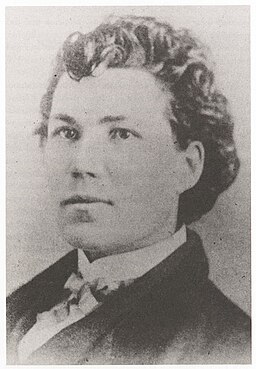
The Civil War is often remembered as a man’s conflict, with women seen only as nurses or supporters on the home front. Yet hundreds of women secretly fought in battle, disguising themselves as men to enlist. Historians estimate that between 400 and 750 women served in both Union and Confederate ranks, often under assumed male names. Their motives ranged from patriotism to personal freedom to devotion to loved ones already at war. Although officially banned from service, these women endured the same harsh conditions as their male counterparts, including combat, disease, imprisonment and death, challenging 19th-century beliefs about gender and courage in the process.
Disguises and Recruitment

Albert Cashier gravesite in Saunemin. Cashier, who was born Jennie Hodgers, is the subject of a wayside exhibit by the Abraham Lincoln National Heritage Area to placed in Pontiac.
Both armies prohibited women from enlisting, forcing them to take on male identities to fight. They bound their chests, cut their hair short and donned uniforms that concealed their figures. Recruitment medical exams were superficial, and many soldiers, including underage boys, easily passed without question, which allowed women to slip through unnoticed. They learned to walk, talk and act like men, often keeping to themselves to maintain secrecy. Some adopted false facial hair or dirtied their faces to appear older and rougher. The lack of strict identification standards meant that women could serve for months or even years before discovery, if they were ever found out at all.
Women on the Battlefield

Those buried at Antietam National Cemetery include Union Army veterans from the Civil War as well as non-Civil War dead including veterans and their wives from the post-Civil War era, including World War II.
Once enlisted, female soldiers performed the same duties as men: drilling, marching and fighting in battles such as Antietam and Fredericksburg. Many also served as couriers, cooks or nurses under fire. Among the best-documented were Sarah Edmonds Seelye, who enlisted as “Franklin Thompson” and later earned a military pension, and Loreta Velazquez, who fought for the Confederacy as “Harry Buford.” Others, like Albert D.J. Cashier — born Jennie Hodgers — served the entire war without their true identities being discovered. Cashier continued living as a man for decades afterward, even receiving a veteran’s pension. Her true identity wasn’t discovered until 1913.
Discovery and Consequence

The first shots of the Civil War were fired at Fort Sumter in 1861. Its history is preserved as part of Fort Sumter and Fort Moultrie National Historical Park.
For many, their secret was uncovered only through injury or illness. When Mary Owens was wounded, doctors found she was a woman after 18 months of service. Some, like Frances Hook, were captured by Confederate forces and revealed during imprisonment. Others, such as Florina Budwin, fought alongside their husbands, were captured and died in Southern prison camps. In some cases, women’s identities were discovered only after death—bodies found on the Gettysburg battlefield and at Shiloh were later confirmed to be female. Though few of the women faced punishment, most were quietly sent home once unmasked, their bravery largely unacknowledged by military authorities.
The Army’s Denial and Historical Silence

Called the Grand Army of the Republic, a plot in the heart of the Eugene Pioneer Cemetery is dedicated to veterans of the Civil War and their families. The area features a 25-foot, blue marble statue of Union soldier John Covell whose grave is among 51 men, women and children buried around the statue.
Despite evidence of their service, the U.S. Army long denied that women fought in uniform. In 1909, officials claimed no records existed of female soldiers, but the assertion was contradicted by documented cases in both Union and Confederate files, which had been painstakingly maintained all those years. The stories of Seelye, Cashier and others appeared in postwar newspapers, memoirs and obituaries, but formal recognition remained rare. Later historians often dismissed these women as anomalies or labeled them with prejudice. Yet their presence defied Victorian expectations of passivity and modesty, revealing a complex and overlooked dimension of Civil War history.
Legacy of Courage

The first image of a woman in the state house was the statue commemorating Civil War nurses, created by Bela Pratt and installed in 2019; and is part of a compilation of visual information: Women Subjects/Women Artists commemorates Women’s History Month at the Massachusetts State House
The many women who fought in the Civil War while disguised as men changed how history understands the boundaries of courage and gender. Though their contributions did not alter the outcome of the war, their determination redefined women’s roles in military life. Modern scholars now view them as early trailblazers, proving that bravery and sacrifice are not bound by gender. In an era when women were confined to the domestic sphere, these soldiers broke barriers by choice, not by circumstance. Their legacy endures as a testament to quiet heroism and a challenge to the limits society once imposed on women.
Sources: National Archives, Smithsonian Magazine



