
A brightly colored portrait of Dora Maar by Pablo Picasso, unseen for more than eight decades, sold in Paris for 32 million euros (about $37 million), marking one of the year’s highest art sales in France. The 1943 canvas, Bust of a Woman with a Flowered Hat (Dora Maar), was completed during the final months of Picasso’s relationship with Maar and captures both her strength and sadness. The painting had remained in the same family collection since 1944, never exhibited publicly, and appeared on the market for the first time at Drouot auction house, where it exceeded its estimated value.
The portrait, part of Picasso’s “Woman in a Hat” series, shows Maar wearing a vivid floral hat against a background of bold color and fragmented form. Art specialists noted that the painting’s condition was exceptional; it had never been varnished, leaving its original texture and pigment intact. Observers described it as a work that reveals Picasso’s mastery of color and his emotional complexity at a moment of personal transition. The portrait also evokes the intensity of the painter’s relationship with Maar, a connection that was both creative and deeply turbulent.
Dora Maar, born Henriette Theodora Markovitch in 1907, was a French-Argentine artist who achieved recognition long before she met Picasso. Trained in both painting and photography, she became known in 1930s Paris for her inventive surrealist images and sharp social commentary. Her commercial studio, which she opened with designer Pierre Kéfer, produced striking fashion and advertising photographs that experimented with collage, lighting and shadow. Beyond commercial work, she used her camera to document poverty and urban hardship across Europe, combining social realism with avant-garde technique.
Maar’s association with the Surrealist movement placed her among a circle of artists who explored dreams, eroticism and the unconscious. Her photomontages and manipulated images challenged the idea of photography as objective truth. She brought this experimental approach to her collaboration with Picasso, whom she met around 1935 or 1936. At that time, Picasso was emerging from a creative lull, and Maar’s influence, particularly her technical skills in photography, helped shape his artistic revival. She recorded the making of his monumental Guernica, taught him new printing methods and inspired several of his most iconic portraits, including Weeping Woman.
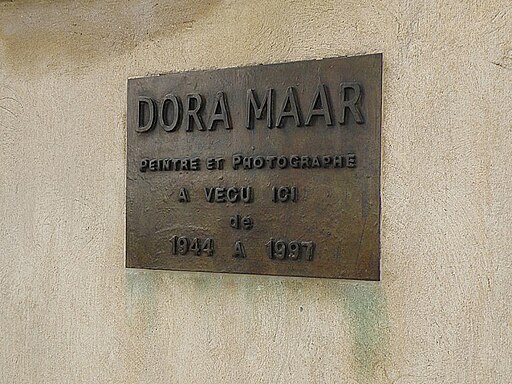
Their relationship ended painfully during World War II, and Maar later withdrew from the public eye. She spent much of her later life painting in the south of France, developing a distinctive abstract style that blended spiritual intensity with subdued color. Though long overshadowed by her role as Picasso’s muse, she continued to work quietly until her death in 1997, leaving behind a substantial body of paintings and photographs that have since gained renewed critical attention. The rediscovery and sale of Bust of a Woman with a Flowered Hat (Dora Maar) has reignited appreciation for Maar’s impact on modern art.



