
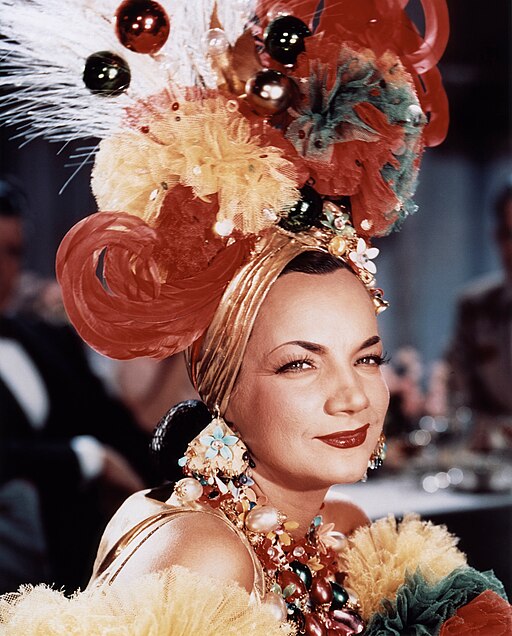
Carmen Miranda rose from humble beginnings in Brazil to become one of Hollywood’s brightest stars. Known for her dazzling costumes and captivating stage presence, she embodied the lively rhythms of samba and the vibrancy of Brazilian culture. Yet her fame came at a cost. While American audiences adored her, many in Brazil accused her of abandoning her roots, catering to stereotypes, selling out and even partaking in cultural appropriation. Miranda’s story is one of both triumph and misunderstanding. She was a woman celebrated for introducing Brazilian music to the world, yet she was also criticized by her own country for the image that success required her to maintain. Her life captures the tension between artistic ambition and cultural authenticity.
From Portugal to Brazil’s Airwaves

Born Maria do Carmo Miranda da Cunha in Portugal in 1909, Carmen was less than a year old when her family settled in Rio de Janeiro. The bustling city shaped her creative spirit, and by her teens, she was performing at festivals and on the radio. Despite her father’s disapproval, her mother encouraged her passion for music. Carmen supported her family by working in shops and as a hatmaker before being discovered by composer Josué de Barros. Her first recordings in 1929 revealed a magnetic voice and rhythm that quickly made her a national sensation. Throughout the 1930s, she became one of Brazil’s most popular radio and film performers, helping to bring samba — a sound born from Afro-Brazilian roots — into mainstream culture.
A Cultural Ambassador in New York

By the late 1930s, Miranda was already a household name in Brazil. Her energy and charisma attracted Broadway producer Lee Shubert, who invited her to star in “The Streets of Paris” in 1939. Supported by Brazil’s government as a goodwill ambassador, Miranda and her band traveled to New York City, where audiences instantly fell in love with her music and style. Her bright costumes, lively dance moves and cheerful persona embodied the glamour and optimism of Latin American culture. The success of her Broadway debut opened the door to a Hollywood career, where she became a leading musical performer and, for a time, the highest-paid woman performer in the United States.
Fame and the Burden of Stereotypes

Hollywood transformed Miranda into a global icon, but also into a caricature. Her roles often exaggerated Latin stereotypes, blending traits from various cultures into one “exotic” image designed to appeal to American audiences. The towering fruit-laden hats and flamboyant costumes from films like “The Gang’s All Here” became her signature look, but they also limited her artistry. While her image fit neatly into the United States’ Good Neighbor Policy, which promoted friendly relations with Latin America during the 1940s, it alienated audiences back home. When Miranda returned to Brazil in 1940, fans who once adored her accused her of becoming too Americanized, even booing her during a performance, which so deeply affected her that she stayed away from Brazil for almost 15 years.
A Complicated Legacy in Samba and Style

Miranda’s success helped bring samba, an Afro-Brazilian rhythm rooted in Carnival and working-class communities, to an international stage. While critics accused her of commercializing or misrepresenting the genre, her performances introduced its infectious beat to millions worldwide. Samba’s fusion of African and European influences mirrored Miranda’s own cultural duality, bridging worlds even as it divided audiences. Her colorful stage presence and joyful energy inspired generations of performers and influenced Brazil’s later Tropicalismo movement. Though she faced criticism from many sides, her artistry helped shape global perceptions of Brazilian music and dance, ensuring that samba, and her name, would remain synonymous with Brazil’s creative spirit.
Rediscovery and Recognition at Home

Carmen Miranda’s final years were marked by exhaustion from constant touring and film work, but her influence never faded. She died in 1955 at the height of her fame, leaving behind a legacy that Brazil later came to embrace more fully. Once criticized for her Hollywood persona, she is now celebrated as a cultural pioneer who opened doors for Latin artists worldwide. Today, her costumes, recordings and memorabilia are preserved in Rio de Janeiro’s Museum of Image and Sound, where an exhibition honors her music and artistry. For Brazil, Carmen Miranda is no longer a stranger, but a symbol of creativity and the complex journey of representing one’s culture on a global stage.
Sources: Smithsonian Institution, Hollywood Walk of Fame, NPR



