
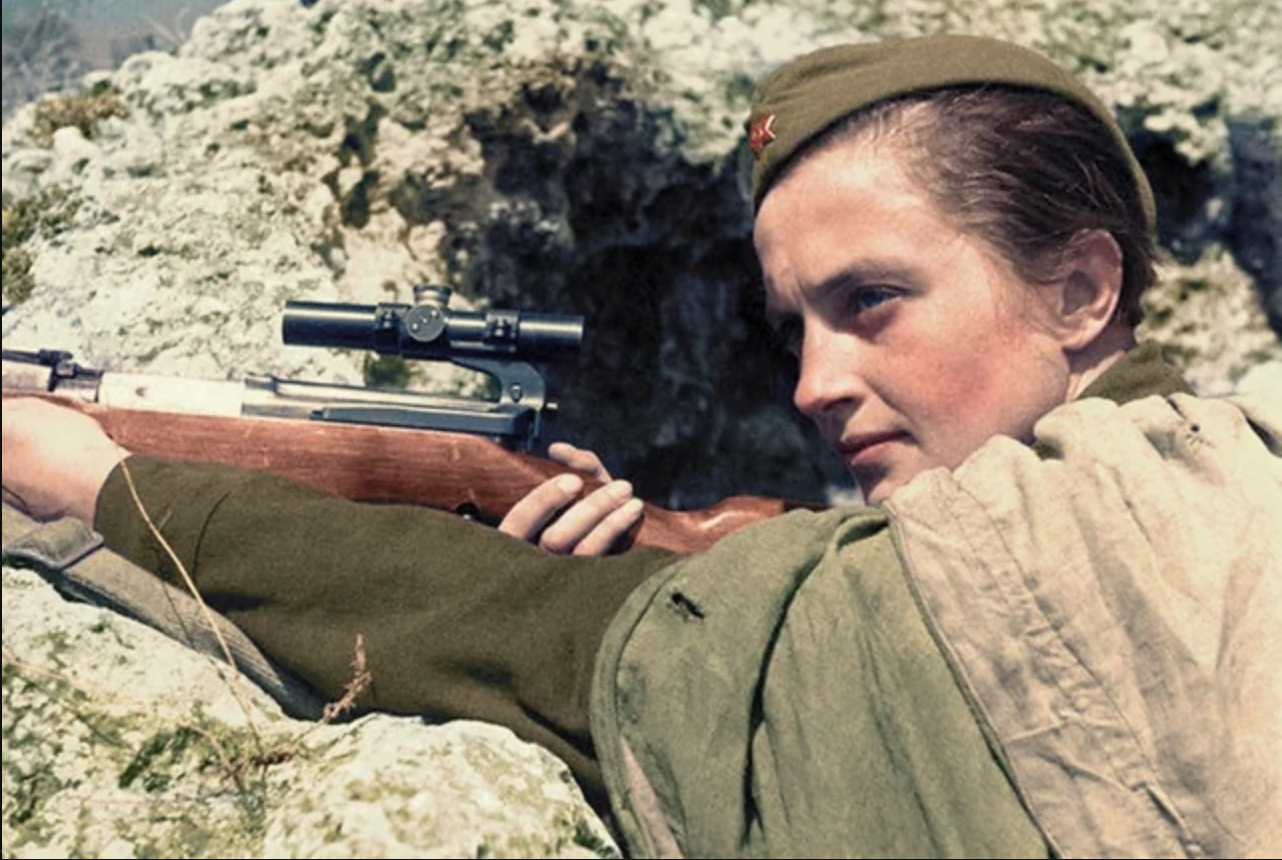

In the snow-choked forests of the Eastern Front, where breath froze before it could be seen and the air itself seemed to burn with the smell of cordite, the Soviet Union deployed an unlikely weapon against Nazi Germany: its women. They came from villages and cities, from schools and factories. Some were students. Others were teachers or nurses. By the time the Red Army crossed into Berlin, more than 2,000 of them had become snipers—trained, patient, and unnervingly precise. These were the female marksmen of the Soviet Union, warriors who blended technical mastery with an unflinching sense of vengeance.
Roza Shanina Was One of the Most Deadly Snipers of WW2

Roza Shanina could have stepped out of a painting. At just twenty years old, with strawberry-blonde hair and bright blue eyes, she didn’t look like a soldier at all. Yet with a Mosin-Nagant rifle pressed against her shoulder, she became one of the most feared snipers of World War II, credited with 75 confirmed kills—including 12 German snipers. “Cute as a kitten, but as dangerous as a Siberian tiger,” one of her comrades said.
These Ladies Had A Major Body Count

Lyudmila Pavlichenko, who would later tour Allied countries and meet President Franklin Roosevelt, tallied 309 confirmed kills—more than any other woman in history. Others, like Nina Petrova, proved that age was no barrier to the fight. A 48-year-old physical education instructor and nurse, Petrova defied military skepticism to take her rifle to the front, not only claiming more than 100 German soldiers but training the next generation of sharpshooters. Their emergence reflected both desperation and ingenuity. By 1942, after millions of Soviet soldiers had been killed or captured, the Red Army opened sniper schools to women. They were seen as patient, methodical, and steady under pressure. In Moscow, the Central Women’s School of Sniper Training turned out thousands of graduates in seven grueling months of instruction.
Training Was Intense

Their education was brutally practical. They learned to stalk prey unseen, to read the curve of a hill or the shadow of a tree, to hold their breath through snow and gunfire. Each carried a rifle, a shovel, a bandage kit, and two grenades—one for the enemy, one for themselves, should capture ever come. Some carried small German pistols instead, keeping a single bullet in reserve for the same purpose.
Roza Shania Was a Rule Breaker

Roza Shanina ignored the rule against keeping diaries. Her journal—her “personal confidante”—captured her moods, doubts, and fierce pride. “Some force draws me to the front lines,” she wrote. “I’m bored in the back. I want to see real war.” Against orders, she repeatedly went AWOL to join male soldiers in direct assaults, earning both reprimands and decorations. In one battle alone, she reportedly killed 54 Germans and captured three more. Her death came on January 27, 1945, just months before Germany’s surrender. She was shielding a wounded officer when enemy fire found her. She was twenty. Her mother, reflecting years later, said quietly, “Maybe it’s for the best. How could she have lived after the war? She shot so many people.”
They Only Had Each Other

The women snipers fought not only the enemy but exhaustion, cold, and, too often, harassment from within their own ranks. Some officers coerced women into “arrangements” in exchange for safer assignments away from the front. Others treated them as novelties rather than comrades. Yet they endured. “In order not to fall asleep, we held each other by the arms,” sniper Yulia Zhukova remembered. “If someone drifted off, the others held her up.”
War Changed These Women Forever

By 1944, the war had transformed them. They no longer resembled the girls who had volunteered to avenge lost fathers and brothers. When the Red Army liberated Nazi concentration camps in Poland, the women were among the first to see the skeletal survivors. “Brava! La femme sovietique!” one group of freed prisoners shouted, blowing kisses toward the armed women in their tattered uniforms. Some, like Nina Lobkovskaya, survived the war and built quiet postwar lives. Lobkovskaya earned a degree in history from Moscow State University and spent decades working at the Lenin Museum. Years later, a man she had rescued—tank commander Colonel Popov—appeared at her door with flowers to thank her for saving his life. Others, like a sniper known only as Klavdiya, came home physically whole but spiritually hollow. “A bullet is a fool; fate is a villain,” she told her mother. “You can never know your future.” Her father was dead, her brothers missing, and her family reduced to living in a dugout. She rebuilt a life, married, had children—but believed her war followed her home. Her daughter’s disabilities, she said, were punishment for the men she had killed.
Respect Didn’t Come Easily For The Snipers

For many, survival didn’t bring peace. Rumors followed them. Some men accused returning snipers of being “unwomanly,” of having lived too long in the company of soldiers. One husband told his wife she was “unable to give birth to a normal child” because she had “learned to shoot.” The irony is that these women fought not for recognition, but for survival—and for vengeance. Every sniper carried with her a story: a burned village, a murdered parent, a letter that never came. Their rifles were an extension of their grief. The oldest of the snipers, Nina Petrova, never made it home. Just months before Germany’s surrender, the 52-year-old—decorated and revered—was killed when the truck she was riding in plunged off a bridge. But not all of them were claimed by fate. Klavdiya Grigoryevna returned home at 21 with white hair and a soldier’s posture. She had grown four inches taller, she said, and had to relearn how to wear dresses and shoes. Yet she was alive—and that, after years of mud, fear, and death, felt like a miracle.
Women At War

The women snipers of the Soviet Union didn’t just change the outcome of battles; they changed the very notion of what women could do in war. They became, in their own quiet way, a nation’s conscience—avengers, protectors, and survivors all at once. They fought for a country that would never fully understand them, but that could not have survived without them. And as one of them once said, standing over her rifle in the snow, “We didn’t go to war to be heroes. We went because there was no one else left.”



